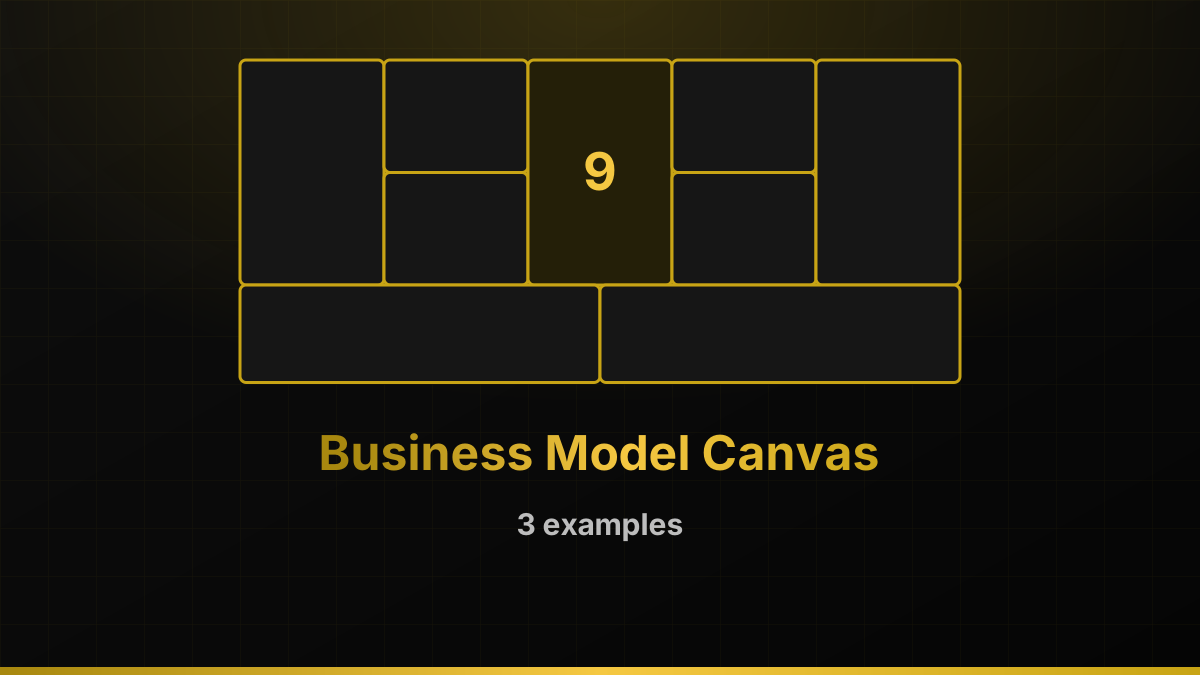
Business Model Canvas: What It Is and 3 Full Examples
Published on:
Reading time: 11 min
Topic: Entrepreneurship
Author: Leandro Valencia
What the Business Model Canvas is, plus three complete examples block by block: a coffee shop, an Instagram clothing store and a freelance designer. Open and edit them free.
Table of Contents
- Business Model Canvas vs Lean Canvas
- Example 1: specialty coffee shop in Medellín
- Example 2: clothing store on Instagram in Lima
- Example 3: freelance designer in Mexico who charges in dollars
- Mistakes when filling in a Canvas
- Build your own Canvas
The Business Model Canvas is a map of your business on a single page: nine blocks that run from the customer to the costs and show, at a glance, how who buys from you, what you offer them and how you make money fit together. Seeing a filled-in one teaches more than its definition, which is why here are three complete examples you can open and edit in our editable Canvas template, free and with no sign-up.
This page does not teach you how to build yours from scratch; for that there is the step-by-step guide to building a business model. Here we look at three finished canvases, one per type of business, and for each one we see what it reveals, where it is weakest and which cheap test would put it to the proof before you spend any money.
Business Model Canvas vs Lean Canvas
The examples come in both versions because they answer different moments. The Business Model Canvas describes how a business that already exists, or is already well defined, operates. The Lean Canvas, adapted by Ash Maurya, is meant for an idea that still has to be validated: it swaps four operating blocks for four learning blocks. If you already sell, start with the first; if you are testing an idea, start with the second.
| Business Model Canvas | Lean Canvas | Difference |
|---|---|---|
| Customer Segments | Customer Segments | Same: defines who buys first |
| Value Propositions | Unique Value Proposition | Boiled down to one short, clear message |
| Channels | Channels | Same in both |
| Revenue Streams | Revenue Streams | Same in both |
| Cost Structure | Cost Structure | Same in both |
| Key Partners | Problem | Moves from who you work with to what hurts the customer today |
| Key Activities | Solution | Moves from what you do to the least that solves the problem |
| Key Resources | Key Metrics | Moves from what you have to the numbers you must watch |
| Customer Relationships | Unfair Advantage | Moves from how you keep the customer to what cannot easily be copied |
Example 1: specialty coffee shop in Medellín
Café La Loma has a shop in an office district, roasts its coffee every week and wants to add recurring income by selling beans on subscription. It is the case of a business that already operates and wants to grow without opening a second location.
Business Model Canvas
| Block | Content |
|---|---|
| Customer Segments | Office workers aged 25 to 40 in El Poblado · People who brew coffee at home · Tourists looking for single-origin Colombian coffee |
| Value Propositions | Single-origin coffee roasted in-house every week · Fresh beans delivered to your door by subscription · A coffee bar where you learn your favorite brew method |
| Channels | Street-level coffee shop · Instagram and Google Maps · Bean orders via WhatsApp |
| Customer Relationships | Baristas who remember your order · Subscriber club with monthly tastings |
| Revenue Streams | Drinks at the bar · Monthly bean subscription · Brewing equipment sales |
| Key Resources | 5 kg roaster · Shop in an office district · Two trained baristas |
| Key Activities | Roasting and packing every week · Making drinks with consistent quality · Posting content about origin and brewing |
| Key Partners | Three farms in southwest Antioquia · Local courier for the subscription · Supplier of valve bags |
| Cost Structure | Shop rent · Green coffee and packaging · Barista payroll |
Lean Canvas
| Block | Content |
|---|---|
| Problem | Supermarket coffee has been roasted for months · It is hard to know which farm the coffee comes from · Today's alternative: coffee chains and mass-market coffee |
| Customer Segments | People who brew coffee at home every day · Early adopters: people who already buy beans online |
| Unique Value Proposition | Farm coffee roasted this week, at your door every month · Concept: "the wine club, but for coffee" |
| Solution | Subscription with weekly roasting · Label with farm, altitude and roast date · Brewing guide in every shipment |
| Channels | Instagram with recipes · Tastings at the shop · Subscriber referrals |
| Revenue Streams | Monthly subscription of 2 or 4 bags · Drinks at the bar |
| Cost Structure | Green coffee · Shipping · Instagram ads |
| Key Metrics | Active subscribers · Cancellations per month · Cost per new subscriber |
| Unfair Advantage | Direct relationship with three farms · A community that comes to the tastings |
What this canvas reveals. The subscription shows up in three blocks of the first canvas (value propositions, relationships and revenue), so much of the model depends on someone agreeing to pay every month for something they now buy one bag at a time. That is where the risk lies: subscribers may cancel soon and the cost of winning them may never be paid back. A cheap test is to offer the subscription for one month to the regulars at the bar, with limited spots, and count how many pay and how many stay into the second month, before buying packaging or putting money into ads.
Open this example in the template
Example 2: clothing store on Instagram in Lima
Moda Barranco sells locally designed clothes almost entirely through social media and chat, because its customers prefer to order by message rather than on a website. Every sale starts with a conversation.
Business Model Canvas
| Block | Content |
|---|---|
| Customer Segments | Women aged 20 to 35 in Lima · Shoppers who prefer ordering by chat over using a website |
| Value Propositions | Locally designed clothes at an affordable price · Weekly drops in limited quantities · Pay with Yape and get delivery in 48 hours |
| Channels | Instagram and TikTok · Orders via WhatsApp · Own delivery in Lima and courier to other regions |
| Customer Relationships | Chat replies in under an hour · Broadcast list with pre-sales |
| Revenue Streams | Clothing sales · Shipping fees to other regions |
| Key Resources | Instagram account with 15,000 followers · Partner sewing workshop · Our own product photos |
| Key Activities | Designing and launching short collections · Handling orders by chat · Coordinating shipments |
| Key Partners | Sewing workshop in Gamarra · Courier for other regions · Fashion micro-influencers |
| Cost Structure | Sewing and fabrics · Delivery and courier · Instagram advertising |
Lean Canvas
| Block | Content |
|---|---|
| Problem | Cheap clothes are often poor quality · Buying from an unknown website breeds distrust · Today's alternative: going to Gamarra or big chains |
| Customer Segments | Young women in Lima who shop through social media · Early adopters: followers of local micro-influencers |
| Unique Value Proposition | Lima design in limited editions: pay with Yape and get it in 48 hours · Free size exchanges and chat support within minutes |
| Solution | Short collections every week · Support via WhatsApp · Free size exchanges |
| Channels | Reels of people trying on the clothes · Collaborations with micro-influencers |
| Revenue Streams | Direct sales with an average ticket of S/ 120 · Shipping fees to other regions |
| Cost Structure | Production by batch · Shipping · Ads |
| Key Metrics | Orders per week · Repeat customers · Chats that end in a sale |
| Unfair Advantage | Loyal community that buys on pre-sale · A workshop that quickly produces small batches |
What this canvas reveals. The Instagram account is at once a key resource, a channel and the front door of the customer relationship, so the whole business hangs from a platform it does not control. The other sensitive point is production: the partner workshop makes small batches, which allows quick launches, but a piece that sells out means waiting for another batch. To test it safely, launch a short collection as a pre-sale through the broadcast list and measure what share of chats ends in a sale and how many buyers come back, producing only what is already paid for.
Open this example in the template
Example 3: freelance designer in Mexico who charges in dollars
Estudio Ana Ruiz is one person who designs interfaces for US startups and charges in dollars. Here the business and the professional are the same thing, and the canvas makes that visible.
Business Model Canvas
| Block | Content |
|---|---|
| Customer Segments | US startups without a design team · Agencies that outsource design |
| Value Propositions | Interface design in your own time zone · Dollar rates lower than a local designer · Weekly deliveries with revisions included |
| Channels | Portfolio on Behance and own website · LinkedIn · Client referrals |
| Customer Relationships | Weekly check-in call · Slack support throughout the project |
| Revenue Streams | Fixed-price projects · Monthly retainer of hours |
| Key Resources | Portfolio with real case studies · Fluent English · Figma and other tool licenses |
| Key Activities | Designing and prototyping · Finding and serving clients · Updating the portfolio |
| Key Partners | Platform to receive payments in dollars · Freelance developers for full projects |
| Cost Structure | Software licenses · Fees for receiving payments · Equipment and internet |
Lean Canvas
| Block | Content |
|---|---|
| Problem | Hiring design in the US is expensive and slow · Cheap freelancers miss deadlines · Today's alternative: generic freelance marketplaces |
| Customer Segments | Seed-stage startups · Early adopters: founders who already work with remote teams |
| Unique Value Proposition | Senior product design in your hours, paid in dollars at half the price · Concept: "your design team, without hiring one" |
| Solution | Two-week design sprints · Retainer with fixed hours per month |
| Channels | LinkedIn · Startup communities · Referrals |
| Revenue Streams | Retainer of USD 2,000 per month · Projects starting at USD 3,000 |
| Cost Structure | Software · Payment fees · Unbilled time spent finding clients |
| Key Metrics | Billed hours per month · Clients on retainer · Effective hourly rate |
| Unfair Advantage | Success stories with well-known startups · Same time zone as the US |
What this canvas reveals. The most important resource and activity is Ana's time, so her income has a ceiling: the hours in the month. The Lean Canvas also lists as a cost the unbilled time she spends looking for clients, something that is easy to forget. The risk is depending on a few clients, since each one who leaves opens an immediate gap. A cheap test is to offer a current client a retainer of fixed hours instead of a fixed-price project, and to work out the effective hourly rate counting the prospecting hours too.
Open this example in the template
Mistakes when filling in a Canvas
These three mistakes are not about choosing the right model but about how the canvas gets filled in.
Writing paragraphs instead of single ideas. A block full of long sentences hides several mixed hypotheses, and you cannot test any of them on its own. Look at the examples above: each note is a short, checkable idea, and no block goes past three.
Mixing segments that need different offers. You can have several segments on one canvas if they share the value proposition and the channels, like the office workers and the home brewers in the first example. If each group needs a different offer, make one canvas per segment: a single canvas for everyone ends up saying nothing about anyone.
Not connecting revenue to costs. The two bottom blocks tend to get filled in as independent lists, and nobody does the math. "Monthly subscription" and "shipping" only mean something once you turn them into figures per unit sold. You can use the profit margin calculator for that and check whether what you charge leaves anything after costs, fees and taxes.
Build your own Canvas
Pick the example closest to your business, load it into the editable Canvas template, replace each note with something you know about your customers and, when you are done, download it as a PNG or PDF. If you are unsure how to organize the work, the step-by-step guide to building a business model takes you from the idea to the first validation.
Frequently asked questions
What is the Business Model Canvas and what is it for?
It is a one-page map with nine blocks that describes how a business creates, delivers and captures value. It helps you see the whole business at a glance, spot the assumptions you have not tested yet, and explain it to a partner, a customer or a bank without writing a forty-page plan.
Who created the Business Model Canvas?
Alexander Osterwalder proposed the Business Model Canvas, together with Yves Pigneur, in the book Business Model Generation (2010). The Lean Canvas is an adaptation by Ash Maurya, designed for startups and new ideas.
Can I copy one of these examples for my own business?
Use it as a starting point, not as an answer. The three canvases are illustrative cases and their figures are assumptions. Load one into the template, delete what does not apply and replace each note with something you know about your own customers.
How often should I review my Canvas?
There is no fixed schedule: review it when something changes or when you finish a test with customers. If an assumption turned out to be false, fix the block that depended on it and look at which other blocks move with that change.
Does a Canvas replace a business plan?
No. The Canvas tells you which model to test and which assumptions are riskiest. The business plan, with projections and operating detail, comes later and is usually needed when you have to convince an investor or apply for a loan.
Related Posts
Keep exploring similar content that may interest you
How to Build a Business Model Step by Step (with Template)
Learn how to build a business model from scratch with the Business Model Canvas: the 9 blocks, the steps to create it, real examples, and the most common mistakes beginners make.
What is a Business Model? How to Design It and Overcome Its Challenges
A comprehensive guide on what a business model is, its critical importance for any company, common challenges when implementing it, a detailed step-by-step process to design it effectively, and practical tips to ensure success and adaptability in today's market.
Entrepreneurship Learning Roadmap: What to Study and in What Order
A step-by-step learning roadmap for starting a business: the 6 stages, the skills to learn in each one, and the ordering mistakes that cost you time and money.
Partnerships
Tools I use every day, on better terms for this community.