How to Calculate the Selling Price of a Product (Margin vs Markup)
Published on:
Reading time: 9 min
Topic: Entrepreneurship
Author: Leandro Valencia
Calculate a product's selling price with one real example from start to finish: unit cost, margin vs markup, marketplace fees and VAT, without losing money.
Table of Contents
- Margin and markup: the difference that changes your price
A complete case: Valentina's candles
- Step 1: add up the real cost of each unit
- Step 2: the classic mistake of adding a percentage to the cost
- Step 3: calculate the price that actually leaves the margin you want
- Step 4: subtract the marketplace fee
- Step 5: set VAT apart, because it isn't yours
- Step 6: round and double-check before publishing
- The formula that sums it all up
- Price is also a message
- Five mistakes that eat your profit
- Run the numbers with your own figures
To calculate the selling price of a product you need four numbers: what each unit costs you, what margin you want to keep, what fee your sales channel charges and what tax you must collect. With those four numbers the price comes from a formula, not a hunch. In this guide we'll work it out from start to finish with a single example business, and if you want to check every step with your own figures, our profit margin calculator is right there, free and with no sign-up.
Margin and markup: the difference that changes your price
Almost every pricing mistake in a small business starts here. Margin and markup are two percentages built from the same profit, but they compare it against different things:
| Concept | Measured against | Question it answers |
|---|---|---|
| Markup | The cost | How much did I add to what it cost me? |
| Margin | The selling price (before tax) | What share of each sale do I keep? |
Since the price is always higher than the cost, the margin is always a lower percentage than the markup for the same sale. If you think in markup but read your results as margin, you believe you earn more than you actually do. And margin is what matters at the end of the month, because it tells you what share of the money coming in you can use to pay rent, your salary and grow.
A complete case: Valentina's candles
Valentina makes soy candles in Bogotá and wants to sell them on a marketplace. Her goal is simple: keep a 40% margin on every candle. Let's follow her numbers step by step, in Colombian pesos, although the logic is the same in any currency.
Step 1: add up the real cost of each unit
The first thing is to know how much it costs her to make one candle. Not just the wax: everything she spends each time she makes a unit.
| Component | Cost per candle |
|---|---|
| Soy wax and wick | $8,000 |
| Glass jar | $5,000 |
| Fragrance oil | $3,500 |
| Label and box | $2,500 |
| Workshop gas and power | $1,000 |
| Total cost per unit | $20,000 |
Notice what's not in the table: the workshop rent or Valentina's salary. Those are fixed costs you pay whether you sell one candle or a hundred, and they're covered by the accumulated profit of many units. Mixing them into the unit cost inflates the price without you knowing by how much.
Step 2: the classic mistake of adding a percentage to the cost
Valentina does what almost everyone does the first time: she takes the cost and adds 40%. $20,000 × 1.40 = $28,000. She sets that price and feels she's earning 40%.
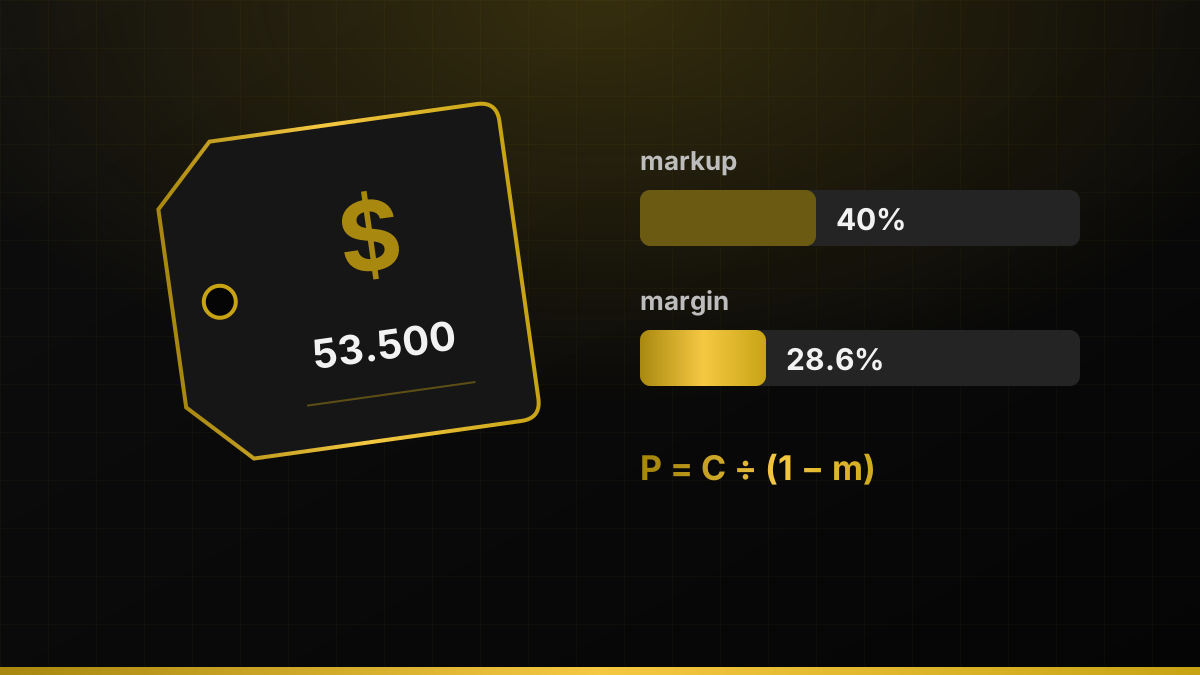
But that 40% is markup, not margin. Selling at $28,000 she earns $8,000 per candle, and $8,000 out of $28,000 is a 28.6% margin. She's more than eleven points short of her goal, and we haven't counted the fee or VAT yet. Once we add them, this price will lose money.
Step 3: calculate the price that actually leaves the margin you want
For the 40% to be a real margin, you have to think backwards: if Valentina wants to keep 40% of the price, the cost must be the remaining 60%. So the price is the cost divided by 0.60:
Price = cost ÷ (1 − margin) = $20,000 ÷ 0.60 = $33,333
Check: $33,333 − $20,000 = $13,333 in profit, and $13,333 ÷ $33,333 = 40%. Now it works. Notice that the markup on this price is 66.7%: to earn a 40% margin you have to add quite a bit more than 40% to the cost.
Step 4: subtract the marketplace fee
The marketplace where Valentina sells keeps 13% of each sale, calculated on the price the customer pays. At $33,333, the fee is $4,333, and her profit drops to $9,000: a 27% margin. The marketplace ate almost a third of what she had planned.
The fee comes out of the price just like the cost, so it has to be set aside in the formula. If 13 cents of every peso she charges go to the fee and she wants to keep 40 cents, the cost has to fit in the 47 cents left:
Price = $20,000 ÷ (0.60 − 0.13) = $20,000 ÷ 0.47 = $42,553
At $42,553 the fee is $5,532 and the profit $17,021, once again 40% of the price. But there's one last guest.
Step 5: set VAT apart, because it isn't yours
Valentina is registered for VAT, so the price she publishes must include 19%. That money isn't income: she collects it to hand over to the tax authority (DIAN, in Colombia). Her real income per sale is the price divided by 1.19.
If she left the price at $42,553 with VAT included, her income before tax would be $35,759. The fee, charged on the full price, is still $5,532. Her profit: $35,759 − $20,000 − $5,532 = $10,227, a 28.6% margin on income before VAT. Far from 40% again.
To include the tax in the formula, margin and cost are measured on the price before VAT, and the fee on the full price:
Price = cost ÷ ((1 − margin) ÷ (1 + VAT) − fee)
Price = $20,000 ÷ (0.60 ÷ 1.19 − 0.13) = $20,000 ÷ 0.3742 = $53,447
Step 6: round and double-check before publishing
Nobody lists a candle at $53,447. Valentina rounds it to $53,500 and runs the full calculation again with that price:
- Income before VAT: $53,500 ÷ 1.19 = $44,958
- Marketplace fee: $53,500 × 13% = $6,955
- Profit per candle: $44,958 − $20,000 − $6,955 = $18,003
- Margin: $18,003 ÷ $44,958 = 40.0%
Here is every price she tried, always with a 13% fee and 19% VAT included:
| Listed price | Income before VAT | Fee | Profit per candle | Real margin |
|---|---|---|---|---|
| $28,000 (cost + 40%) | $23,529 | $3,640 | −$111 | −0.5% |
| $33,333 (no fee or VAT) | $28,011 | $4,333 | $3,678 | 13.1% |
| $42,553 (no VAT) | $35,759 | $5,532 | $10,227 | 28.6% |
| $53,500 (full formula) | $44,958 | $6,955 | $18,003 | 40.0% |
The "intuitive" $28,000 price didn't just fall short of 40%: it lost $111 on every candle sold. The more she sold, the more money she lost. That's the real cost of confusing margin and markup.
The formula that sums it all up
If you keep just one thing from this article, let it be this sequence:
- Unit cost: everything you spend each time you make or buy one unit.
- Target margin: the share of the pre-tax price you want to keep.
- Fee: the percentage your channel charges, calculated on the full price.
- Tax: the VAT you must collect, or 0 if you're not registered.
- Price = cost ÷ ((1 − margin) ÷ (1 + tax) − fee), then round and double-check.
If the result comes out negative or absurd, the formula is warning you: with that fee, that tax and that cost, the margin you're asking for isn't reachable on that channel.
Price is also a message
The formula gives you the minimum price to earn what you want. It doesn't tell you whether the market will pay it. $53,500 for a candle can be reasonable if it's seen as a handmade gift, and a problem if it sits on the same page as $25,000 factory candles.
This is where price stops being just arithmetic and becomes positioning: it tells customers who to compare you with. That's why it's worth deciding together with the product, the channel and the communication, as we explain in the guide to the marketing mix and the 4Ps. If the number doesn't fit your positioning, Valentina has options before cutting prices blindly:
- Sell through a channel with no fee. On Instagram or at fairs, with direct payment, the price with the same 40% margin and VAT included is $20,000 × 1.19 ÷ 0.60 = $39,667, about $14,000 less than on the marketplace.
- Lower the unit cost. Buying jars in bulk or changing the box can move the final price much more than fighting over a thousand pesos in fees.
- Accept a different margin on a specific channel. Earning 30% on the marketplace can make sense if it brings customers who later buy from you directly.
- Sell bundles. A set of three candles spreads packaging and shipping, and raises the value of each order.
Five mistakes that eat your profit
- Confusing margin and markup. Adding 40% to the cost doesn't leave a 40% margin; it leaves 28.6%.
- Calculating the fee on the price before VAT. The platform charges you on what the customer pays, tax included.
- Counting VAT as income. You collect it, but it isn't yours; measure your margin on the pre-tax price.
- Putting fixed costs into the unit cost. Rent is covered by volume, not split by eye across each unit.
- Copying the competition's price without doing the math. Their cost, their channel and their margin aren't yours.
Run the numbers with your own figures
Now that you know where every peso comes from, try it with your product. In the profit margin calculator you can enter your cost, your fee and your VAT, and choose whether you want to see the margin of a price you already have or the price you need for the margin you're after. Try it with the price you use today: if the real margin surprises you, better to find out now than at the end of the month.
Step-by-step guide
Add up the unit cost
Materials, packaging and everything you spend on each unit, without fixed costs.
Set the margin you want
It's a share of the pre-tax price, not of the cost.
Set aside the channel fee
It's calculated on the full price the customer pays, tax included.
Separate the tax
Divide the price by (1 + VAT) before measuring your profit.
Apply the formula and round
Cost ÷ ((1 − margin) ÷ (1 + VAT) − fee); round and check again.
Frequently asked questions
What is the formula to calculate the selling price from the margin I want?
Without fees or taxes, divide the cost by (1 − margin): with a cost of 20,000 and a 40% margin, the price is 20,000 ÷ 0.60 = 33,333. If you sell on a marketplace and charge VAT, the full formula is cost ÷ ((1 − margin) ÷ (1 + VAT) − fee).
Why don't I earn 40% if I add 40% to the cost?
Because that 40% is calculated on the cost (that's markup), while margin is measured on the price. A product that costs 20,000 and sells for 28,000 leaves 8,000, which is 40% of the cost but only 28.6% of the price. And that's before fees and taxes, which shrink it even further.
Is the marketplace fee calculated before or after VAT?
On most marketplaces and payment gateways, the fee applies to the total price the customer pays, VAT included. That's why it weighs more than it seems: you also pay a fee on a tax that isn't yours. Check your platform's terms, because some also add a fixed fee per sale.
Do I have to include VAT in the price I publish?
If you're registered for VAT, yes: in Latin America and Spain, the price shown to the final consumer usually has to include the tax. You collect that tax for the government, so subtract it before measuring your profit. If you aren't registered for VAT, run the numbers with a 0% tax.
What if the price I get is higher than my competitors'?
Don't cut the price blindly. First check whether you can lower your unit cost, sell through a channel with no fee, or accept a lower margin on that channel in exchange for volume. If none of that is enough, the product may need to stand out to justify its price, or it may not be profitable sold that way.
Do rent and my salary go into the unit cost?
No. Unit cost includes only what you spend every time you make one unit: materials, packaging, the share of labor that goes into each piece. Rent, utilities and your fixed salary are fixed costs, covered by the profit of many units: that's what calculating your break-even point is for.
Related Posts
Keep exploring similar content that may interest you

Entrepreneurship Classes: What to Learn and How to Choose
Do entrepreneurship classes actually work? Topics a good course should cover, formats (online, in-person, mentoring) and red flags to spot empty courses.

Entrepreneurship Learning Roadmap: What to Study and in What Order
A step-by-step learning roadmap for starting a business: the 6 stages, the skills to learn in each one, and the ordering mistakes that cost you time and money.

What Is Entrepreneurship? Definition, Types and Hard Truths
What is entrepreneurship really? A clear definition, its main types, common myths to drop, and how to know if you're ready to start a business in Latin America.
Partnerships
Tools I use every day, on better terms for this community.