What is a Business Model? How to Design It and Overcome Its Challenges
Published on:
Reading time: 19 min
Topic: Entrepreneurship
Author: Leandro Valencia
A comprehensive guide on what a business model is, its critical importance for any company, common challenges when implementing it, a detailed step-by-step process to design it effectively, and practical tips to ensure success and adaptability in today's market.
Table of Contents
- In this article we will explore:
- Main Problems when Implementing a Business Model
- Tips and Recommendations for a Successful Business Model
- Conclusion: The Business Model as a Compass for Success
- Philosophical Reflection: The Business Model as a Bridge Between Vision and Reality
Imagine building a house without blueprints. No matter how clear your idea is, without a concrete guide, the project would be destined for chaos or, even worse, failure. In the dynamic world of business, the business model is precisely that blueprint: a detailed and strategic outline that traces how your brilliant idea will become a profitable, sustainable, and scalable reality in the long term. It is the fundamental architecture of your company.
A business model is, in essence, the strategic design that meticulously explains how a company creates, delivers, and captures value. This value is not just for its customers, whose problems it solves or needs it satisfies, but also for the organization itself (ensuring its profitability and growth) and its stakeholders (investors, employees, society). In short, and to demystify the term, it describes:
- What you sell: Your product, service, or solution and, fundamentally, its unique value proposition that differentiates it.
- To whom you sell it: Your target customer segments, deeply understanding their needs, desires, and behaviors.
- How you do it: The channels through which you reach your customers, the relationships you establish with them, the key activities you perform, and the key resources you use.
- How much you earn and spend: Your revenue structure (how you monetize your offer) and your cost structure (what you invest in to operate).
- Why customers will choose you and not the competition: Your competitive advantage and sustainable differentiation.
Both massive multinational corporations and agile small entrepreneurs and startups in the initial phase need a solid and well-articulated business model to navigate and stay relevant in an increasingly competitive, globalized, and constantly changing market. However, designing a robust and effective business model is not a simple task; it requires a deep understanding of the market, genuine empathy with customers, an honest analysis of internal capabilities, and a clear vision of the future.
In this article we will explore:
Throughout this guide, we will break down the essential components so you can build or refine your own business model, allowing you to make more informed and strategic decisions:
- Clear and concise definition: What exactly is a business model and why is it absolutely essential for any project, regardless of its size, sector, or stage of development?
- Common challenges and frequent mistakes: The most common problems companies face when designing, implementing, or trying to pivot their business model.
- Step-by-step practical guide: A structured and detailed process to create a clear, coherent, and, above all, effective and actionable business model.
- Practical tips and actionable recommendations: Proven strategies to adapt your model to changing market needs, ensure its resilience, and foster continuous innovation.
- Useful tools and frameworks: Mention of popular methodologies such as Alexander Osterwalder's Business Model Canvas and Ash Maurya's adapted Lean Canvas.
Main Problems when Implementing a Business Model
Many companies, even those with innovative ideas and talented teams, stumble when trying to materialize their vision into a functional and profitable business model. Identifying these common pitfalls is the first crucial step to being able to anticipate and avoid them:
- Unclear or diffuse value proposition:
- Description: If the company cannot concisely, convincingly, and distinctively articulate what makes it unique or how it solves a specific problem for its customers superior to the alternatives, it generates confusion both internally and externally.
- Impact: It hinders the connection with the target audience, differentiation in the market, and team alignment.
- Example: A tech startup offering "innovative AI solutions for business efficiency" without specifying what concrete problems it solves, for what kind of companies, or how its AI is superior.
- Underestimation of costs and poor financial planning:
- Description: One of the most critical and, unfortunately, common mistakes. Not correctly calculating the financial, human, and time resources necessary to launch, operate, and scale the business.
- Impact: Uncontrolled operating expenses, unsustainable customer acquisition costs (CAC), more expensive product development than expected, and unforeseen events can eat up capital and lead to fatal liquidity problems.
It is crucial to have a realistic and conservative projected cash flow.
- Limited or superficial customer knowledge:
- Description: Not thoroughly researching or understanding the true needs, desires, "pain points," motivations, and behaviors of the target customer. Basing decisions on assumptions instead of data.
- Impact: Leads to ineffective marketing and sales strategies, development of products or services that no one wants or values, and a considerable waste of valuable resources. Remember always: you are not necessarily your customer.
- Lack of flexibility and resistance to change:
- Description: Markets are living entities that change rapidly due to technological advances, new government regulations, changes in consumer behavior, the emergence of disruptive competitors, or unexpected crises (such as pandemics).
- Impact: Rigid business models, which are not designed to adapt or pivot, are condemned to become obsolete and lose competitiveness.
- Inefficient use of resources and poor operations:
- Description: Not correctly optimizing key resources (team time, human talent, available technology, investment capital, physical or digital infrastructure) can drastically limit growth.
- Impact: Increases costs unnecessarily, reduces profitability, and can generate operational bottlenecks that frustrate customers.
- Excessive dependence on a single channel, customer, or supplier:
- Description: Putting all your "eggs in one basket" is inherently risky. Relying heavily on a single sales platform, a large customer representing the majority of revenue, or a critical supplier.
- Impact: If that channel fails (e.g., an algorithm change on a social network), that customer leaves, or that supplier has problems, the impact on the business can be devastating and sudden. Diversification is key.
- Ignoring or underestimating the competition:
- Description: Not conducting a thorough and continuous competitive analysis, or erroneously believing that "we have no competition."
- Impact: Prevents identifying threats and opportunities, hinders differentiation, and can lead to being surprised by strategic moves from other market players.
Step by Step to Design and Implement a Solid Business Model
Creating an effective business model is an iterative and dynamic process, not a one-time event. Here is a detailed roadmap, which you can adapt to your specific context:
- Exhaustive Market Research and Idea Validation (Discovery Phase):
- Environment Analysis (PESTEL, Porter): Deeply understand the ecosystem in which you are going to compete. Study market trends (size, growth, projections), analyze your direct and indirect competitors (their strengths, weaknesses, business models, pricing strategies), and identify entry barriers, emerging opportunities, and potential threats.
- Talk to Potential Customers (Customer Development): Get out of the building! Conduct in-depth interviews, structured surveys, or focus groups to validate your initial hypotheses and identify unmet needs or real and urgent problems that your solution could address. Don't assume, ask and listen actively! The goal is to find a problem worth solving.
- Define Your Unique Value Proposition (UVP):
- Answer these key questions from the customer's perspective:
- What specific problem does my product or service solve for this customer segment?
- How does it solve it differently, better, faster, or cheaper than existing alternatives (including inaction)?
- What tangible benefits (time/money savings, increased efficiency) and intangible benefits (peace of mind, status, belonging) will the customer obtain?
- Your UVP should be clear, concise, convincing, easy to communicate, and, above all, relevant to your target customer. It should resonate with their aspirations and pain points.
- Segment Your Target Customer and Create Your Buyer Personas:
- Don't try to be everything to everyone; it's a recipe for failure. Define as precisely as possible the market segments you will target.
- Create detailed buyer personas: semi-fictional profiles of your ideal customers, including demographics (age, gender, location, income), psychographics (values, interests, lifestyle), behaviors (how they buy, what channels they use), motivations, and pain points. Give them a name and a story.
- Example:
A SaaS software company could have personas like "Mark, the SMB Marketing Manager overwhelmed by lack of time" or "Sophia, the Tech Startup CEO looking to scale operations."
- Establish Your Revenue Strategy and Cost Structure (The Financial Engine):
- Revenue Streams: How will you generate money? Consider various models:
- Asset sale (physical products)
- Usage fee (pay per consumption)
- Subscriptions (recurring access)
- Lending/Renting/Leasing
- Licensing (use of intellectual property)
- Brokerage fees
- Advertising
- Freemium model (basic free, premium paid)
- Cost Structure: Identify and quantify your fixed costs (rent, base salaries, software) and variable costs (raw material, sales commissions, pay-per-click advertising). Calculate your break-even point and financial projections.
- Key Metrics (Financial KPIs): Define how you will measure financial health (e.g.,
gross margin,customer acquisition cost (CAC),customer lifetime value (LTV),cash burn rate).
- Choose the Right Channels (Distribution and Communication):
- Communication and Marketing Channels: How will you make your value proposition known and relate to your customers throughout their lifecycle (awareness, consideration, decision, retention)? (e.g., Social media, email marketing, SEO/SEM, content marketing, online/offline advertising, PR, events).
- Distribution and Sales Channels: How will you deliver your product or service to the customer and facilitate the transaction? (e.g., Physical stores, own e-commerce, marketplaces, direct sales force, distributors, telephone sales, mobile apps).
- Define Customer Relationships:
- What type of interaction do your customers expect? Will it be automated, personalized, self-service, community-based?
- Examples: Dedicated personal assistance, self-service (FAQs, chatbots), online communities, co-creation.
- Identify Key Resources and Key Activities (The Internal Machinery):
- Key Resources: What assets are indispensable for your model to work? They can be:
- Physical: Facilities, machinery, vehicles, inventory.
- Intellectual: Brand, patents, copyrights, data, proprietary software.
- Human: Specialized talent, organizational culture, expert knowledge.
- Financial: Credit lines, investment capital, cash flow.
- Key Activities: What are the most important actions the company must take to create and deliver its value proposition, reach markets, maintain customer relationships, and generate income? (e.g., Product development/R&D, production/operations, marketing and sales, logistics, supply chain management, customer service).
- Consider Strategic Alliances (Partnerships):
- Are there other companies, organizations, or individuals you could collaborate with to optimize your model, reduce risks, access new markets or resources, or strengthen your value proposition?
- Types of alliances: Key suppliers, distributors, technology partners, joint ventures, marketing alliances.
- Test, Iterate, and Pivot (Lean Startup Mindset):
- Launch a Minimum Viable Product (MVP) to test your most critical hypotheses with the least risk, time, and cost possible.
- Measure results using actionable metrics, learn from data and qualitative feedback from early adopters.
- Be prepared to adjust (iterate) your model based on validated learning, or even drastically change direction (pivot) if data indicates your current model is not viable.
Fail fast, fail cheap, learn faster.
Key Elements of a Business Model (Inspired by the Business Model Canvas)
An extremely popular visual and collaborative tool for designing, analyzing, and communicating business models is the Business Model Canvas, developed by Alexander Osterwalder and Yves Pigneur. This canvas is divided into nine interconnected blocks:
| Canvas Block | Brief Description | Key Question to Answer | Practical Example (Netflix) |
|---|---|---|---|
| Customer Segments | Groups of people or organizations the company targets. | For whom are we creating value? Who are our most important customers? | Movie and series lovers, families, internet users. |
| Value Proposition | The bundle of products/services that create value for a specific segment. | What value do we deliver to the customer? Which problem are we helping to solve or need are we satisfying? | On-demand entertainment, wide catalog, no ads (premium). |
| Channels | How the company communicates with and reaches its customer segments to deliver a value proposition. | Through which touchpoints do we interact and deliver value? | Website, mobile/TV apps, online advertising. |
| Customer Relationships | Types of relationships a company establishes with specific customer segments. | How do we acquire, retain, and grow customers? What type of relationship do they expect? | Self-service, personalized recommendations, community. |
| Revenue Streams | The cash a company generates from each customer segment. | For what value are our customers really willing to pay? How do they currently pay? | Monthly subscriptions (Basic, Standard, Premium). |
| Key Resources | The most important assets required to make a business model work. | What critical assets (physical, intellectual, human, financial) do we need? | Tech platform, content (licensed and original), brand. |
| Key Activities | The most important actions a company must take to operate successfully. | What must we do exceptionally well to deliver our value proposition? | Software development, content management, marketing. |
| Key Partnerships | The network of suppliers and partners that make the business model work. | Who are our key partners and suppliers? Which key activities do partners perform? | Content producers, ISPs, device manufacturers. |
| Cost Structure | All costs incurred to operate a business model. | What are the most important costs inherent in our business model? | Content production/licensing, technology, marketing. |
Using this type of framework can help you have a holistic and structured vision, facilitating discussion and innovation within your team.
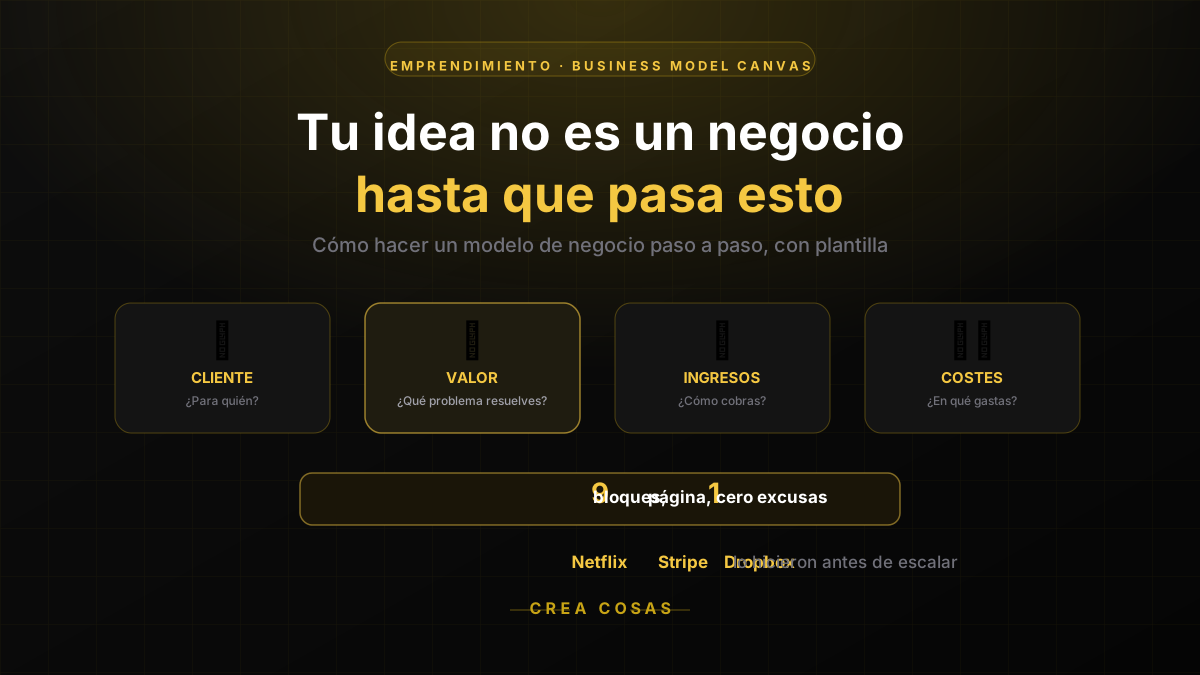
A visual example of how a Business Model Canvas is structured, facilitating a global understanding of the business.
Tips and Recommendations for a Successful Business Model
Turning a good theoretical design into a truly successful, profitable, and resilient business model in practice requires continuous attention, disciplined execution, and a strategic and adaptable mindset. Here are some practical tips:
- Be Flexible, Agile, and Anticipate Change: The business world is inherently dynamic and volatile (VUCA environment: Volatile, Uncertain, Complex, and Ambiguous).
- Scan the Environment Continuously: Stay alert and proactive to new disruptive technologies, imminent regulatory changes, strategic moves from the competition, and the constant evolution of consumer habits and expectations.
- Plan Scenarios and Contingencies: Prepare your model to adapt. For example, if you depend on a physical channel, how could you integrate digital options to expand your reach and build resilience against unforeseen events (such as a pandemic or an economic crisis)?
- Don't fall in love with your solution or your current model; fall in love with the problem you solve for your customers and with your customers themselves.
- Think Big, Act Small (and Fast) - Adopt the Lean Methodology:
- Ambitious Vision, Concrete and Incremental Steps: Have ambitious long-term goals, but start with clear, measurable, achievable, relevant, and time-bound (SMART) short-term objectives.
- Pilot Tests and Experimentation: Validate your model's riskiest hypotheses in a controlled environment (a pilot market, a specific customer segment, an A/B campaign) to identify errors and make adjustments before a costly and risky expansion.
- Know Your Competition Deeply and Learn (without Blindly Copying):
- Smart and Continuous Benchmarking: Observe what other companies in your sector and adjacent sectors are doing well (and poorly). Analyze their business models, pricing strategies, marketing, and customer service.
- Key and Sustainable Differentiation: This will help you identify opportunities for improvement, innovation, and to significantly differentiate your value proposition. It's not about copying, but adapting, improving, and innovating based on lessons learned and the unique characteristics of your business.
- Foster Strong, Long-Term Relationships with Your Customers:
- Beyond the One-Time Transaction: Build emotional and lasting bonds. This is achieved through an excellent and consistent customer experience, personalized attention, transparent communication, effective loyalty programs, and outstanding after-sales service.
- Turn Customers into Brand Ambassadors: A satisfied and loyal customer not only buys again but becomes an active promoter of your brand, generating valuable and credible word-of-mouth marketing. Measure Net Promoter Score (NPS).
- Monitor Your Results Constantly and Make Data-Driven Decisions (Not Intuition):
- Relevant and Actionable KPIs: Establish Key Performance Indicators (KPIs) that measure the success and health of each component of your business model (e.g.,
conversion rate,churn rate,customer satisfaction (CSAT/NPS),profitability per customer,engagement rate). - Periodic and Systematic Analysis: Review these data regularly (daily, weekly, monthly, quarterly, as appropriate) and act quickly on any negative deviations or worrying trends. Use Business Intelligence tools and dashboards to visualize information.
- Never Stop Innovating and Experimenting:
- Innovation is not just for tech startups or large corporations with R&D departments. It can (and should) happen in your product, service, process, distribution channel, revenue model, or even in the way you relate to your customers.
- Foster a culture of curiosity, controlled experimentation, and continuous learning within your organization. Dedicate time and resources to exploring new ideas.
Important Warning: A business model is not a static document that is created once and filed in a drawer. It is a living tool, a hypothesis in constant validation, that must be reviewed, questioned, and adapted continuously as your company grows, the market evolves, and you learn more about your customers.
Conclusion: The Business Model as a Compass for Success
A well-defined, validated, and excellently executed business model is, without a doubt, the cornerstone, the DNA, of any business project aspiring to lasting success and long-term sustainability. Much more than a simple static document or an academic exercise, it is a living, dynamic, and strategic tool that guides daily decision-making, aligns the efforts of the entire team toward common goals, and adapts the company's general strategy to the changing and often unpredictable needs of the market and customers.
By dedicating time, intellectual effort, and resources to designing it carefully, implementing it with discipline, and crucially, reviewing and refining it periodically, you not only ensure economic viability in the short and long term but also foster the organization's intrinsic capacity to innovate, pivot with agility when necessary, and stay relevant and competitive in a business environment that is in constant and accelerated transformation.
True business success does not lie solely in having a brilliant idea or a revolutionary product, but in the ability to articulate and execute a coherent and robust business model that aligns all its components synergistically: from a clear, attractive, and convincing value proposition to an optimized cost structure, diversified revenue streams, and impeccable execution in all customer interactions and internal operations. With the steps, tools, and tips presented in this guide, you are much better prepared to trace a solid and strategic path toward the growth, profitability, and sustainability of your venture or company.
Already got the logic down and want to put it into action today? In How to Build a Business Model Step by Step (with Template) you'll find a short, actionable version: a ready-to-use Canvas template, examples of well-known business models (subscription, freemium, marketplace, razor & blade), and a checklist to fill in your 9 blocks in 60 minutes.
Philosophical Reflection: The Business Model as a Bridge Between Vision and Reality
Creating a business model is much more than an analytical task or a strategic planning exercise; it is, in its deepest form, like designing a robust, elegant, and functional bridge that connects an entrepreneur's ethereal and passionate vision with the raw and tangible reality of the market and operations. It is an exercise in structured imagination, where the boldest dreams and highest aspirations are aligned with practical details, available resources, and the inherent limitations of the real world. In this introspective and often challenging process, essential questions arise that go beyond numbers, strategies, and market shares: What genuine value do I want to bring to the world through my company? How do I want to positively impact the lives of my customers, employees, and community? What is the legacy I aspire to build and leave behind?
Every business, from the modest corner store run by a family to the vast global corporation with thousands of employees, carries with it an intrinsic and unique narrative. It is a story that begins with a spark, an idea, a detected need, and seeks to resonate deeply not just in the rational mind, but also in the emotional heart of its customers and stakeholders. But success, in its most holistic and transcendent conception, is measured not only by the tangible and quantifiable—growing sales, geographic expansion, financial profitability, market valuation—but also by the intangible ability to adapt with grace, to innovate with purpose and ethics, and to remain relevant and valued in a world where change is the only constant and uncertainty is the new norm.
A truly successful and enduring business model is not a rigid, dogmatic, and immutable structure, carved in stone. Like a living and complex organism, it must breathe, evolve, learn from its mistakes, and continuously adapt to its changing environment, always looking toward the future with boldness and optimism, but without ever losing its essence, its fundamental purpose, its soul. This delicate and dynamic balance between transcendent purpose and pragmatic flexibility, between long-term vision and short-term agile execution, is, perhaps, the true art, the subtle science, and the greatest challenge of entrepreneurship with meaning and sustainable success.
Let's Build the Bridge to Success Together!
If this reflection and practical guide has inspired you to take the next step in your project, to refine your current business model, or simply to see your company from a new strategic perspective, we want to hear from you and accompany you on your journey!
- Subscribe to our weekly newsletter to receive more strategic content, practical tools, and inspiration to drive your ideas and projects.
- Give it a Like if you found this article useful, informative, and valuable.
- Comment below with your own experiences, the challenges you've faced, or the doubts you have when designing or implementing your business model. The community learns from shared experiences!
- Share this article with your friends, colleagues, partners, and any entrepreneur or business leader you think could benefit from this information.
Together, we can transform great ideas into successful, sustainable, and impactful business realities.
Code Example: Simple YAML Structure for a Model Element
Sometimes, structuring your ideas in simple formats like YAML can help clarify things. For example, for a value proposition of a coaching service:
value_proposition:
 for_segment: "Mid-career professionals (35-50 years old) feeling stuck."
 problem_solved: "Lack of clarity on next career steps, lack of motivation, fear of change."
 solution: "Personalized 3-month executive coaching program with weekly sessions, self-assessment tools, and a concrete action plan."
 key_benefits:
 - "Renewed clarity on career goals and trajectory."
 - "Increased confidence and motivation."
 - "Practical strategies to overcome obstacles and transition."
 key_differentiator: "Proprietary methodology based on neuroscience and 10+ years of experience with high-level executives. Satisfaction guarantee."
Related Posts
Keep exploring similar content that may interest you
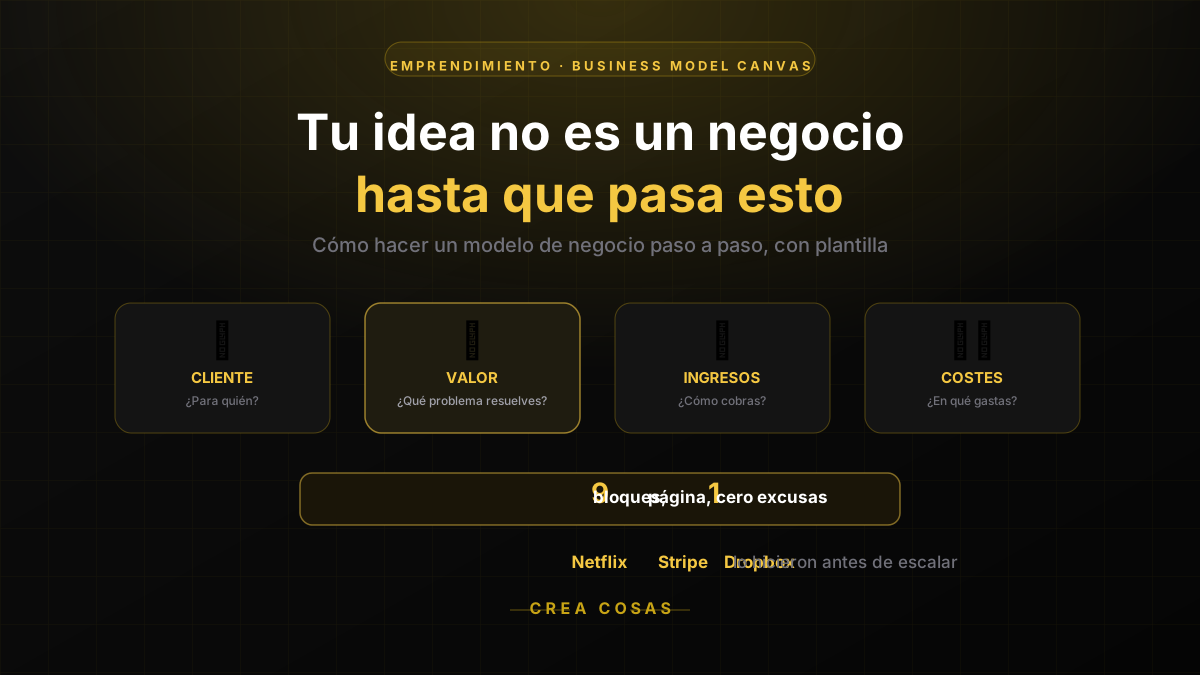
How to Build a Business Model Step by Step (with Template)
Learn how to build a business model from scratch with the Business Model Canvas: the 9 blocks, the steps to create it, real examples, and the most common mistakes beginners make.

Starting from Scratch: The Ultimate Guide to Launching Your Business Successfully
A comprehensive guide to transforming your idea into a profitable business with few resources. Learn to validate, plan agilely, use digital tools, AI, and finance your growth intelligently.

Entrepreneurship with Confidence: Transform Your Passion into a Real Business
Discover how to align your interests with a business idea, validate your idea, design a strategic plan, secure financing, and launch your venture successfully. A review of what entrepreneurship is, key characteristics of an entrepreneur, steps to start, and the benefits and challenges of this exciting adventure.
Partnerships
Tools I use every day, on better terms for this community.