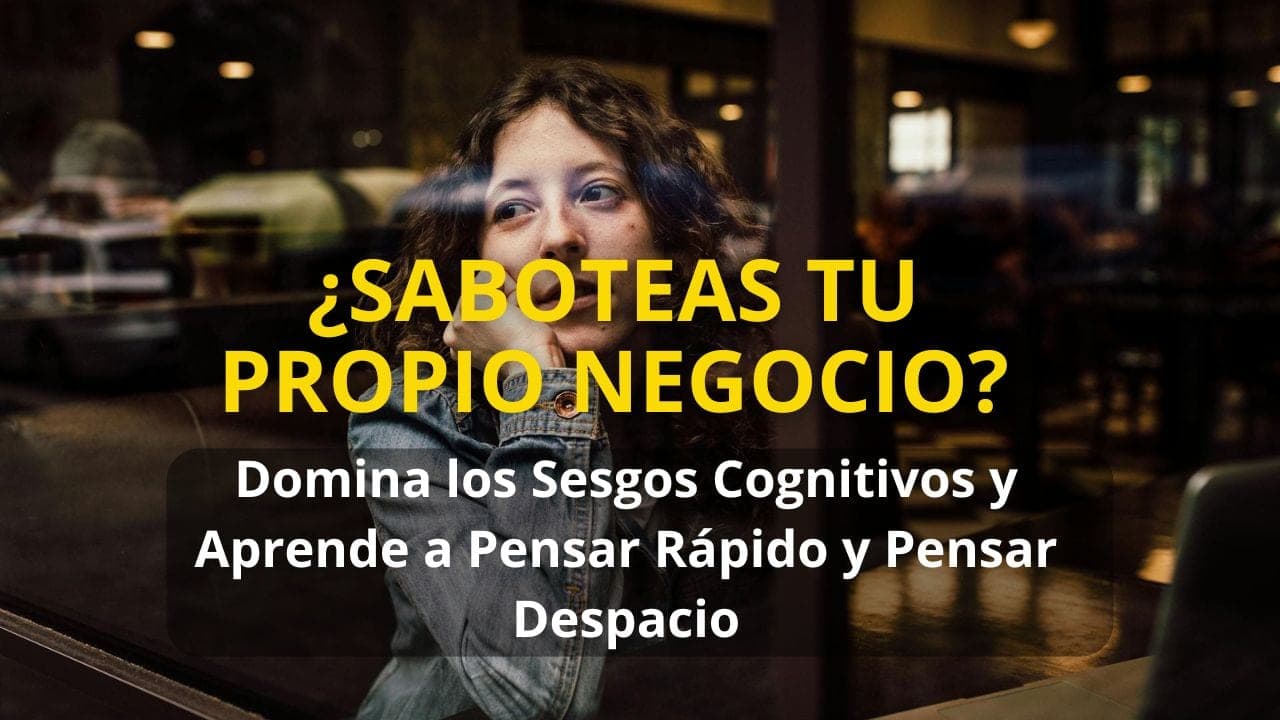
Cognitive biases: thinking fast and slow
Published on:
Reading time: 9 min
Topic: Entrepreneurship
Author: Leandro Valencia
Discover how invisible cognitive biases, like confirmation bias or loss aversion, impact your decisions and learn to master them to think clearly and lead your company to success.
Table of Contents
- The Mental Double Game: System 1 and System 2 in the Entrepreneurial World
- Decoding the Biases that Sabotage Your Business
- Reprogram Your Entrepreneurial Mind: 7 Steps to Overcome Biases
- Recommended Tasks
A couple of years ago I made a decision that felt completely rational at the time: I turned down a collaboration proposal because it "did not fit the plan." What I did not see until months later was that confirmation bias had done all the work for me — I had only looked for information that justified what I already wanted to decide, and ignored every signal pointing in the other direction. When I reached Kahneman's book, I recognized that pattern immediately. Not as something exceptional, but as something that happened constantly in my business and content decisions. This article starts from that experience: the biases that most affect people building their own projects, and what you can actually do to reduce their impact.
Every day you make decisions for your life and your business, but do you think they are 100% rational? The truth is that invisible biases are influencing you right now. Daniel Kahneman, Nobel Prize winner in Economics, demonstrated how our minds deceive us with 'mental shortcuts.' As an entrepreneur, ignoring these biases is putting your success at risk. In this article, we will show you how these biases impact your key decisions and how to master them to think clearly and win big.
The Mental Double Game: System 1 and System 2 in the Entrepreneurial World
As an entrepreneur, you are multitasking, fast, and need to make quick decisions. Your intuition is key, but also your worst enemy! The book 'Thinking, Fast and Slow' reveals that your mind operates with two systems:
-
System 1: The Fast Thinker. It is intuitive, impulsive, emotional, and acts almost automatically. It is like your brain's autopilot. It reacts quickly to danger, tells you if you like something or not, and allows you to make decisions in an instant, without you realizing it! On a daily basis, System 1 allows you to navigate familiar situations without mental effort. But, in the complex world of entrepreneurship, this "fast thinking" can be a trap.
-
System 2: The Slow Thinker. It is logical, analytical, reflective, and requires conscious effort. It activates when you concentrate on a difficult problem, when you do complex calculations, or when you need to make an important decision that requires evaluating different options. System 2 is slower, consumes more mental energy, but it is your best ally for strategic and rational decisions!
The problem arises when we rely too much on System 1 in situations that demand System 2. And that is where cognitive biases come into play. These biases are systematic errors in our thinking, "mental shortcuts" that System 1 takes to simplify reality, but that often lead us astray from the path of the wisest decision.
Decoding the Biases that Sabotage Your Business
In this article, we are not only going to understand the theory of "Thinking, Fast and Slow," but we are going to ground it in your daily life as an entrepreneur. We will reveal:
- The most common cognitive biases that haunt entrepreneurs.
- Practical and recognizable examples in real situations. You will recognize yourself in many of them!
- Concrete and actionable strategies to combat these biases.
"The essence of intuition is that it is not magic, but sudden recognition." - Daniel Kahneman
Silent Enemies: Cognitive Biases that Attack Entrepreneurs
1. The Echo of Your Ideas: Confirmation Bias
Have you ever fallen so much in love with an idea that you only seek the approval of those around you? Be careful! You are falling into the trap of Confirmation Bias. This bias drives us to seek, interpret, and remember information that confirms our beliefs, while ignoring what contradicts them.
- Entrepreneurial Example: You create a new app and are convinced it will be a success. You show your app to friends and family. When someone says "What a great idea!", you fill with enthusiasm. But if someone gives you constructive criticism, you tend to dismiss that opinion thinking that they "don't understand the vision."
- Consequence: You invest time and money in a project with little real potential, ignoring warning signs.
- Immediate Anti-Bias Action: Actively seek the opinion of someone who thinks differently from you, RIGHT NOW.
2. The Danger of Thinking You're Invincible: Overoptimism
Optimism is fundamental, but excess is toxic! Overoptimism Bias leads us to overestimate our abilities and probability of success, while underestimating risks.
- Entrepreneurial Example: You project sales for the next year. Blinded by optimism, you believe you will easily exceed all goals, underestimating the competition or potential crises. You base your budget on unrealistic projections. Result: you run out of liquidity in 6 months.
- Consequence: You take unnecessary risks, underestimate planning, and over-extend your resources.
- Immediate Anti-Bias Action: Review your most optimistic projections TODAY and ask yourself: What can REALISTICALLY go wrong?
3. The Paralysing Fear: Loss Aversion
Do you hold on to a toxic client or a strategy that no longer works? Loss Aversion might be playing against you. This bias makes us feel the pain of a loss much more intensely than the pleasure of an equivalent gain.
- Entrepreneurial Example: You have invested heavily in software that has become obsolete. Although it would be more profitable to change, you resist "abandoning" the initial investment, losing time and productivity.
- Consequence: It keeps you trapped in unprofitable decisions, preventing you from pivoting or exploring new opportunities for fear of assuming the loss.
- Immediate Anti-Bias Action: Identify TODAY an area of your business where you are holding on to something that doesn't work for fear of losing. What opportunity are you losing by not changing?
4. The Misleading First Impression: Anchoring Effect
Our tendency to rely on the first piece of information we receive (the "anchor") when making decisions.
| Situation | Anchor (Initial Price) | Biased Decision | Market Reality |
|---|---|---|---|
| Local rental | $5000/month | Accepting a "discount" to $4500 as a good offer. | Real value could be $3500. |
| Negotiation with supplier | $10,000 per lot | Negotiating down to $8,000, feeling like a great achievement. | Other suppliers offer the same for $6,000. |
- Consequence: It can harm you in negotiations, leading you to accept inflated prices or set incorrect prices for your products.
- Immediate Anti-Bias Action: Before an important negotiation, research REAL market price ranges and values.
5. The Illusion of Recency: Availability Bias
We overestimate the probability of events that are easy to remember because they are recent or emotionally impactful.
- Entrepreneurial Example: You read about a startup that failed (negative event) and you become too conservative. Or you read about a viral success (positive event) and you take excessive risks believing it is the norm.
- Consequence: You make decisions based on fear or overreaction to isolated events, rather than on objective data.
- Immediate Anti-Bias Action: When faced with a decision influenced by a recent event, look for data and statistics that give you a real and broad perspective.
6. Trapped in the Past: Sunk Cost Fallacy
We continue to invest in something failing just because we have already invested heavily in it.
- Entrepreneurial Example: You continue to invest in a product with no future because "you have already come too far," rather than assuming the loss and redirecting resources.
- Consequence: It drains your resources, energy, and motivation, preventing you from pivoting or innovating.
- Immediate Anti-Bias Action: Evaluate a doubtful project. Ask yourself: If I were starting from scratch TODAY, would I invest in this? If the answer is NO, it's time to cut your losses.
Reprogram Your Entrepreneurial Mind: 7 Steps to Overcome Biases
- Stop and Reflect! Before an important decision, stop. Close your eyes, inhale for 4 seconds and exhale for 6. Repeat 3 times to activate your System 2.
- Create Checklists and Protocols. Define a step-by-step process for recurring decisions (hiring, investments) that forces you to analyze data.
- Seek Diverse Perspectives. Encourage debate and constructive criticism. Diversity of viewpoints weakens individual biases.
- Use Data, Data, and More Data. Base your decisions on metrics, surveys, and market analysis. Objective evidence is the antidote to biased intuition.
- Experiment and Learn. Adopt a trial and error mindset. Test hypotheses, measure results, and learn from failures.
- Assign a "Devil's Advocate." Ask someone to tear your ideas apart to find the flaws that your optimism hides.
- Practice Mindfulness. Stress activates System 1. Meditation and breaks improve your concentration and reduce impulsivity.
Recommended Tasks
- Actively seek the opinion of someone who thinks differently from you about a key idea.
- Review your most optimistic projections and make a list of what could go wrong.
- Identify a "sunk cost" in your business and decide if it's time to cut your losses.
- Research the market prices of a service you plan to hire, before talking to suppliers.
- Practice conscious pausing (3 deep breaths) before your next major decision.
The entrepreneurial path is full of uncertainty, but with the compass of reason and self-awareness, you can navigate the storms and build the business you dream of!
Ready to take the next step? Visit our YouTube channel for more content on entrepreneurial mindset, business strategies, and tools to boost your success.
Related Posts
Keep exploring similar content that may interest you

Finite vs. Infinite Games: How to Design Your Life and Business for the Long Term
Learn how to think about goals, work, and entrepreneurship with a long-term mindset. Discover how to use goals as a compass, document lessons, and move forward through experiments instead of blind bets.

The Dilution Effect: Why Doing More Things Makes You Fail Faster
Discover why doing too many things at once kills your progress. The Dilution Effect is one of the silent startup killers — here's what it is and how to escape it.
Entrepreneurship Classes: What to Learn and How to Choose
Do entrepreneurship classes actually work? Topics a good course should cover, formats (online, in-person, mentoring) and red flags to spot empty courses.
Partnerships
Tools I use every day, on better terms for this community.