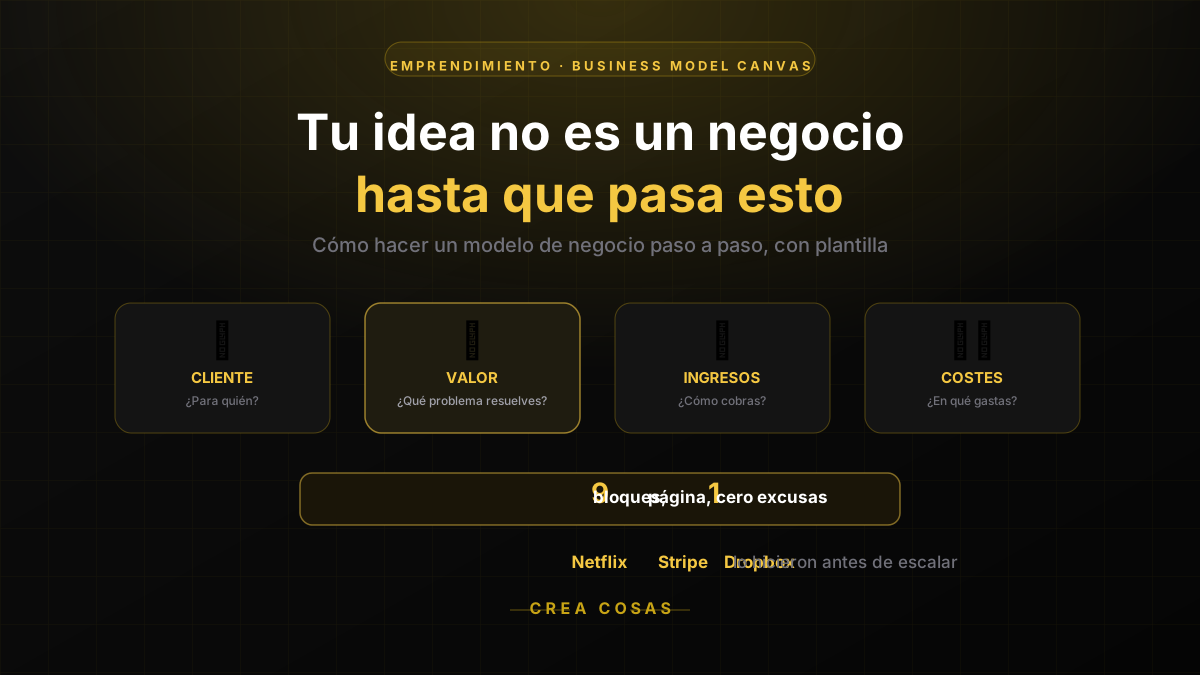
How to Build a Business Model Step by Step (with Template)
Published on:
Reading time: 12 min
Topic: Entrepreneurship
Author: Leandro Valencia
Learn how to build a business model from scratch with the Business Model Canvas: the 9 blocks, the steps to create it, real examples, and the most common mistakes beginners make.
Table of Contents
To build a business model you define 9 elements: customer segments, value proposition, channels, customer relationships, revenue streams, key resources, key activities, key partners, and cost structure. The Business Model Canvas is the most widely used tool to map them visually on a single page, and it's the mandatory starting point before writing a 60-page business plan nobody is going to read.
This guide explains the 9 blocks, the steps to create your model, the most common model types, and the mistakes people make most often when starting out. If you're still not clear on the difference between a business model, a business plan, and a strategy, keep reading: it'll be clear in the next five minutes.
What is a business model?
A business model is the logic a company uses to create, deliver, and capture value. In plain terms: how you decide who you sell to, what you sell them, how you deliver it, and how you make money from it.
The most useful definition for entrepreneurs is Alexander Osterwalder's: "A business model describes the rationale of how an organization creates, delivers, and captures value." Three verbs, three questions:
- Create value: what problem do you solve, and for whom?
- Deliver value: how does your solution reach the customer?
- Capture value: how do you monetize it, that is, how does value turn into revenue?
If you fail at any one of the three, the business doesn't work. You can create enormous value but not know how to deliver it (many failed inventions). You can deliver it but not capture it (many startups scale while burning cash with no profit).
Business model ≠ business plan ≠ strategy
A common mix-up worth clarifying:
| Concept | What it answers | Typical length |
|---|---|---|
| Business model | How does this work, logically? | 1 page (Canvas) |
| Business plan | How do we execute it over 3 years, with numbers? | 20–60 pages |
| Strategy | How do we win against the competition? | Variable |
The model is the idea. The plan is the detailed execution. The strategy is how you win. Always start with the model: if the logic doesn't work on one page, it won't work on fifty.
The 9 blocks of the Business Model Canvas
The Business Model Canvas (BMC) was popularized by Alexander Osterwalder in Business Model Generation (2010). It's a one-page canvas with 9 blocks filled in order. Most importantly: it's iterative. You don't fill it out once; you revisit it every time you learn something new.
Block 1 · Customer segments
Who are we creating value for? Who are our most important customers?
Don't say "everyone." Define concrete segments by:
- Demographics (age, income, location).
- Behavior (how they buy, what motivates them).
- Need (what problem they have).
Example: Netflix doesn't serve "everyone who watches TV." It serves (1) households with internet access and (2) film and TV fans willing to pay a monthly subscription.
Block 2 · Value proposition
What problem are we solving? What need are we satisfying?
Here you describe what you offer, to whom, and why it's better than the alternatives. A good value proposition answers:
- What customer problem do you solve?
- What tangible benefit do they get?
- Why you and not the competition?
Example: Stripe's value proposition for developers isn't "payment gateway." It's "clean API, excellent documentation, integration in 5 minutes." That precision is what sets them apart.
Block 3 · Channels
How do we reach customers? How do we deliver the product to them?
Communication channels (how they find out about you), distribution channels (how they receive the product), and sales channels (how they buy). Each channel has its own cost and effectiveness.
Example: a natural cosmetics brand might sell through (1) its own website, (2) marketplaces like Amazon, (3) selected physical stores, (4) social media with integrated shops.
Block 4 · Customer relationships
What type of relationship do we establish with each segment?
Automated (self-service)? Personal (consulting)? Community-based (user forum)? Subscription-based? The relationship shapes costs and retention.
Block 5 · Revenue streams
What are customers willing to pay for? How do they pay?
Pricing models: subscription, transaction, freemium, advertising, commission, licensing. The same product can monetize in several ways; each generates different dynamics.
Block 6 · Key resources
What assets do we need for the model to work?
Physical (factory, warehouse), intellectual (patents, brand), human (technical team), financial (capital). Without these resources, the model isn't sustainable.
Block 7 · Key activities
What must we absolutely get right?
Design, production, marketing, logistics, technical platform. Key activities are the ones that, if they fail, bring everything down.
Block 8 · Key partners
Who does the things we shouldn't be doing ourselves?
Suppliers, external manufacturers, distributors, technology partners. Strategic alliances that let you scale without doing everything in-house.
Block 9 · Cost structure
What are the most important costs in the model?
Fixed costs (payroll, rent), variable costs (raw materials, commissions), economies of scale (more production means lower unit cost). The cost structure defines margins and viability. Once you have costs and prices, check your numbers with the margin calculator.
Visual tip: on the Canvas, blocks 1–5 sit on the right side (the customer, value, and revenue side). Blocks 6–9 sit on the left (the internal, cost, and operations side). The value proposition goes in the center: it's the heart of it.
Steps to build your business model
There's no sacred sequence, but this one works for most entrepreneurs:
Step 1 · Define your customer
Pick one segment. Not three, not five. One. "B2B SaaS startups under 50 people in Europe" is a segment. "Companies" is not. If you can't draw your ideal customer in detail, you don't know who you're selling to.
Tool: the customer persona. Write a fictional name, age, job title, frustrations, goals, and where they look for information.
Step 2 · Design your value proposition
Fill in this sentence from Steve Blank: "We help [segment] who have [problem] by providing [solution], unlike [alternative], because [reason you're better]."
If you can't fill that sentence in convincingly, you still don't have a value proposition.
Step 3 · Map the 9 blocks of the Canvas
Open our editable Business Model Canvas template (the format popularized by Strategyzer) and fill in the 9 blocks with short notes, one idea per note, as if they were sticky notes. That way you can move things around and reorder without fear of getting it wrong, and download it as a PNG or PDF when you are done.
Step 4 · Validate with real customers
Before spending on product, talk to 20 people in your segment. Do they have the problem? How do they solve it today? What would they pay for something better?
This phase is called Customer Development (Steve Blank). Its rule: get out of the building. The answers aren't in your head, they're on the street.
Step 5 · Build an MVP
MVP stands for Minimum Viable Product: the simplest version of your product that lets you validate the value proposition with real customers, not survey respondents.
Legendary example: Dropbox started with a 3-minute video showing how the product would work, before it was even built. Sign-ups went from 5,000 to 75,000 overnight.
Step 6 · Measure and learn
Define the metrics that tell you if the model works: CAC (customer acquisition cost), LTV (customer lifetime value), retention, churn. If CAC exceeds LTV, you don't have a business.
Step 7 · Iterate or pivot
If the metrics don't validate your hypotheses, don't push through: pivot. Changing your segment, proposition, or channel isn't failure, it's learning. Twitter was born out of a failed podcast startup (Odeo). Slack was born out of a video game that didn't work out (Glitch).
Common mistakes when defining a business model
1. Trying to serve everyone
"My product works for many types of customers." False. If you try to serve everyone, you serve no one well. Start with a niche, dominate it, then expand.
2. Confusing product with business model
The product is what you sell. The model is how you make money from it. The iPod was a product; iTunes plus iPod, as an ecosystem, was a revolutionary business model.
3. Not validating before building
Months of development with zero conversations with customers. Result: a brilliant product nobody wants.
4. Underestimating acquisition costs
"If I make a good product, people will come." No. Real CAC is always higher than you imagined. If you don't calculate it, you don't have a business, you have an expensive hobby.
5. Not iterating
Filling out the Canvas once and framing it. A business model is a living document. It gets reviewed every sprint, every quarter.
6. Ignoring the competition
Pretending it doesn't exist. Competition always exists, even if it's just "the status quo" (how the customer solves the problem today). Identify it and differentiate.
7. Not differentiating the value proposition
"Quality, service, and price." Everyone says that. It's not a value proposition, it's noise. Your value proposition needs to be specific and defensible.
Examples of well-known business models
Each model appears here in short form; if you want to see the full Canvas of three Latin American businesses, block by block, check out these Business Model Canvas examples.
Subscription
Netflix, Spotify, SaaS in general. The customer pays a recurring fee for access to a catalog or service. Predictable revenue, retention as the critical metric.
Freemium
Slack, Notion, Dropbox. A basic free version to attract users; a paid version for those who need more. The challenge: converting a high enough percentage of free to paid.
Marketplace
Airbnb, Uber, Amazon Marketplace. You connect two sides (buyers and sellers) and take a commission. The challenge: the chicken-and-egg problem, you need both sides to launch.
Direct-to-consumer (D2C)
Warby Parker, Gymshark, Casper. You sell directly to the end customer, without intermediaries, typically online. High margin, brand control, dependence on digital acquisition.
Advertising
Google, Meta, media outlets. The service is free for the user; the paying customer is the advertiser. It works at massive scale: you need millions of users.
Transaction or commission
Stripe, PayPal, banks with fees. You charge a percentage per processed transaction. It scales with volume.
Licensing
Classic enterprise software, franchises. You charge for the right to use your technology or brand.
Razor & blade (base and consumables)
Gillette, Nespresso, printers. You sell the cheap base (the machine) and the expensive consumables (blades, capsules, ink). Recurring revenue from refills.
Servitization or product-as-a-service
Rolls-Royce (engines charged by flight hour), mobility subscriptions. Instead of selling the product, you sell the outcome. Recurring revenue, higher retention.
How to get started today with your own Canvas
- Download a Business Model Canvas template, for example from strategyzer.com.
- Print it on A3 or stick it on a whiteboard.
- Get your team together, or just yourself with a coffee.
- Fill in the 9 blocks with sticky notes in 60 minutes.
- Get out of the building and validate with 5 customers.
If you also want to apply solid management principles from day one, check out our guide on the foundations and characteristics of management.
Frequently asked questions
What is a business model?
It's the logic a company uses to create, deliver, and capture value. It describes who you sell to, what you sell them, how you deliver it, and how you make money. The most widely used tool to visualize it is the Business Model Canvas.
What's the difference between a business model and a business plan?
A business model is the logic, one page, a Canvas. A business plan is the detailed execution, 20 to 60 pages, with financial projections, marketing plan, and team. Always start with the model: if the logic doesn't work on one page, it won't work on fifty.
What is the Business Model Canvas?
It's a one-page canvas with 9 blocks (segments, value proposition, channels, relationships, revenue, resources, activities, partners, costs) created by Alexander Osterwalder. It lets you design a complete business model on a single page.
How do I choose the right business model?
It depends on three factors: your customer, your value proposition, and your resources. A tech startup usually picks SaaS (subscription). A physical ecommerce business is usually D2C or marketplace. Best approach: fill out the Canvas with several models and validate which one generates the most value at the lowest cost.
How much does it cost to build a business model?
Nothing in money: a free template, sticky notes, and a coffee. A lot in time spent reflecting and validating. If you do it well, you save months of development and thousands of dollars building a product nobody wants.
Conclusion
A well-designed business model is the difference between a brilliant idea that goes nowhere and a project that generates revenue. You don't need 60 pages or an MBA: you need one page, nine blocks, and the discipline to go out and validate.
Start today. Print the Canvas. Fill in the 9 blocks. Get out of the building. The rest is iteration.
Want to understand the full logic behind each block, the most common challenges when implementing it, and how to keep your model alive over time? Read the complete guide What is a Business Model? How to Design It and Overcome Its Challenges, with an in-depth look at the Business Model Canvas and the problems that make most business models fail.
Related Posts
Keep exploring similar content that may interest you
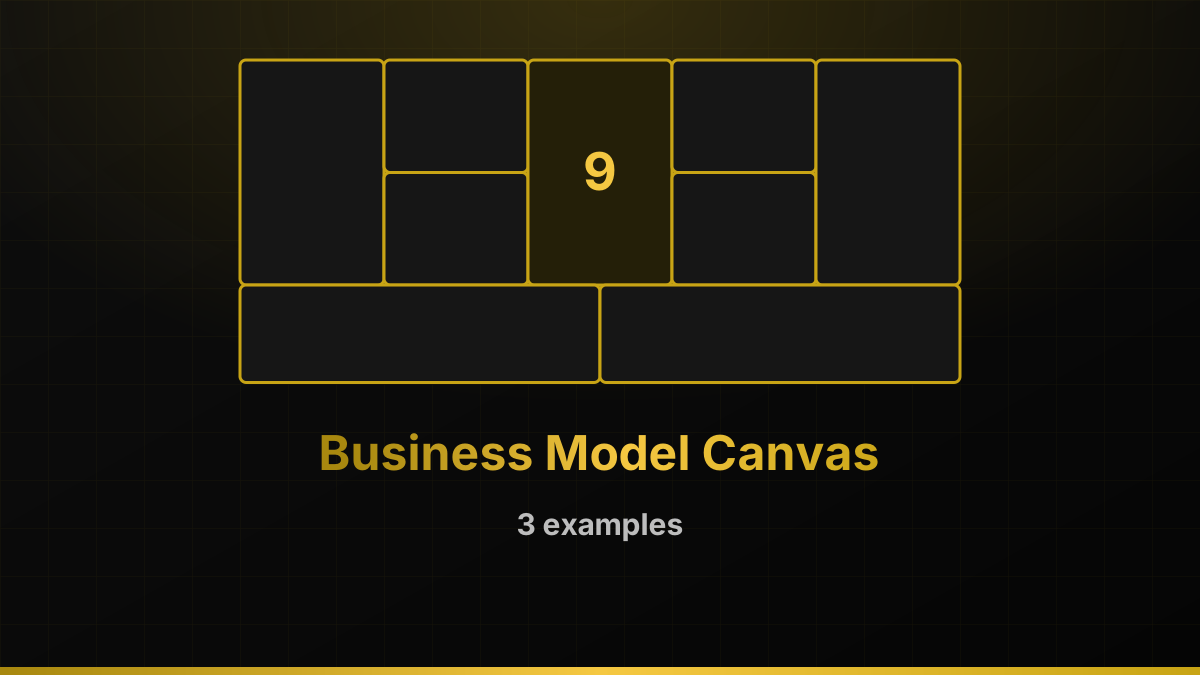
Business Model Canvas: What It Is and 3 Full Examples
What the Business Model Canvas is, plus three complete examples block by block: a coffee shop, an Instagram clothing store and a freelance designer. Open and edit them free.
What is a Business Model? How to Design It and Overcome Its Challenges
A comprehensive guide on what a business model is, its critical importance for any company, common challenges when implementing it, a detailed step-by-step process to design it effectively, and practical tips to ensure success and adaptability in today's market.
Entrepreneurship Learning Roadmap: What to Study and in What Order
A step-by-step learning roadmap for starting a business: the 6 stages, the skills to learn in each one, and the ordering mistakes that cost you time and money.
Partnerships
Tools I use every day, on better terms for this community.