Z.ai GLM vs OpenCode Go: Price and Plan Comparison
Published on:
Reading time: 10 min
Topic: Technology
Author: Leandro Valencia
Z.ai's GLM Coding Plan next to OpenCode Go: $10 a month, Go Plus at $40, a cap per model, and Z.ai's credits. Who each subscription actually fits.
Table of Contents
If you are deciding between 's GLM Coding Plan and OpenCode Go, you probably already know that both promise coding with AI agents without a premium subscription. They are products with different pricing logic. Comparing them only by the number on the receipt leads to the wrong conclusions.
This article puts the two tables side by side. Z.ai's credits and dollar prices come from Z.ai's developer documentation, reviewed on September 30, 2026: the plan is still "from $18 a month," with the Lite, Pro, and Max credit windows we already had. OpenCode's figures come from the Go documentation, reviewed on September 29, 2026. Where something is not published, I say so.
Updated September 30, 2026.
The table you came for: prices side by side
| Z.ai GLM Coding Plan (Lite) | OpenCode Go | |
|---|---|---|
| Monthly price | $10 from the first charge. Go Plus: $40 | |
| Type of limit | Credits with a multiplier by model | Dollars of usage per model, not one shared pocket |
| 5-hour window | 2,000 credits | 20% of that model's monthly cap. On a $60 model, that is $12 |
| Weekly window | 10,000 credits | 50% of that model's cap. On a $60 model, that is $30 |
| Monthly ceiling | No explicit monthly ceiling; the weekly window governs it | 100% of that model's cap: $15, $30, or $60 on Go |
| Included models | GLM-5.3 and GLM-5.3-Flash | The public list in the Go documentation. GLM-5.3 and GLM-5.3-Flash are on it too |
| Refundable | No | Not documented in the source I checked. Confirm it before you pay |
| Off-peak discount | Yes, 50% outside Monday–Friday 14:00–18:00 Singapore time | DeepSeek on Go distinguishes peak and off-peak. The rest of the catalog is not documented as a general discount |
| Team limit | Not documented in the source I checked | Only one member per workspace can subscribe to Go or to Go Plus |
| Data retention | Prompts processed on Zhipu AI infrastructure (a Chinese company) | 0 days on most. 30 days on Grok 4.7, Grok 4.6, GPT 6 Luna, and GPT 5.6 Luna, not used for training. Muse Spark Contributor allows training |
Two things stand out. Go's entry price ($10) is still below Z.ai Lite (~$18), and they do not measure the same thing: one hands out credits with a per-model multiplier, the other hands out a dollar cap per model. Neither one is unlimited.
Z.ai is not a single plan. To complete the picture, with the credits the developer documentation was still publishing on September 30, 2026:
| Z.ai plan | Monthly price | Credits/5h | Credits/week |
|---|---|---|---|
| Lite | ~$18 | 2,000 | 10,000 |
| Pro | ~$72–80 | 12,000 | 60,000 |
| Max | ~$160–168 | 28,000 | 140,000 |
Those Pro and Max dollar amounts did not show up again in the public summary I checked that day. I am leaving them as they were in the previous review, and you should confirm them on the subscription page before you pay. The credits do match the documentation.
OpenCode Go is not a single plan either. Go costs $10 a month and Go Plus costs $40 a month. The models are the same. What changes is each one's monthly cap, and not by a single multiplier: GLM-5.3-Flash goes from $60 to $180, Kimi K2.6 from $60 to $240, and Kimi K3 from $15 to $60.
Where they are alike
- Both use a 5-hour window as a firewall. Z.ai measures it in credits (2,000 on Lite). Go measures it as 20% of the monthly cap of the model you are using. In both cases, that window fills before the weekly or monthly ceiling if the session is intense.
- Both charge differently depending on the model, not a flat price per request. On Z.ai, GLM-5.3 output has a multiplier of 24 against 6.9 for input. On Go, each model has its own monthly cap ($15, $30, or $60 on the $10 plan) and the windows come from that cap.
- Neither is an open API with no restrictions. Z.ai limits use to a list of supported coding agents. Go is meant for OpenCode and for other agents with similar traffic, and it publishes validated clients and clients with session problems.
- Both analyses recommend not depending on a single provider. If one quota runs out, the other keeps going.
Where they actually differ
Models: a house family versus a catalog
Z.ai gives access to its own models. The developer documentation, on September 24, 2026, says the plans support GLM-5.3 and GLM-5.3-Flash. What changes when you move from Lite to Pro or Max is the number of credits, not a different model list.
OpenCode Go gives a catalog from several providers. In the September 29, 2026 review it includes, among others, Grok 4.7 and 4.6, GLM-5.3, GLM-5.3-Flash, and GLM-5.2, Kimi K3, K2.7 Code, and K2.6, Qwen3.8 Max, Qwen3.8 Flash, and Qwen3.7 Plus, DeepSeek V4.1 Flash, V4 Pro, V4 Flash, and V4 Flash Vision Exp, MiniMax M3 and M2.7, MiMo-V2.6 and V2.5, LongCat-2.0, Hy4 preview, and Hy3, plus two models that are free for a limited time. GLM-5.3 is already inside Go. You do not need a Z.ai subscription to have that generation. What Z.ai sells is its own credit system and its agent list. On Go, GLM-5.3 has a monthly cap of $15 ($3 every 5 hours). GLM-5.3-Flash has a cap of $60.
Supported tools
Z.ai documents compatible agents: ZCode, Claude Code, Claude for IDE, Codex, Cursor, Cline, OpenCode, Roo Code, Kilo Code, Crush, Goose, Droid, TRAE, Qoder, Pi, and Eigent, plus best-effort support for general-purpose agents. Integration is a matter of changing the base URL according to the protocol.
Go is meant first as a provider inside OpenCode. The documentation names validated clients (among them Claude Code, Codex, Hermes, Pi, ZCode, jcode, and Kilo Code CLI) and others with incomplete session support. If your workflow already lives in an agent that Z.ai lists and Go does not validate, that list carries weight.
Privacy and where the data goes
Z.ai is a Chinese company (Zhipu AI) and prompts pass through its infrastructure. That is worth reviewing if you handle code under an NDA or regulated data.
On Go, the privacy table from September 29, 2026 says the catalog is not used for training, with exceptions. Grok 4.7, Grok 4.6, GPT 6 Luna, and GPT 5.6 Luna retain data for 30 days and are not used for training. Muse Spark 1.3 and 1.2 Contributor do allow prompts and responses to train Meta models, and they are only in some regions. DeepSeek is listed at 0 days under an agreement the documentation says is valid through October 31, 2026. The old line that "30 days applies only to Grok 4.5" no longer describes the table: Grok 4.5 is not in the Go catalog.
Teams
For Z.ai, the source I checked does not document a team policy. For Go it does: only one member per workspace can subscribe to Go or to Go Plus.
Who is each one for?
Z.ai's GLM Coding Plan makes more sense if:
- You already write clear specs and the bottleneck is the cost of executing a lot inside the GLM family.
- You work with agents Z.ai documents and you want that explicit support.
- Z.ai's credit system for GLM-5.3 and GLM-5.3-Flash works for you, with the 2,000-credit window on Lite, instead of the $15 cap GLM-5.3 has on Go.
- You can absorb about $18 a month at the entry tier.
OpenCode Go makes more sense if:
- You want to start at $10 a month, from the first charge, and try several models without one subscription per brand.
- Your work already lives in OpenCode, or in a client the Go documentation treats as validated.
- You code alone. You are not looking for a shared quota: a workspace allows a single subscription.
- If the catalog convinces you and the $10 quota does not, the published step up is Go Plus at $40, not a third tier of better models.
If you do not want to choose, combining them is still reasonable when the budget allows it: Z.ai credits for volume on GLM, and Go for the rest of the catalog. GLM-5.3 exists on Go, but with a monthly cap of $15. That is not the same margin as Z.ai's credit plan.
Frequently asked questions
Are Z.ai GLM and OpenCode Go the same type of product?
No. Z.ai is a tiered subscription to its GLM models, with credits. OpenCode Go is a $10-a-month plan, with Go Plus at $40, that gives access to a catalog from several providers. The cap is in dollars and it is per model.
Can I use GLM-5.3 inside OpenCode Go?
Yes. The Go documentation from September 29, 2026 includes GLM-5.3 and GLM-5.3-Flash. GLM-5.3 has a monthly cap of $15 on the $10 plan. GLM-5.3-Flash has a cap of $60. Z.ai serves them in its own credit system, not inside that dollar cap.
Which is cheaper, Z.ai or OpenCode Go?
On the entry price, Go ($10 from the first month) is cheaper than Z.ai Lite (~$18 a month). Go Plus costs $40. They do not measure the same use: credits with a multiplier versus a dollar cap per model. The real cost depends on the model and the volume.
Is this comparison the same as OpenCode Zen vs OpenCode Go?
No. Zen is a pay-per-use gateway. The public list is in its documentation and includes Claude, GPT, Gemini, and also GLM. Go is the subscription with a ceiling that this article compares with Z.ai. The Zen analysis is in OpenCode Zen and Go.
Do I have to pick only one?
No. Combining providers is still reasonable when the budget allows it.
Verdict
There is no absolute winner. Z.ai sells access to GLM-5.3 and GLM-5.3-Flash with credits and a long tool list. OpenCode Go sells a wider catalog at $10 a month from the first charge, with Go Plus at $40 if the quota falls short. If the budget is tight and you want to try several models, start with Go. If your workflow depends on an agent Z.ai documents and you want more room on GLM-5.3 than Go's $15 a month, the GLM Coding Plan is the more solid bet.
Z.ai credits and Lite's entry price checked on September 30, 2026 in Z.ai's developer documentation. Pro and Max prices in dollars, left as in the previous review. OpenCode Go checked on September 29, 2026 in the official documentation. Confirm the amounts on the product page before you pay.
Related Posts
Keep exploring similar content that may interest you
Z.ai and its GLM models: which is which and when to use each one
A practical catalog of Z.ai's models —GLM-5.3, Flash, 4.6V, OCR, GLM-Image, CogVideoX and the Coding Plan—: what each one does, what it costs, and how to pick the right one for every task.
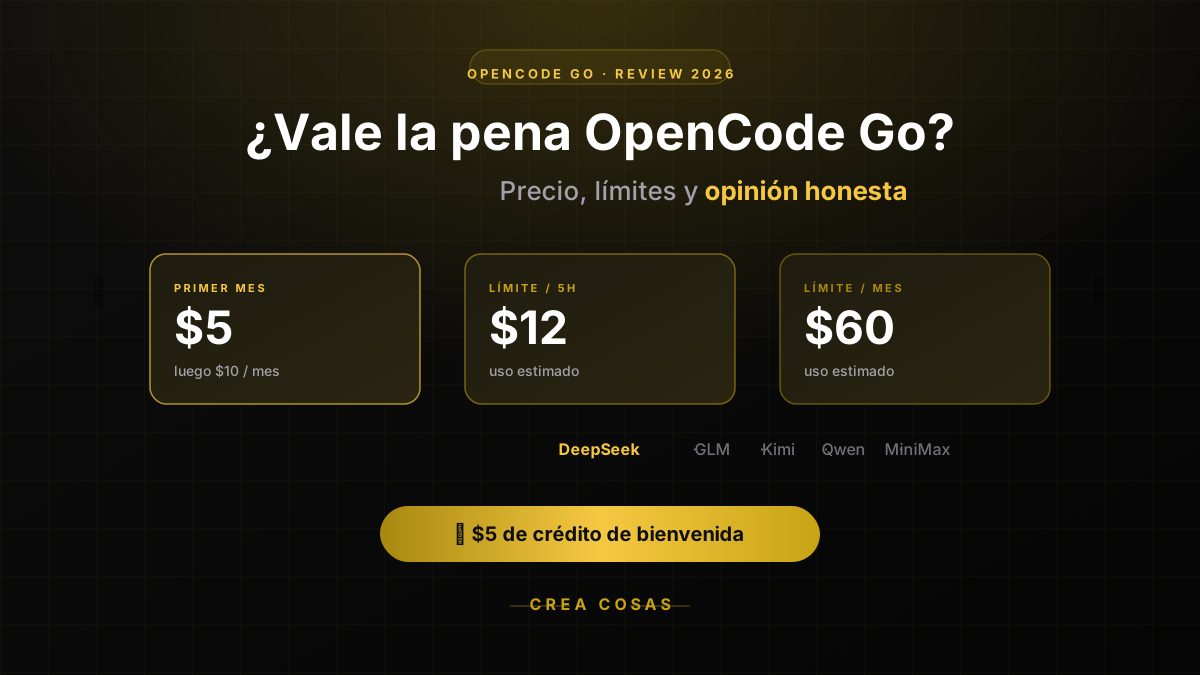
OpenCode Go Pricing & Limits (Oct 2026): $10/mo, Real Caps
OpenCode Go costs $10/month; Go Plus is $40. Each model has its own cap: 20% every 5 hours, 50% a week. Real limits per model and when to skip it.
Manus vs Claude Code vs OpenCode: Pricing and Which to Pick (2026)
Manus works in the cloud; Claude Code and OpenCode work on your machine. We compare pricing, how each one bills, key features and which fits your profile.
Partnerships
Tools I use every day, on better terms for this community.