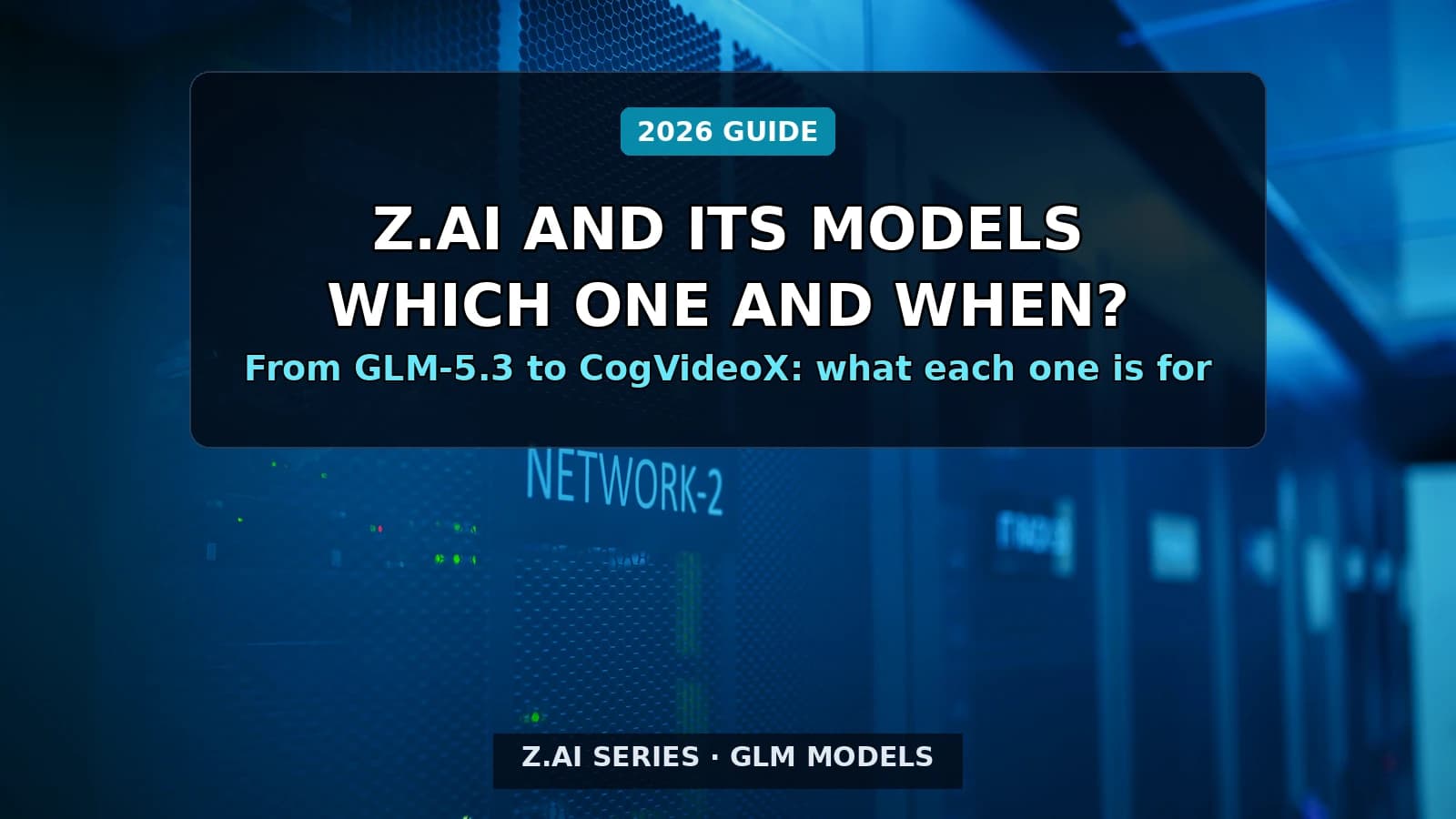
Z.ai and its GLM models: which is which and when to use each one
Published on:
Reading time: 9 min
Topic: Technology
Author: Leandro Valencia
A practical catalog of Z.ai's models —GLM-5.3, Flash, 4.6V, OCR, GLM-Image, CogVideoX and the Coding Plan—: what each one does, what it costs, and how to pick the right one for every task.
Table of Contents
- The map in 30 seconds
- The makers: image, video and voice
- Quick decision guide
- What actually changes between Coding Plan tiers
The map in 30 seconds
| Model | Type | What it's for | API price |
|---|---|---|---|
| GLM-5.3 | Text | The flagship: hard code, agents, long tasks | $1.40 / $4.40 |
| GLM-5.3-Flash | Text + image | Volume: chat, extraction, classification | $0.15 / $0.50 |
| GLM-5.2 | Text | The MIT alternative with lossless 1M context | $1.40 / $4.40 |
| GLM-4.7 / 4.6 | Text | The previous generation, still solid all-round | $0.60 / $2.20 |
| GLM-4.7-Flash | Text | Free on the API: sketches and side projects | $0 |
| GLM-4.6V | Vision | Screenshots, documents, UIs, native tool use | $0.30 / $0.90 |
| GLM-4.6V-Flash | Vision | Same idea, free | $0 |
| GLM-OCR | OCR | Scans and PDFs into clean text | $0.03 / $0.03 |
| GLM-Image | Image | Generation with readable text inside the image | ~$0.015 per image |
| CogVideoX-3 | Video | Short clips | ~$0.20 per video |
| GLM-ASR-2512 | Voice | Audio transcription | ~$0.0024 per minute |
If you take only one idea from this table: the "type" column matters more than the version number. A text 5.3 won't help you read a screenshot, and a 4.6V shouldn't be used for what GLM-OCR does at a tenth of the price.
The thinkers: text models
GLM-5.3 — the flagship
It's the top model of the family (August 2026) and the one that answers by default when you ask for "the best". It's optimized for code and agents: on Z.ai's own benchmarks it improved ~50% over GLM-5.2, and on terminal tasks and long refactors it sets the open-source state of the art. 1-million-token context and up to 128K of output — enough for an agent to write a whole feature in a single run.
One pricing detail almost nobody looks at: cached input costs $0.26 instead of $1.40. If your app sends the same system prompt on every call, that's nearly an 80% automatic discount on the repeated part.
Use it for: complex refactors, autonomous agents, large codebase analysis, hard reasoning. Don't use it for: classifying tickets or summarizing emails. That's Flash territory, and the bill difference is 10x.
GLM-5.3-Flash — the workhorse
The budget version (August 2026): 320B total parameters, 18B active, a hybrid architecture that cuts cache and compute costs. It accepts images in addition to text, also with 1M context, and it's the default model in Z.ai's chat.
At $0.15/$0.50 per million tokens, it's among the cheapest options in its class on the market. Rule of thumb: if the task bores you, it's for Flash; if it costs you effort, it's for full 5.3.
Use it for: chatbots, structured extraction, classification, summaries, anything at volume. Don't use it for: software architecture or decisions production depends on. There, the flagship's quality points pay for themselves.
GLM-5.2 — the MIT option
June 2026, same price as 5.3 on the API. Why does it exist, then? The license: GLM-5.3 shipped weights under its own license (with a security review required for giant AI-service companies), while GLM-5.2 is pure MIT. It was flagged as probably the most capable open-weight model at launch, with lossless 1M context (less goal-forgetting on long tasks).
Use it for: self-hosting in a company without talking to lawyers, or when your policy only allows MIT/Apache licenses.
GLM-4.7, 4.6 and friends — the generation that stayed
GLM-4.7 (late 2025) is still a serious model — the last with a public SWE-bench Verified score, 73.8% — at $0.60/$2.20. GLM-4.6 is roughly the same price. And GLM-4.7-Flash is free on the API: 30B total parameters, 3B active, perfect for prototypes, webhooks and automations that barely reason.
The GLM-4.5 and 4.5-Air from mid-2025 opened this era, but today they're history: 128K context and less capability than any of the above. If an old tutorial tells you "use GLM-4.5", swap it for 4.6 or newer.
The seers: vision and documents
GLM-4.6V — the one that understands what it sees
The vision model (106B, 128K context): it understands screenshots, documents with layout, product photos, UIs. Its trick is native tool use: it can look at an interface and chain actions on it, from visual perception to online action. At $0.30/$0.90 it's notably cheaper than the text flagships.
Use it for: agents that navigate interfaces, extraction where document layout matters, detailed image description. The trap: if you only need the text from a scanned PDF, GLM-OCR does that job at $0.03.
GLM-OCR — the cheap specialist
A tiny model (0.9B) that does exactly one thing: turn scans into clean text. The correct pattern is using it as the first step of a pipeline: OCR first, text model after. Processing 500 invoices this way costs cents; feeding them all to the flagship with image input costs dollars.
The makers: image, video and voice
- GLM-Image (January 2026): image generation at ~$0.015 per unit, with an unusual strong point: text inside the image comes out readable (signs, covers, mockups). MIT open weights.
- CogView-4: the house's historic generator, at ~$0.01 per image. Simpler, cheaper.
- CogVideoX-3: short video at ~$0.20 per clip. For ad drafts and social media material, not final production.
- GLM-ASR-2512: speech-to-text at ~$0.0024 per minute of audio. Ridiculously cheap for subtitling.
- GLM-TTS: the inverse, text to speech, with open weights.
- AutoGLM-Phone: the experimental 9B agent that operates a phone. A curiosity today, a signal of where the house is heading.
How to use them correctly: five rules
1. Pick by task, not by version number
The most common mistake is treating the catalog as a ladder where "newest is best". Flash isn't "the bad GLM": it's the GLM for simple tasks at volume, and on those tasks it matches quality at a tenth of the cost. The correct selection is horizontal: first the type (text, vision, OCR, image), then the tier (flagship or Flash), and only at the end the version.
2. Use the right channel for each thing
Z.ai has three doors, and mixing them is the number one source of surprise bills:
- chat.z.ai — for trying and chatting, free. Ideal before writing a single line of code.
- Pay-as-you-go API — for your apps. OpenAI-compatible endpoint:
from openai import OpenAI

client = OpenAI(
    api_key="YOUR_API_KEY",
    base_url="https://api.z.ai/api/paas/v4",
)

response = client.chat.completions.create(
    model="glm-5.3-flash",
    messages=[{"role": "user", "content": "Extract name and total from this invoice"}],
)
- GLM Coding Plan — the subscription for coding tools (Claude Code, Cline, OpenCode, Roo and friends). Here's the detail that burns: the plan uses its own coding endpoint and its own API key. If you configure the pay-as-you-go key on the generic endpoint, it doesn't deduct the plan's quota — it bills separately. The full walkthrough is in the onboarding post.
3. Context is not free (nor harmless)
With a 1M-token window, the temptation is to paste the whole repository "because it fits". Two problems: you pay for every token you send, and models degrade or forget the goal when the prompt is a haystack. Long context replaces badly-done RAG, not well-done RAG. And turn on prompt caching: the 5.3's cached input costs $0.26 instead of $1.40 — if your system prompt is fixed, that difference is pure money.
4. Specialists before all-rounders
The pattern repeats across the whole catalog: the cheap pipeline beats the expensive universal model. Scanned PDF → GLM-OCR ($0.03) + Flash, not the flagship staring at images. UI screenshot → 4.6V, not the text one. Blog image → GLM-Image ($0.015), not a premium tool. Every specialist exists because it does one thing better or a hundred times cheaper than the generalist.
5. Don't marry the exotic variants
In August 2026, Z.ai quietly pulled the GLM-5-Turbo and GLM-5V-Turbo variants from the API. Base models and Flash lines have been stable for years; experiments get retired. If your production hardcodes a model name, make it a mainline one — and keep a fallback configurable via environment variable, not via commit.
Quick decision guide
- Coding with agents (Claude Code, Cline, OpenCode) → GLM Coding Plan + GLM-5.3. Step-by-step activation here.
- Everyday chat, studying, drafts → chat.z.ai free (5.3-Flash by default).
- App with a volume of simple calls → GLM-5.3-Flash on the API.
- Hard reasoning in production → GLM-5.3.
- Self-hosting without license discussions → GLM-5.2 (MIT), or the Flash models on small hardware (Ollama guide here).
- Sketches and trivial automations → GLM-4.7-Flash, free on the API.
- PDFs and scans → GLM-OCR + Flash; if layout matters, GLM-4.6V.
- Understanding screenshots, UIs, visual documents → GLM-4.6V.
- Images → GLM-Image (readable text) or CogView-4 (cheaper).
- Short video → CogVideoX-3.
- Transcriptions → GLM-ASR-2512.
- Data that can't leave your machine → MIT weights on your own hardware.
What actually changes between Coding Plan tiers
If your case is coding, the subscription has three tiers: Lite ($18/month, 10,000 weekly credits), Pro ($80/month, 60,000) and Max ($168/month, 140,000). All three use the same models — 5.3 included; what changes is quota. Two little-known multipliers: paying quarterly or annually takes 20% and 30% off, and requests outside peak hours (outside 14:00–18:00 Singapore time on weekdays) consume half the credits. Coding at night in Latin America is, quite literally, half price.
The deep comparison against OpenCode Go — when each subscription makes sense — is in this post, and the real three-month usage experience, in the review.
Prices and features cited are as of September 2026 and change frequently. Verify at docs.z.ai before making any serious decision.
Want to try it? With this invitation link you get 10% off your first Coding Plan order: you save on the first payment and I receive platform credit.
— Leandro Valencia
Frequently asked questions
What is the best Z.ai model today?
For hard tasks (complex code, agents, long analyses), GLM-5.3. For volume (chat, extraction, classification), GLM-5.3-Flash, which costs about 10 times less and also accepts images. Both share a 1-million-token context. The version number matters less than the letters: Flash is the budget line.
Are GLM models free?
It depends on the channel. The chat at chat.z.ai is free, GLM-4.7-Flash and GLM-4.6V-Flash cost nothing on the API, and the open weights (MIT) can be downloaded and run without license fees. What you pay for is the API for the large models (per token) and the GLM Coding Plan (a subscription for coding tools).
Can I run GLM on my own computer?
Yes, if you pick the right model. The Flash variants are small (GLM-4.7-Flash has around 30B total parameters) and run with vLLM, SGLang or Ollama on consumer hardware. The 744B flagships do not fit on a normal machine: those you use via API or serious self-hosting with several GPUs.
Which model should I use to extract data from scanned PDFs?
The cheap pipeline: GLM-OCR first (about $0.03 per million tokens) to turn pages into text, then a text model like GLM-5.3-Flash to structure the information. If the document layout matters (tables, positions), use GLM-4.6V instead of OCR.
Is the Coding Plan worth it if I already pay for another AI subscription?
It depends on how much quota you burn. The plan starts at $18 per month with weekly renewable quota and works inside Claude Code, Cline or OpenCode without changing your workflow. The detailed price and limits comparison against OpenCode Go is in another post in this series.
Related Posts
Keep exploring similar content that may interest you
How to Use Z.ai (GLM): Sign-Up, Plan and First Prompt
Guide to signing up for Z.ai, activating the GLM Coding Plan, creating your API key and connecting Claude Code, Cline or OpenCode. Onboarding, not a review.
Z.ai GLM vs OpenCode Go: Price and Plan Comparison
Z.ai GLM Coding Plan vs OpenCode Go: prices, credits, usage limits, included models, and an honest recommendation of who each subscription is actually for.

The best Ollama models for everyday use (2026 guide)
2026 guide to choosing Ollama models: comparison table of Qwen 3.5, Gemma 4, gpt-oss, qwen3-coder and more, with quantization, required RAM, and what to install based on your hardware.
Partnerships
Tools I use every day, on better terms for this community.