Opus 5.5 vs Sonnet 5.5: which Claude model to use in 2026
Published on:
Reading time: 9 min
Topic: Technology
Author: Leandro Valencia
We compare Anthropic's models: Opus 5.5, Sonnet 5.5, Fable 5.1 and Haiku 4.5. Their prices, strengths and which one is worth using depending on the task.
Table of Contents
- Introduction: the right model saves you time and money
- The Claude family today, in one table
- Claude Opus 5.5: the one that thinks long term
- Claude Sonnet 5.5: almost Opus, at half the price
- Opus 5.5 vs Sonnet 5.5, head to head
- Fable 5.1 and Haiku 4.5: the two extremes
- Practical guide: which model to use for each case
- Conclusion
- Frequently asked questions
- Sources
Introduction: the right model saves you time and money
September 2026 was a busy month for Anthropic. In less than four weeks it launched Claude Fable 5.1 (September 1), Claude Opus 5.5 (September 22) and Claude Sonnet 5.5 (September 28). If you use Claude to code, write or automate your business, the question is no longer "how good is Claude?" but "which Claude do I use for this?".
Choosing well matters. The most powerful model is not always the best: sometimes you pay twice as much for an answer a faster model would have given just as well. In this guide I explain what each model does, how much it costs and, above all, when each one makes sense. I focus on the two you will use the most: Opus 5.5 and Sonnet 5.5.
The Claude family today, in one table
Today Anthropic offers four main models in its API. Prices are in dollars per million tokens (source).
| Model | What it is designed for | Input / output (USD per million tokens) | Context |
|---|---|---|---|
| Claude Fable 5.1 | Demanding reasoning and agents that work for hours | $10 / $50 | 1M tokens |
| Claude Opus 5.5 | Agentic coding and knowledge work | $4 / $20 | 1M tokens |
| Claude Sonnet 5.5 | The best balance between speed and intelligence | $2 / $10 | 1M tokens |
| Claude Haiku 4.5 | The fastest and cheapest | $1 / $5 | 200K tokens |
One detail: Anthropic also has Claude Mythos 5.1, the same model as Fable with a different security configuration. It is restricted to verified researchers in cybersecurity and life sciences, so you will not see it in your regular account.
Claude Opus 5.5: the one that thinks long term
Opus 5.5 is the model Anthropic itself recommends as the starting point for most work. It came out on September 22, 2026 and is faster and cheaper than Opus 5, not more expensive (source).
What changed compared to Opus 5:
- Price: dropped from $5/$25 to $4/$20 per million tokens, and cache reads fell from $0.50 to $0.20.
- Real cost: according to Anthropic, it costs around 40% less on typical workloads.
- Speed: generates responses about 30% faster.
- Agentic coding: went from 52.3% to 66.4% on Terminal-Bench 4.0.
- Office work: 1,846 Elo points on GDPval-AA, which measures real tasks from 44 professions.
Where Opus 5.5 shines:
- Coding agents that work on their own for hours. Project migrations, large refactors, systems architecture.
- Computer use. It reaches 81.8% on OSWorld, the benchmark that measures whether a model can operate a desktop like a person.
- Financial and business analysis. Models, reports, reviewing long documents where a mistake is costly.
- Ambiguous tasks. When the problem is not well defined and the model has to decide on its own what to do.
A practical trick: in the API, Opus 5.5 ships with the effort parameter (effort) set to medium by default. If the task is hard, raise it to high; if it is simple, lower it and save tokens.
Claude Sonnet 5.5: almost Opus, at half the price
Sonnet 5.5 came out on September 28, 2026 and is, for most people, the everyday model. It costs $2/$10 per million tokens, exactly half of Opus 5.5 (source).
The surprising part is how close it came to its big brother. On GDPval-AA, the real professional work benchmark, it scores 1,844 points against Opus 5.5's 1,846: practically a tie. And on Terminal-Bench 4.0 it even beats it, with 70.6% versus 66.4%.
What changed compared to Sonnet 5:
- Generates responses more than 30% faster.
- Costs up to 30% less per task, at the same price per token (The New Stack).
- It is the first Sonnet with the same cybersecurity protections as Opus 5.
Where Sonnet 5.5 shines:
- Everyday coding. Fixing bugs, writing functions, tasks with a clear scope.
- Content creation. Articles, scripts, emails, social media posts.
- Data and image analysis. It reads charts, screenshots and documents with good accuracy.
- Design and documents. Presentations, proposals and mockups.
- Automations with tools. Chatbots and workflows that call APIs, where response speed shows.
Anthropic itself describes it as "a faster, lower-cost complement" to Opus 5.5. That is the best summary.
Opus 5.5 vs Sonnet 5.5, head to head
On most benchmarks they are very close; the real difference lies in price and in open-ended tasks that demand sustained judgment.
| Aspect | Opus 5.5 | Sonnet 5.5 |
|---|---|---|
| Release date | Sep 22, 2026 | Sep 28, 2026 |
| Input / output price (USD per million tokens) | $4 / $20 | $2 / $10 |
| Terminal-Bench 4.0 (terminal agents) | 66.4% | 70.6% |
| GDPval-AA (professional work, Elo) | 1,846 | 1,844 |
| FrontierCode 1.1 (hard coding) | 54.4% | 46.2% (max effort) |
| Strongest at | Long, ambiguous and critical tasks | Clear, fast, high-volume tasks |
Sources: Opus 5.5, Sonnet 5.5.
My simple rule: if you can explain the task in two or three sentences and you know what the result looks like, use Sonnet 5.5. If the task is long, has many moving pieces or you do not know where to start, use Opus 5.5. As Anthropic says, Opus "remains clearly stronger on complex, open-ended work that requires sustained judgment".
Fable 5.1 and Haiku 4.5: the two extremes
Claude Fable 5.1 is the top of the range. Anthropic presents it as its most advanced model for code and knowledge work, with extra strength in scientific research (source). It costs $10/$50 per million tokens, two and a half times what Opus 5.5 is worth. Use it when:
- An agent has to work on its own for hours without losing the thread.
- You need deep, multi-step research that ends in a finished document, spreadsheet or presentation.
- You already tried Opus 5.5 and the result fell short.
Claude Haiku 4.5 is the fastest and cheapest: $1/$5 per million tokens. It is not the smartest, but for many tasks it does not need to be. Use it for:
- Customer service chatbots that need to answer instantly.
- Classifying, tagging or summarizing thousands of texts.
- Subagents: small tasks a bigger model delegates to it.
Practical guide: which model to use for each case
For most entrepreneurs and creators, Sonnet 5.5 covers 80% of the work and Opus 5.5 is reserved for what is critical.
| If you want to... | Use | Why |
|---|---|---|
| Write articles, scripts or emails | Sonnet 5.5 | Fast, good writing, half the price |
| Fix a bug or write a function | Sonnet 5.5 | Clear, well-scoped task |
| Build a full app or migrate a project | Opus 5.5 | Stays on track on long tasks |
| Automate tasks on your computer | Opus 5.5 | Best at computer use |
| Analyze finances or a long contract | Opus 5.5 | Better judgment when a mistake costs |
| Read screenshots, charts or invoices | Sonnet 5.5 | Good vision at a lower cost |
| Serve customers on WhatsApp in real time | Haiku 4.5 | The fastest and cheapest answer |
| Classify thousands of messages or reviews | Haiku 4.5 | High volume, low cost |
| Deep research that takes hours | Fable 5.1 | The most capable for long, demanding work |
Two strategies to start (source):
- Savings first: start with the cheapest model that works and move up only if you notice it falls short. Ideal for prototypes and projects on a tight budget.
- Quality first: start with Opus 5.5 and, once everything works, test whether Sonnet 5.5 or Haiku 4.5 give the same result for less.
Conclusion
If you keep just one idea: Sonnet 5.5 for the everyday, Opus 5.5 for what cannot fail. Sonnet 5.5 delivers nearly identical results at half the price, and Opus 5.5 justifies its cost when the task is long, ambiguous or critical. Fable 5.1 and Haiku 4.5 are the extremes: one for the most demanding work, the other for the fastest and highest volume.
My recommendation: take a real task from your week and try it on both models. In 20 minutes you will know which one suits you better than reading ten comparisons.
Which one are you using? Tell me in the comments.
Frequently asked questions
Which is the best Claude model in 2026? The most capable is Claude Fable 5.1, but for most uses Anthropic recommends starting with Opus 5.5, and Sonnet 5.5 offers nearly the same performance at half the price.
How much does Claude Opus 5.5 cost? On the API it costs $4 per million input tokens and $20 per million output tokens.
How much does Claude Sonnet 5.5 cost? $2 per million input tokens and $10 per million output tokens.
Is Sonnet 5.5 better than Opus 5.5 for coding? For well-scoped tasks it can be: it beats Opus on Terminal-Bench 4.0 (70.6% vs 66.4%). For long, complex projects, Opus 5.5 is still stronger.
Which Claude model is the cheapest? Claude Haiku 4.5, with $1 per million input tokens and $5 for output.
Sources
Frequently asked questions
Which is the best Claude model in 2026?
The most capable is Claude Fable 5.1, but for most uses Anthropic recommends starting with Opus 5.5, and Sonnet 5.5 offers nearly the same performance at half the price.
How much does Claude Opus 5.5 cost?
On the API it costs $4 per million input tokens and $20 per million output tokens.
How much does Claude Sonnet 5.5 cost?
$2 per million input tokens and $10 per million output tokens.
Is Sonnet 5.5 better than Opus 5.5 for coding?
For well-scoped tasks it can be: it beats Opus on Terminal-Bench 4.0 (70.6% vs 66.4%). For long, complex projects, Opus 5.5 is still stronger.
Which Claude model is the cheapest?
Claude Haiku 4.5, with $1 per million input tokens and $5 for output.
Related Posts
Keep exploring similar content that may interest you
Z.ai and its GLM models: which is which and when to use each one
A practical catalog of Z.ai's models —GLM-5.3, Flash, 4.6V, OCR, GLM-Image, CogVideoX and the Coding Plan—: what each one does, what it costs, and how to pick the right one for every task.
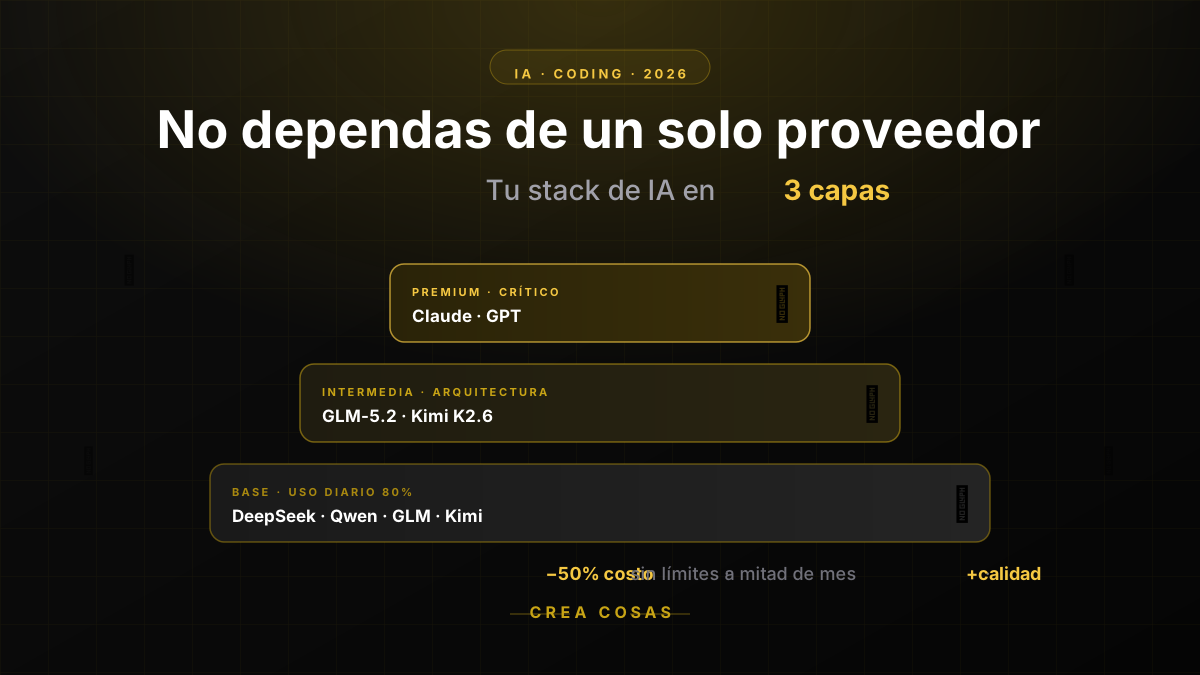
Why in 2026 You Should No Longer Rely on a Single AI Provider for Coding
If you run out of AI quota mid-month, the problem isn't your discipline: it's putting all your eggs in one basket. Learn how to diversify across DeepSeek, Qwen, GLM, Kimi, Claude and GPT to code cheaper and without interruptions.

Claude Fable 5.1: how to pick the right model
What actually changed with Claude Fable 5.1, which Claude model to use for each type of task (Fable, Opus, Sonnet, Haiku), and how to build an AI routine for your business without burning through your budget or your usage limits.
Partnerships
Tools I use every day, on better terms for this community.