Principles of Organization in Management (with Examples)
Published on:
Reading time: 9 min
Topic: Management
Author: Leandro Valencia
The principles of organizational management explained: division of work, hierarchy, unity of command, span of control, delegation, and coordination. With examples.
Table of Contents
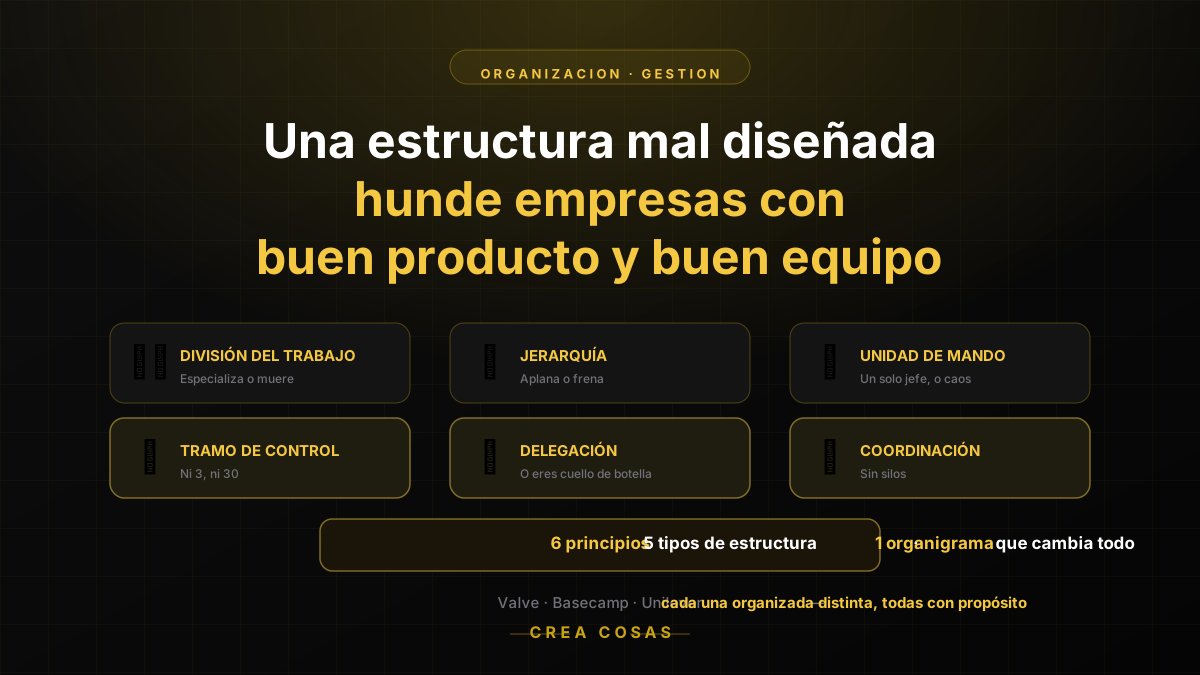
The principles of organization in management are the rules for structuring a company: division of work, hierarchy, unity of command, span of control, coordination, and delegation. They define how tasks, authority, and responsibilities are distributed so the company runs as a cohesive system instead of a chaos of good intentions.
In this guide you'll find the six key principles, the types of organizational structure, and how to put it all into an org chart. If you need broader context, start with our introduction to the principles of management (Post #1).
What is organization as a management function?
Within the four classic functions (planning, organizing, leading, controlling), organizing is the one that designs the structure the company will run on. It consists of:
- Identifying all the tasks that need to be done to reach the objectives.
- Grouping those tasks into positions and departments.
- Assigning authority and responsibilities to each position.
- Establishing the hierarchical and coordination relationships among them.
The result is the org chart: a visual representation of who does what, who reports to whom, and how information flows.
Organizing well is decisive because a poorly designed structure can sink a company with a good product and a good team. Wrong structures generate silos, slow decisions, duplicated effort, and conflict. Right structures enable speed, clarity, and focus.
The 6 principles of organization
Although different authors propose varied lists, there are six principles that capture the universal practice of business organization.
Division of work
It's the starting point: specialization. Instead of everyone doing everything (sales, production, accounting), each person focuses on one area. Result: more efficiency, more skill, less time lost to context switching.
Example: In a restaurant, there's a cook, a waiter, a cashier, and a manager. Each one specializes. If everyone did everything, chaos would be guaranteed.
Modern limit: Extreme specialization breeds boredom and fragility (if that person leaves, everything stops). That's why today we seek to combine specialization with versatility.
Hierarchy
Hierarchy is the chain of authority running top-down (and bottom-up) in the organization. Each level has a degree of authority over the level below, and answers to the one above.
Example: CEO → Marketing Director → Sales Manager → Sales Rep. Information flows both ways: objectives downward, reports and problems upward.
Modern risk: A hierarchy with too many layers creates the "telephone game": information gets distorted as it passes through layers. The current trend is to flatten the hierarchy to speed up decisions.
Unity of command
Each person should report to a single boss. If they get instructions from two, there's conflict over priorities and a dilution of responsibility.
Example: A designer who gets briefings from both the Marketing Director and the Product Director will be lost. They need a single point of reference.
Modern exception: Matrix structures deliberately break this principle (a developer reports to their tech lead and to their product manager). They work when there's clarity: each boss decides in their domain, and disputes are resolved with a protocol.
Span of control
The span of control is the number of people a manager can effectively supervise. Too wide → loss of control. Too narrow → too many managers, extra cost.
Practical rules:
- Routine, predictable work → wide span (15-30 people).
- Complex or creative work → narrow span (5-8 people).
- Mature, autonomous teams → span as wide as possible.
Common mistake: Promoting the best technician to manager and giving them a team of 12 people with no training. The span breaks and everyone suffers.
Delegation
Delegation is the mechanism by which a manager transfers authority and responsibility to a subordinate so they can make decisions on their behalf. Without delegation, everything escalates to the boss, who becomes a bottleneck.
Elements of good delegation:
- Specific task: what needs to be done.
- Sufficient authority: the power to decide what's needed.
- Clear responsibility: answering for the results.
- Limits: how far they can decide on their own, from where they must consult.
Typical mistake: Delegating the task but not the authority. "Do it, but check with me at every step." That's not delegating: it's micromanagement.
Coordination
Division of work creates specialists; coordination makes those specialists work as a team, not as isolated silos.
Coordination mechanisms (Mintzberg):
- Mutual adjustment: informal communication (typical of small teams and startups).
- Direct supervision: a manager coordinates (classic in hierarchical structures).
- Standardization: processes, norms, skills, outputs (typical of large companies).
- Rituals: dailies, weeklies, retrospectives (typical of agile teams).
Without coordination, division of work generates silos: marketing chases its KPI, sales its own, and product another. The customer notices the inconsistency.
Types of organizational structure
The principles aren't always applied the same way: they give rise to different types of structure, each useful depending on the context.
Line structure
Each person reports to a single boss, in a clear chain. Simple, easy to understand, slow for complex decisions. Typical of traditional SMEs and family businesses.
Functional structure
Departments are grouped by specialty (marketing, finance, production, HR). Efficient through specialization, but tends to create silos. Typical of mid-sized companies.
Matrix structure
Each person reports to two bosses: one functional (their specialty) and one project or product lead. Combines specialization and focus, but creates tension if not managed well. Typical of tech companies and consultancies.
Divisional structure
The company is split by products, markets, or geographies. Each division runs almost like an independent company. Typical of multinationals (Unilever, by product category).
Flat / network structure
Minimal hierarchical layers. Autonomous teams, direct communication. Fast but demands high maturity. Typical of startups and agile companies like Valve or Basecamp.
How to choose?
There's no perfect structure. It depends on:
- Size: more people, more structure.
- Industry: mass production favors functional; innovation favors matrix or flat.
- Culture: flat structures require trust-based cultures.
- Timing: what works during growth doesn't work in crisis.
Application examples
Case 1 · A neighborhood bakery
Pure line structure. The owner is baker, seller, and accountant. When growing to 3 people: split roles (baker, shop assistant, delivery). Span of control: 3 people, can be supervised directly. Unity of command: clear, everything goes through the owner.
Case 2 · A 25-person digital agency
Matrix structure. Each designer reports to the Creative Director (functional) and to the Project Manager of the client they're assigned to (project). It works if the two bosses agree on priorities; it blows up if each pulls their own way.
Case 3 · A consumer multinational
Divisional structure by categories (food, cleaning, personal care). Each division has its own marketing, sales, and production. Coordination across divisions through committees and standardized processes.
Case 4 · A software startup
Flat structure. 4 autonomous squads, each with a clear objective, with no middle manager between the team and the CEO. Coordination through dailies and weekly demos. Wide spans of control (8-12 people per squad).
Org chart: how to reflect the principles
The org chart is the visual representation of the structure. A good org chart should:
- Show a clear hierarchy: top-down levels, with no ambiguity.
- Reflect functional vs. hierarchical relationships: in a matrix, with different line styles.
- Indicate the span of control: the number of people under each manager.
- Include names and titles, not just abstract departments.
- Be up to date: an old org chart creates more confusion than having none at all.
Frequent mistake: Making an org chart and forgetting about it. A company's real structure almost never matches the official org chart. It must be updated every time there's a reorganization.
Frequently asked questions
What is organization as a management function?
It's one of the four classic functions (planning, organizing, leading, controlling). It consists of grouping tasks into positions, assigning authority, and designing the relationships between areas. The result is the org chart.
What are the principles of organization?
The six main ones are: division of work, hierarchy, unity of command, span of control, delegation, and coordination. Fayol included some of these in his 14 general principles of management.
Difference between line and matrix structure?
In a line structure, each person reports to a single boss. In a matrix, they report to two: one functional and one project lead. The matrix is more flexible but requires better conflict management.
How many people can a manager supervise?
It depends on the work. Routine tasks allow wide spans (15-30). Complex or creative work requires narrow spans (5-8). The modern rule: small, autonomous teams outperform large, supervised ones.
Why is it said that division of work creates silos?
Because when each person specializes heavily and only interacts with their own department, they lose sight of the whole. Silos are fought with coordination: shared rituals, common objectives, role rotation.
Conclusion
Organizing a company isn't "make an org chart and done." It's designing the human system that will execute the strategy. The six principles —division of work, hierarchy, unity of command, span of control, delegation, and coordination— are the rules that make that system work.
If you want to keep going deeper:
- The complete guide to administrative principles (Post #3) to see how these integrate with the rest.
- The 14 principles of Fayol (Post #2) for the historical context.
- If you lead people, you'll also want our guide to HR management principles (Post #5).
And if you're building a company, don't miss how to build a business model step by step (Post #8): organization is one of the decisions you make on day one, even if you don't realize it.
Related Posts
Keep exploring similar content that may interest you

Cheap Software Licenses on Eneba for Your Whole Team
Buy VPN, Office and software licenses on Eneba without getting the region or key type wrong. A guide to equip your team without paying list price.

Introduction to Fayol's Management and How to Apply It with Agile
An introduction to Fayol's management for today's teams: what still holds, where it clashes with Agile and OKRs, and how to turn each principle into concrete decisions.

What to Watch in Your Business to Find the Bottleneck Before It Costs You Money
The critical points of your value chain and the concrete metrics to review at each one, so you can spot bottlenecks before they turn into losses.
Partnerships
Tools I use every day, on better terms for this community.