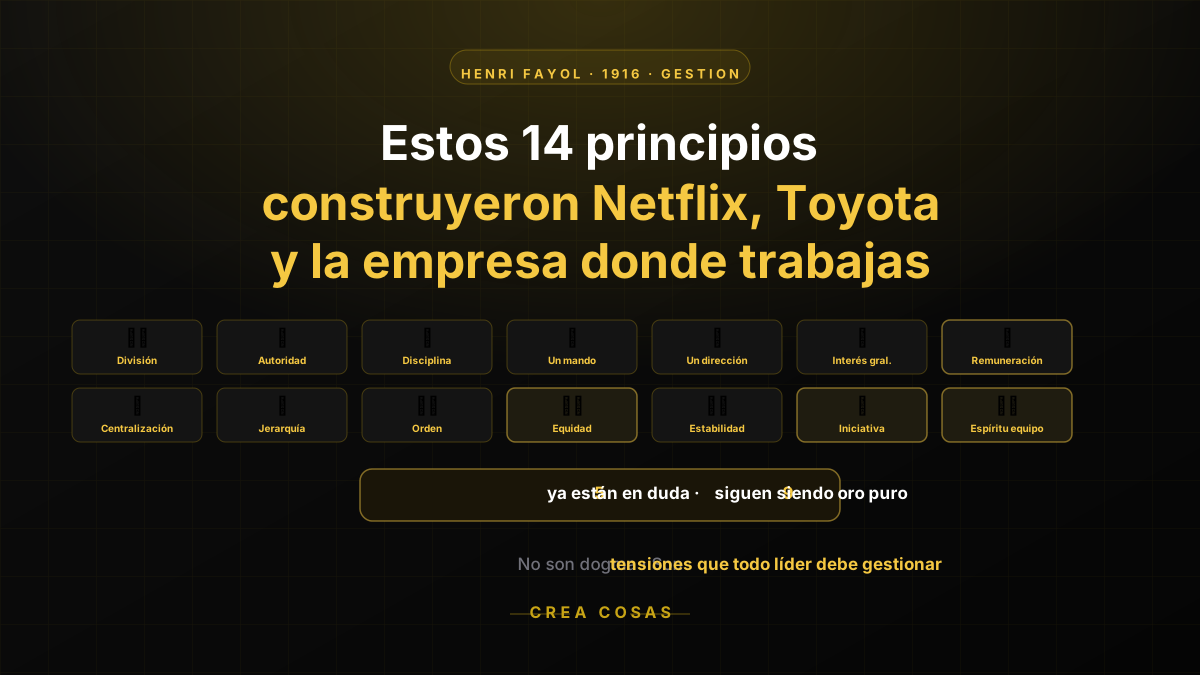
Fayol's 14 Principles: What Each One Means, with Modern Examples
Published on:
Updated on:
Reading time: 12 min
Topic: Management
Author: Leandro Valencia
Fayol's 14 principles one by one: what each principle says, a current example and how to apply it today, with a summary table at the start to review the full list.
Table of Contents
- Fayol's 14 principles in one table
- Who was Henri Fayol?
The 14 principles explained one by one
- 1. Division of Work
- 2. Authority and Responsibility
- 3. Discipline
- 4. Unity of Command
- 5. Unity of Direction
- 6. Subordination of Individual Interests to the General Interest
- 7. Remuneration
- 8. Centralization
- 9. Hierarchy (Scalar Chain)
- 10. Order
- 11. Equity
- 12. Stability of Tenure
- 13. Initiative
- 14. Team Spirit (Esprit de Corps)
- Keep reading
Henri Fayol's 14 principles of management are: division of work, authority and responsibility, discipline, unity of command, unity of direction, subordination of individual interests to the general interest, remuneration, centralization, scalar chain, order, equity, stability of tenure, initiative, and esprit de corps. Published in 1916, they remain the most widely taught framework in business management. If you want the big picture first, start with what management principles are and who formulated them.
Fayol's 14 principles in one table
| # | Principle | What it says | Current example | Status in 2026 |
|---|---|---|---|---|
| 1 | Division of Work | Specialize each person to gain efficiency | In a software team, one person owns the interface and another the servers | Relevant + versatility |
| 2 | Authority and Responsibility | Whoever decides answers for the result | The sales manager sets the targets and answers for it if the strategy fails | Relevant |
| 3 | Discipline | Keep what was agreed, on both sides | The team meets deadlines and the company pays on time | Relevant (cultural, not imposed) |
| 4 | Unity of Command | One boss per person | In an agency, each job has a single owner who assigns the work | Debated |
| 5 | Unity of Direction | One plan and one owner per objective | A single plan and a single owner for selling in another country | Relevant (OKR) |
| 6 | Subordination of Individual Interests | The common goal comes before each person's interest | Commissions that reward keeping the customer, not just closing the sale | Reinterpreted (incentives) |
| 7 | Remuneration | Pay that is fair for the person and for the company | Salary bands reviewed every year with market data | Relevant + expanded |
| 8 | Centralization | Decide how much power to concentrate for the context | With 5 people the founder decides; with 50, each area decides its own matters | Lever, not dogma |
| 9 | Hierarchy | A clear chain of command, with shortcuts when needed | Two managers at the same level solve a problem without escalating it (the bridge pass) | Flattening |
| 10 | Order | Everything and everyone in its place | In a remote team, one channel and one document for each type of decision | Relevant (Lean, matching) |
| 11 | Equity | Justice plus kindness | The same promotion criteria for everyone on the team | More relevant than ever |
| 12 | Stability of Tenure | Keep people long enough for them to perform | Onboarding and a career plan so you do not rebuild the team every six months | Relevant |
| 13 | Initiative | Let people propose and act | Anyone can try a small improvement without three approvals | Key (psych. safety) |
| 14 | Team Spirit | Cohesion is strength | Shared rituals and deliberately designed conversation spaces in a remote team | Relevant |
Who was Henri Fayol?
Henri Fayol (1841–1925) was a French mining engineer who led the Compagnie de Commentry-Fourchambault-Decazeville, a steelworks that went from the brink of bankruptcy to profitability under his management. While his contemporary Frederick Taylor studied how to make the individual worker more efficient, Fayol focused on how the entire company was directed.
In 1916 he published Administration Industrielle et Générale, where he proposed:
- Five administrative functions: to forecast, to organize, to command, to coordinate, to control (today condensed into four: planning, organizing, leading, controlling).
- The 14 principles that guide those functions.
- Six qualities that a manager should possess (physical, intellectual, moral, educational, technical, and experiential).
His contribution was so decisive that he is considered, alongside Taylor, a father of modern management. And although his work is over a century old, the principles remain surprisingly useful if you know how to adapt them.
The 14 principles explained one by one
Each principle comes with its definition, an example, and a note on how to apply it today.
1. Division of Work
Definition: Specializing each person in a specific part of the work allows for greater efficiency, because it focuses attention and reduces task-switching time.
Example: In a car factory, one person installs windshield wipers thousands of times a day. In software, a frontend developer specializes in the interface while a backend developer specializes in servers.
How to apply it today: Deep specialization remains powerful, but excess generates boredom and fragility (if that person leaves, the team stops). Modern solution: combine specialization with versatility. "T-shaped" profiles (deep in one area, capable in several) are the right balance.
2. Authority and Responsibility
Definition: Whoever gives orders has the authority to do so, but also responsibility for the results. One cannot exist without the other.
Example: A sales manager can demand targets from their team (authority), but if those targets are not met due to poor strategy, they answer for it (responsibility).
How to apply it today: Many companies break this principle by granting authority without responsibility (the classic "manager who blames the team") or responsibility without authority (the "accountable" person who cannot make any decisions). The golden rule: whoever is accountable for a result must be able to make decisions about it.
3. Discipline
Definition: Discipline is respect for the agreements established between company and workers. It is not submission: it is honoring what was agreed upon.
Example: Arriving at the agreed time, respecting delivery deadlines, following safety protocols. But also, on the company's side: paying on time, respecting breaks, fulfilling what was promised at hiring.
How to apply it today: Discipline has evolved from "obey because I say so" to "follow through because it makes sense." Companies with strong cultures (Patagonia, Basecamp) do not need to impose discipline: it emerges because people believe in what they do.
4. Unity of Command
Definition: Each person should receive orders from a single boss. If they receive instructions from two, there is conflict, confusion, and dilution of responsibility.
Example: A developer who reports to their tech lead for technical matters and to the product manager for what to build is, technically, violating this principle. In traditional companies this is avoided with a clear hierarchy.
How to apply it today: This is the most debated principle. Matrix structures and autonomous teams deliberately contradict it, and they work when there is role clarity. The modern key: even if you have two "bosses," only one decides on each matter. Ambiguity, not plurality, is the real problem.
5. Unity of Direction
Definition: Activities that pursue the same objective should be grouped under a single plan and a single leader. Do not confuse with unity of command (which refers to people); unity of direction refers to plans and objectives.
Example: If a company has three teams working on "internationalization" without coordination, there are three directions. There should be a single internationalization plan, a single leader, and everyone aligned with it.
How to apply it today: When a company grows, teams duplicate efforts without realizing it. The classic symptom: two departments building similar tools. Solution: map strategic objectives and assign an owner to each one.
6. Subordination of Individual Interests to the General Interest
Definition: The interests of the company take precedence over the individual interests of any employee (or of the manager themselves).
Example: A star salesperson who manipulates their pipeline to earn more short-term commission, damaging the long-term customer relationship, is violating this principle.
How to apply it today: Be careful not to interpret this as "the company before the person." The modern reading is more nuanced: when individual incentives become misaligned with collective objectives, the system breaks. Designing incentives well is the respectful way to apply this principle.
7. Remuneration
Definition: Remuneration must be fair and satisfactory for both the employee and the company. Neither exploitative nor excessively generous.
Example: A company that pays below market suffers turnover and loses talent. One that pays without control goes bankrupt. The middle ground requires benchmarking and transparency.
How to apply it today: Fayol already warned that remuneration is not just money: it includes recognition, autonomy, flexibility, and growth. Companies that compete only on salary always lose to those that can pay more; those that compete on purpose and conditions win.
8. Centralization
Definition: The question is not whether to concentrate or distribute decision-making power, but in what proportion to do so according to the company, its size, and its context.
Example: A 5-person startup is naturally centralized: the founder decides everything. A 100,000-employee multinational cannot function that way: it must decentralize.
How to apply it today: Centralization is neither good nor bad: it is a lever. The most effective companies adjust it dynamically. Routine operations tend to be centralized for efficiency. Complex and local decisions tend to be decentralized for speed and context. The mistake is treating it as ideology, not as a tool.
9. Hierarchy (Scalar Chain)
Definition: The hierarchy is the line of authority from top management down to the lowest levels. All information should be able to travel both ways.
Example: In a classic org chart, the CEO communicates to directors, these to managers, and these to supervisors. Information flows upward (reports, problems) and downward (instructions, objectives).
How to apply it today: Strict hierarchy falls into the "telephone game": information gets distorted as it passes through layers. Fayol himself proposed a remedy: the bridge pass (passerelle), which allows two managers at the same level to communicate directly without escalating to the CEO. It is a precursor of what we now call horizontal or cross-functional communication.
10. Order
Definition: "A place for everything, and everything in its place." Applies to the material (tools, equipment) and to the human (each person in the right role).
Example: In a professional kitchen, each utensil has a fixed position: the chef doesn't waste time searching. In a company, each person should be in the role where they add the most value.
How to apply it today: Material order is as valid as ever (Lean, 5S). Human order has evolved: today we talk about person-role matching, and about periodically reviewing that match. People change; roles do too.
11. Equity
Definition: Employees should be treated with justice and benevolence. Not just legal rectitude: also humanity.
Example: Firing someone for poor performance while complying with the law is just. Doing so with a transition plan, honest conversations, and respect for their career is equitable.
How to apply it today: Equity includes pay equity between genders, respectful treatment of people with disabilities, genuine work-life balance, and diversity. It is Fayol's most "modern" principle: his early twentieth-century formulation fits perfectly with the expectations of 2026.
12. Stability of Tenure
Definition: High turnover is costly and destabilizing. Effective companies retain their people long enough for them to deliver their best.
Example: A team that changes every 6 months never reaches the high-performance stage. Tuckman's curve (forming, storming, norming, performing) requires time.
How to apply it today: Stability does not mean a job for life. It means intentionally investing in retention: solid onboarding, career plans, a strong culture. Voluntary turnover below 10% per year is generally healthy; above 25% is a symptom of systemic problems.
13. Initiative
Definition: Allowing and encouraging employees to propose ideas and take action, within the limits of their role. Initiative is one of the great drivers of motivation.
Example: A company where every small decision requires 3 approvals kills initiative. One where delegation is clear and well-intentioned mistakes are celebrated multiplies it.
How to apply it today: "Psychological safety" is the modern version of this principle. Google identified it as the number one factor in high-performing teams in its Project Aristotle. Without safety to make mistakes, there is no initiative.
14. Team Spirit (Esprit de Corps)
Definition: Harmony and cohesion among organization members are a source of strength. "Unity is strength."
Example: A team that knows each other, trusts one another, and shares objectives outperforms another of superior individual talent but lacking unity.
How to apply it today: Cohesion cannot be decreed: it must be built. It requires shared rituals, clear common purposes, public recognition, and healthy conflict resolution. In remote teams, it demands more intention: spontaneous coffee doesn't exist — it has to be designed.
Are they still relevant today? Criticism and modern application
Here is a summary; the criticism of Fayol explains in depth why applying them as dogma holds a company back.
What remains relevant
- Division of work, equity, stability of tenure, initiative, and team spirit are more relevant than ever.
- Authority and responsibility is the foundation of modern accountability.
- Unity of direction is exactly what OKRs pursue.
What is debated
- Unity of command is deliberately broken in matrix structures and autonomous teams like Spotify's.
- Centralization is now interpreted as a lever, not as a moral principle.
- Hierarchy is flattening. The fastest companies reduce layers to accelerate decisions.
What has aged the worst
- The idea that the manager is "the one who thinks" and the worker "the one who executes." Knowledge is distributed in modern companies.
- The total absence of any mention of diversity, sustainability, or social impact. Fayol thought of the company as a machine; today we think of it as a living system.
The modern interpretation
The 14 principles are a list of tensions to manage, not dogmas to obey. The good modern manager:
- Decides when to centralize and when to decentralize.
- Maintains the minimum necessary hierarchy.
- Promotes initiative even at the cost of some disorder.
- Takes care of people not out of moralizing, but because it is the way to win.
Keep reading
- Start here: management principles: what they are, key authors and examples
- An introduction with an agile lens: Fayol's management compared with Agile
- Practical case: administrative principles in an SMB
- The critical view: criticism of Fayol and his 14 principles
Frequently asked questions
How many management principles did Fayol propose?
14, published in Administration Industrielle et Générale (1916). It is the most widely taught list, although other authors have proposed versions with 5, 11 or more principles.
Three examples of Fayol's 14 principles?
Division of work (specializing to go faster), equity (correcting unequal treatment) and unity of command (one boss per person). The rest of the list has a definition, an example and a modern application on this same page.
Which of Fayol's principles solves unequal treatment?
Equity. If a company treats people unequally, the principle that corrects it is equity: justice plus kindness, not just complying with the law.
What are the key points about authority according to Fayol?
Authority is not authoritarianism; it always comes with responsibility; operational authority can be delegated, but final responsibility is not diluted.
What is the difference between unity of command and unity of direction?
Unity of command: each person takes orders from a single boss (people). Unity of direction: each objective has a single plan and a single owner (plans).
Difference between Fayol and Taylor?
Taylor studied the efficiency of the individual worker. Fayol studied general management: the manager's functions and principles for the whole company. They are complementary.
Are Fayol's 14 principles still current?
Yes, with adaptations. Equity, initiative and team spirit are more relevant than ever. Unity of command and hierarchy are being reinterpreted in more agile structures.
The 14 principles with a current example for each one?
Yes: every principle in this article has a definition, a current example and how to apply it today. Use the table of contents to jump to the one you are asked about in an exam or a meeting.
Related Posts
Keep exploring similar content that may interest you

Introduction to Fayol's Management and How to Apply It with Agile
An introduction to Fayol's management for today's teams: what still holds, where it clashes with Agile and OKRs, and how to turn each principle into concrete decisions.

Management Principles: What They Are, Key Authors and Examples
What management principles are, who formulated them (Fayol, Taylor, Weber and Mayo) and current examples in a small business, a remote team and a startup.

Cheap Software Licenses on Eneba for Your Whole Team
Buy VPN, Office and software licenses on Eneba without getting the region or key type wrong. A guide to equip your team without paying list price.
Partnerships
Tools I use every day, on better terms for this community.