
Applying Fayol's Principles Today: Management vs Agile
Published on:
Reading time: 18 min
Topic: Management
Author: Leandro Valencia
A long-form application guide: what still holds from Fayol in a modern company, where it clashes with Agile and OKRs, and how to turn each principle into decisions.
Table of Contents
- Deep Introduction to the Topic: The Essence of Management
- Henri Fayol's Principles of Management: A Timeless Legacy
- Practical Application of the Principles in the Modern Business Environment: Concrete Examples
- Contemporary Approaches in Management: Adapting to New Times
- Relevance of Fayol's Principles in the Current Context: A Modern Perspective
- Related Modern Tools and Methodologies: Maximizing Impact
- Strategic Tips and Recommendations: Implementing the Principles Successfully
- Conclusion: An Enduring Legacy of Order, Efficiency, and Adaptability
- Keep reading
Looking for a quick introduction? Start with our short guide, What Are Management Principles?. This is the in-depth version: practical application, comparison with modern methodologies, and current management tools.
Fayol's principles of management are 14 universal rules for planning, organizing, directing, and controlling an organization, formulated by French engineer Henri Fayol in 1916. They remain the foundation most modern management theory still builds on, from how Scrum teams assign roles to how global corporations structure reporting lines. This guide breaks down all 14 principles with modern examples, shows how they compare to methodologies like Agile and Lean, and points out where they still hold up in 2026 — and where they don't.
Deep Introduction to the Topic: The Essence of Management
Management, in its broadest and most accepted definition, is both a science (due to its body of systematized knowledge, theories, and techniques) and an art (due to the need for intuition, creativity, and interpersonal skill in its application). Its fundamental purpose is to strategically plan the desired future, organize available resources (human, financial, material, technological, information), direct people's efforts toward established goals, and control performance to ensure results align with what was planned, all to reach specific objectives in an efficient manner (using the fewest resources possible) and an effective manner (achieving the proposed results).
Since the dawn of the first human organizations – from building the pyramids to managing ancient empires – this discipline has constantly evolved, adapting and responding to the profound social, economic, political, and technological changes that have marked human history.
One of the most significant and enduring milestones in the formal development of administrative theory was the formulation of the 14 principles of management by Henri Fayol (1841-1925). Fayol, a mining engineer and brilliant French theorist, is universally considered one of the founding fathers of modern management. His contributions, published mainly in his work "Administration Industrielle et Générale" (1916), laid the foundations for a more systematic and professional approach to business management.
Henri Fayol's Principles of Management: A Timeless Legacy
Henri Fayol, based on his vast experience as the director of a large mining and metallurgical company, formulated 14 fundamental principles that he considered essential and universally applicable for the good management of any type of organization, not just industrial companies. In his time, in the early 20th century, these principles were truly revolutionary. They offered a systematic structure and a coherent framework at a historical moment when business management often lacked a formalized approach and was based more on personal intuition or tradition.
Initially, his ideas were received with great interest and widely adopted in Europe, especially in his native France. They served as a solid base for organizations to face the complex challenges derived from the Second Industrial Revolution, economic expansion, and the growing complexity of business operations. Over time, and through translations and academic dissemination, his influence spread globally, indelibly marking the beginning of management as a formal discipline and a university field of study.
These principles, although conceived in a very different context from today, possess an intrinsic wisdom and a fundamental logic that allows them to remain surprisingly relevant and applicable in 21st-century organizations.
Let's look at a detailed summary of each of Fayol's 14 principles:
| No. | Fayol Principle | Detailed Description | Key Modern Implication |
|---|---|---|---|
| 1 | Division of Work | Specialization of tasks allows individuals to build experience, improve skills, and be more efficient and productive. | Specialized roles in agile teams (e.g., Product Owner, Scrum Master), functional departments (Marketing, Finance). |
| 2 | Authority and Responsibility | Authority is the right to give orders and the power to exact obedience. This must be accompanied by an equivalent responsibility for results. | Leaders with decision-making power who are accountable for their teams' performance. Empowerment of employees with responsibility over their projects. |
| 3 | Discipline | Obedience, application, energy, and respect for rules and agreements established between the company and its employees. Essential for smooth operation. | Codes of conduct, clear internal policies, compliance with SLAs (Service Level Agreements), strong organizational culture. |
| 4 | Unity of Command | Each employee should receive orders and instructions from only one direct superior. This avoids authority conflicts and confusion. | Although matrix structures challenge this, clarity in the reporting line for performance evaluation remains crucial. |
| 5 | Unity of Direction | All organizational activities having the same objective must be directed by one manager and use a single plan. | Strategic alignment of all departments toward the company's vision. Unified product leadership for a product line. |
| 6 | Subordination of Individual Interest to General Interest | The interests of one or more employees should not prevail over the interests and goals of the organization as a whole. | Decisions based on the common good of the company, professional ethics, management transparency to avoid conflicts of interest. |
| 7 | Remuneration | Compensation for work performed must be fair, equitable, and satisfactory for both employees and the organization. | Total compensation systems (salary, bonuses, benefits, development), pay equity, performance recognition. |
| 8 | Centralization (vs. Decentralization) | The degree to which decision-making authority is concentrated at the upper hierarchy levels or delegated to lower levels. Optimum degree depends on context. | Business models combining centers of excellence (centralized) with operational autonomy in business units (decentralized). |
| 9 | Scalar Chain (Hierarchy) | The line of authority ranging from the highest level to the lowest in the organization. Communication should follow this chain, except for justified exceptions (Fayol's "bridge"). | Clear organizational charts, though with more fluid and horizontal communication channels facilitated by technology. |
| 10 | Order | A place for everything and everything in its place; a position for everyone and everyone in their position (Material Order and Social Order). |
Well-defined work processes (BPM), efficient inventory management, organized workspaces (physical and digital), clear job profiles. |
| 11 | Equity | Kindness and justice in dealing with employees to foster loyalty, devotion, and motivation. A combination of benevolence and justice. | Diversity, equity, and inclusion (DEI) policies, fair and impartial treatment, merit-based growth opportunities. |
| 12 | Stability of Tenure of Personnel | High employee turnover is both a cause and effect of poor management and is detrimental to efficiency. Talent retention should be sought. | Employee retention programs, investment in career development, creating a good work environment to reduce turnover. |
| 13 | Initiative | The ability to conceive and execute a plan. Initiative at all organizational levels should be encouraged and stimulated. | Innovation culture, empowerment to propose improvements, intrapreneurship, spaces for experimentation (e.g., Google's "20% time"). |
| 14 | Esprit de Corps (Team Spirit) | Harmony, cohesion, and unity among organization members are a great source of strength. Foster teamwork and communication. | Team building activities, fostering interdepartmental collaboration, transparent communication, leadership that inspires unity. |
“To manage is to forecast and to plan, to organize, to command, to coordinate and to control.” - Henri Fayol. This quote summarizes the five main functions of management according to Fayol, which complement his 14 principles.
Practical Application of the Principles in the Modern Business Environment: Concrete Examples
These principles are not mere theoretical abstractions; they have direct, tangible, and observable applications in the day-to-day of modern organizations. Let's look at some additional examples illustrating their validity:
- Division of Work:
- Classic Example: On an automobile assembly line, each worker specializes in a specific task (installing doors, mounting engines, painting bodies), which increases speed and precision.
- Modern Example: In a digital marketing agency, there are specialized roles like
SEO Specialist,Content Creator,PPC Manager,Social Media Manager, each focused on one area to maximize campaign effectiveness. - Unity of Command:
- Classic Example: A soldier in an army receives orders from a single sergeant or captain to avoid confusion on the battlefield.
- Modern Example: In a software development company using agile methodologies, although a developer collaborates with multiple stakeholders, for their performance evaluation and main task assignment, they usually report to a specific Engineering Manager or Team Lead.
- Equity:
- Classic Example: A foreman who treats all his workers fairly and without favoritism, earning their respect and loyalty.
- Modern Example: Companies that implement robust diversity, equity, and inclusion (DEI) policies, ensuring equal opportunities in hiring, promotion, and remuneration, regardless of gender, ethnic origin, sexual orientation, etc. This is not only ethical but improves morale and innovation.
- Initiative:
- Classic Example: A factory employee suggesting an improvement in the production process that saves time and materials.
- Modern Example: Tech companies like Google that institutionalized "20% Time," allowing engineers to dedicate part of their work time to personal projects that could benefit the company. Many innovations, like Gmail, emerged from this policy.
- Stability of Personnel:
- Classic Example: A craft workshop where masters teach apprentices for years, ensuring knowledge transmission and quality.
- Modern Example: Tech companies investing heavily in benefits, professional development, and a positive work environment to retain their star engineers and designers, knowing that the cost of replacing them (in terms of recruitment, training, and loss of tacit knowledge) is extremely high.
High turnover is a symptom of underlying problems.
Contemporary Approaches in Management: Adapting to New Times
While Fayol's principles provide a solid foundation, the 21st-century business environment – characterized by globalization, technological disruption, speed of change, and greater social and environmental awareness – has driven the development and adoption of complementary and, in some cases, more adaptive management approaches. These approaches do not necessarily invalidate classic principles; they often reinterpret them, nuance them, or apply them in novel ways. Some of the most prominent include:
- Agile Management:
- Description: Born in the software development world (Agile Manifesto, 2001), this philosophy has expanded to many other areas. It focuses on flexibility, intense collaboration (with the customer and within the team), frequent and incremental value delivery, and rapid adaptation to changes.
- Key Principles: Individuals and interactions over processes and tools; working software over comprehensive documentation; customer collaboration over contract negotiation; responding to change over following a plan.
- Relationship with Fayol: Although Agile may seem to challenge the "scalar chain" or "unity of command" with self-organizing teams, principles like "esprit de corps," "initiative," and a form of "division of work" (roles in Scrum like Product Owner, Scrum Master, Development Team) are fundamental.
- Customer-Centric Management:
- Description: An approach that places the customer at the epicenter of all organizational decisions and processes. Inspired by disciplines like User Experience (UX), Service Design, and Relationship Marketing, it seeks to deeply understand customer needs, desires, and pain points to offer solutions and experiences that generate loyalty.
- Key Principles: Customer empathy, creation of customer journeys, personalization, continuous feedback, value co-creation.
- Relationship with Fayol: "Unity of direction" is reinterpreted as aligning the entire organization toward customer satisfaction. "Remuneration" can be linked to customer satisfaction metrics (NPS, CSAT).
- Transformational Leadership:
- Description: A leadership model where leaders inspire and motivate their followers to transcend their individual interests for the good of the team and the organization, and to reach extraordinary performance levels. They focus on the development of their collaborators and on creating a compelling vision of the future.
- Pillars (the "4 Is"): Idealized Influence (being a role model), Inspirational Motivation (communicating an attractive vision), Intellectual Stimulation (encouraging creativity and critical thinking), Individualized Consideration (attending to the development needs of each follower).
- Relationship with Fayol: Resonates strongly with "initiative," "esprit de corps," and "subordination of individual interest to the general interest" (but achieved through inspiration rather than mere obedience).
- Data-Driven Management:
- Description: Uses data and analysis to inform and guide strategic and operational decision-making, rather than relying solely on intuition or experience.
- Tools:
Business Intelligence (BI),Big Data Analytics,Machine Learning. - Relationship with Fayol: The principle of "order" (having the right info in the right place) and the "control" function are enormously boosted by this approach.
Relevance of Fayol's Principles in the Current Context: A Modern Perspective
Although some critics might label Fayol's principles as "classic" or even "outdated" in the era of artificial intelligence, the metaverse, and liquid organizations, their fundamental essence and underlying logic remain deeply applicable and valuable. The key lies in their intelligent reinterpretation and adaptation to contemporary challenges and opportunities.
- "Unity of direction," for example, today focuses on aligning multidisciplinary teams, often geographically distributed and working remotely, toward a common goal in complex and dynamic projects. Tools like
OKRs (Objectives and Key Results)help materialize this principle. - "Authority and responsibility" adapt to flatter and more horizontal organizational structures, where leadership is often shared or distributed, and collaborative decision-making is the norm. Employee empowerment is a modern manifestation of this principle.
- "Scalar chain" (hierarchy) might seem rigid, but the need for clear communication channels and problem escalation still exists, though now complemented by more informal communication networks and collaborative tools (
Slack,Teams) that allow for more fluid "bridges." - "Division of work" remains crucial, but now combined with the need for more flexible roles, "T-shaped" skills (depth in one area, breadth in others), and greater interdisciplinary collaboration.
In an environment where organizations face unprecedented global challenges like accelerated digitalization, environmental and social sustainability, and cultural diversity management, principles like "unity of direction" (toward sustainable goals), "stability of tenure" (in a competitive talent market), "equity" (in its broadest DEI conception), and "esprit de corps" (in diverse and remote teams) are reinterpreted and revitalized to foster more conscious management, aligned with ethical values, promoting inclusion, organizational resilience, and continuous innovation.
Warning: Applying Fayol's principles in a dogmatic and rigid way, without considering the specific context of the organization and the current environment, would be an error. Their true power lies in their flexibility and the wisdom to adapt them.
Related Modern Tools and Methodologies: Maximizing Impact
The effective application of classic management principles can be significantly boosted through the use of modern management tools and methodologies. These do not replace the principles but offer practical ways to implement and optimize them:
- Impact Mapping:
- Description: A visual strategic planning technique helping teams align their activities and deliverables with business goals and desired impacts on key actors' behavior.
- Relationship with Principles: Helps solidify "unity of direction" and "subordination of individual interest to general interest," ensuring all efforts contribute to higher goals.
- User Story Mapping:
- Description: A collaborative technique mainly used in agile development to organize and prioritize work from the user's perspective. It visualizes the user journey and functionalities needed to satisfy their needs.
- Relationship with Principles: Facilitates "division of work" into tasks centered on user value and promotes "esprit de corps" through collaboration in its creation.
- OKRs (Objectives and Key Results):
- Description: A collaborative and outcome-based goal-setting framework popularized by companies like Intel and Google. It consists of defining ambitious and inspiring Objectives, and measurable Key Results indicating progress toward those objectives.
- Relationship with Principles: Reinforces "unity of direction" by aligning the whole organization, "authority and responsibility" by assigning owners to KRs, and "initiative" by encouraging challenging goals.
- Balanced Scorecard:
- Description: A strategic management framework allowing organizations to translate their vision and strategy into a coherent set of performance indicators, organized in four perspectives: financial, customer, internal processes, and learning and growth.
- Relationship with Principles: Supports Fayol's "control" function comprehensively and helps balance different aspects of "remuneration" (based on multidimensional performance) and "discipline" (toward achieving strategic goals).
- Project Management Software (e.g., Jira, Asana, Trello):
- Description: Platforms facilitating planning, tracking, collaboration, and management of tasks and projects.
- Relationship with Principles: Directly support "division of work," "order," "scalar chain" (through approval flows), and "esprit de corps" (via centralized communication).
Strategic Tips and Recommendations: Implementing the Principles Successfully
Applying management principles effectively is not a matter of following a recipe word for word, but of adapting them with intelligence and sensitivity to each organization's unique context. Here are some key tips:
- Deeply Evaluate Your Organization's Specific Needs:
- Not all principles will have the same relevance or applicability in all companies or at all stages of their development. Perform a diagnosis to identify which are most critical or where the greatest opportunity areas exist for your particular case.
- Example: An early-stage startup might prioritize "initiative" and "esprit de corps" over a very rigid "scalar chain."
- Adapt Them Creatively to the Modern Context and Your Culture:
- Reinterpret the principles so they resonate with current challenges and values of your sector and organization, such as sustainability, digital transformation, diversity and inclusion, and employee well-being.
- Example: The principle of "order" in a software company can mean having well-organized code repositories (
Git), clear documentation, and efficientCI/CDprocesses.
- Combine Classic Principles with Agile and Flexible Approaches:
- Do not see Fayol's principles and agile methodologies as mutually exclusive. Look for synergies. For example, Fayol's "unity of direction" can guide product vision in a Scrum team.
- Foster collaboration, transparent communication, and rapid adaptation to changes, which are Agile hallmarks.
- Promote Continuous Training in Leadership and Management:
- Invest in developing leadership and management skills at all levels of your team. Ensure leaders understand not only the "whats" but also the "hows" and "whys" of these principles.
- Effective leadership is crucial to bringing these principles to life.
- Foster Communication and Transparency at All Levels:
- Many principles (unity of command, unity of direction, esprit de corps, equity) depend on clear, open, and two-way communication.
- Use multiple channels and ensure relevant info flows appropriately.
- Constantly Measure, Review, and Adjust (PDCA Cycle):
- Applying management principles is not a one-time event, but a continuous process of improvement (Plan-Do-Check-Act).
- Establish metrics to evaluate your management initiatives' impact and be prepared to adjust your approach based on results and feedback.
Conclusion: An Enduring Legacy of Order, Efficiency, and Adaptability
The principles of management, especially those articulated by Henri Fayol, represent an intellectual legacy of incalculable value. They are a timeless guide that, when understood in their essence and combined with the wisdom of modern approaches and tools, can radically transform how we manage our organizations and lead our teams.
Adapting them with intelligence and sensitivity to the contemporary context not only ensures their continued relevance but also maximizes their positive impact on achieving strategic goals, building solid, cohesive, high-performance teams, and fostering a healthy and sustainable organizational culture.
Management, in its fundamental quest, is a reflection of the human desire for order, efficiency, and purpose in our collective enterprises. Management principles not only guide organizations toward tangible success but also reveal the perennial importance of collaboration, professional ethics, justice, shared vision, and adaptability in a world characterized by constant change and increasing complexity.
Frequently Asked Questions
How many of Fayol's principles are still used today?
Most of the 14 still apply, though several are reinterpreted for flat, remote, and matrixed organizations. Unity of command and rigid scalar chains are the two most challenged by modern team structures.
What's the difference between Fayol's principles and Agile?
Agile is a delivery methodology; Fayol's principles are structural rules for running an organization. They overlap more than they conflict — division of work, initiative, and esprit de corps all show up inside Scrum roles and ceremonies.
Do small businesses and startups need all 14 principles?
No. Early-stage teams get more value from initiative, esprit de corps, and unity of direction than from a strict scalar chain. Apply the principles that match your current stage, not the full list at once.
Where should I start if I only have time for one thing?
Pick the principle your team violates most often — usually unity of command or unity of direction — and fix that first. Our short guide to what management principles are is a faster read if you need the basics before working through all 14.
Fayol's principles are more than a history lesson: they're still one of the fastest ways to diagnose why a team is stuck — confused reporting lines, no shared direction, no room for initiative. Pick the principle your organization is weakest on, apply it for a month, and measure what changes.
Keep reading
- Start here: What are management principles?
- The full list: Fayol's 14 principles, one by one
- Real case: Administrative principles in a real small business
Related Posts
Keep exploring similar content that may interest you

What Are Management Principles? Definition and Examples
A clear definition of management principles, what they are for, and simple examples. The quick entry point before you work through Fayol's 14 one by one.
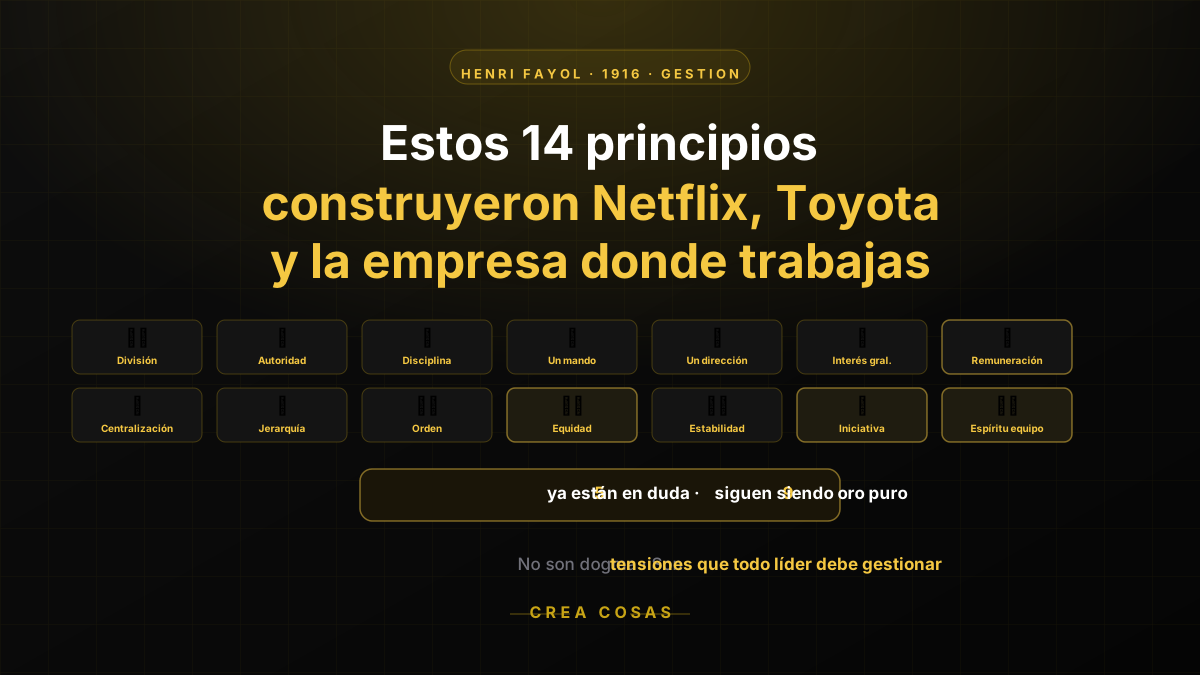
Fayol's 14 Principles of Management (Explained with Examples)
Henri Fayol's 14 principles explained one by one, with real examples and a summary table. The complete list, for when you already know what they are.
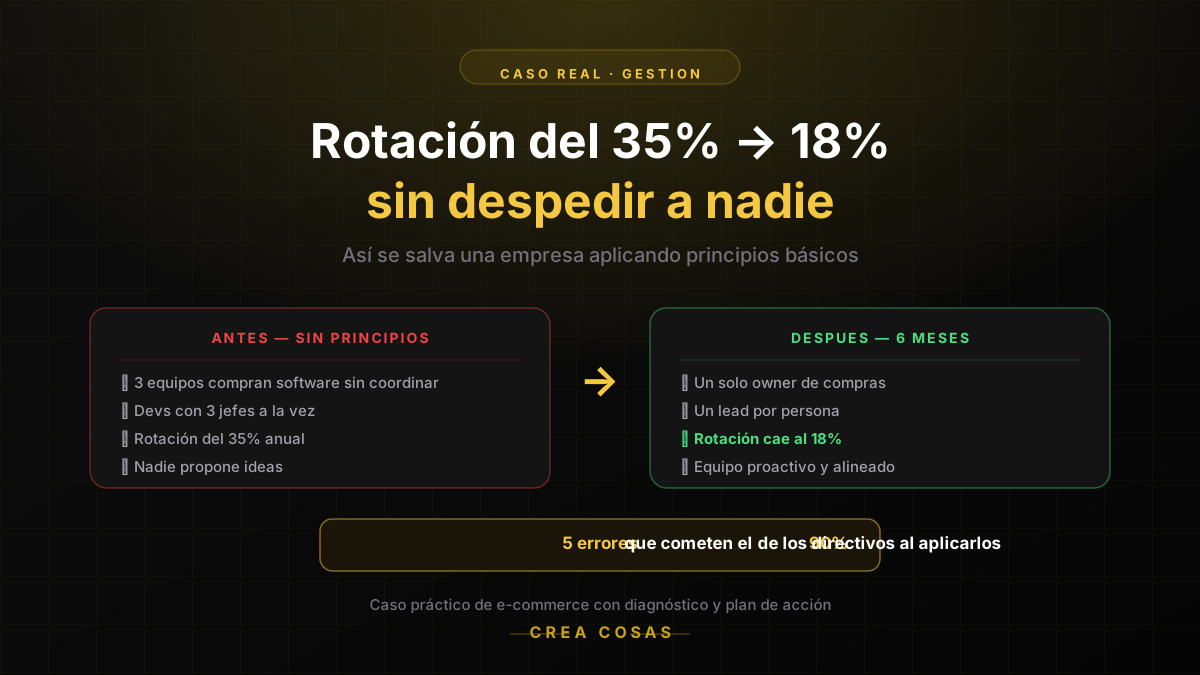
Administrative Principles: A Real Small-Business Case Study
Administrative principles applied to a real small business: what was measured, what changed, and what results it produced. A step-by-step case study, not theory.
Partnerships
Tools I use every day, on better terms for this community.