
Management Principles: What They Are, Key Authors and Examples
Published on:
Updated on:
Reading time: 8 min
Topic: Management
Author: Leandro Valencia
What management principles are, who formulated them (Fayol, Taylor, Weber and Mayo) and current examples in a small business, a remote team and a startup.
Table of Contents
- Definition of management principles
- Origin: Henri Fayol's 14 principles
- What are management principles for?
- The 4 management processes
- Characteristics of administrative principles
- Management principles by author
- Difference between principles, functions and processes
- Are they still relevant today?
- Keep reading
Management principles are the universal rules that guide how a company plans, organizes, directs and controls its work. They were formulated by the French engineer Henri Fayol in the early twentieth century and they are still the foundation of modern management. Their goal is simple: help a group of people reach common goals efficiently, making good use of the resources available.
In this guide you will see what they are, who formulated them, what they are for and how they are applied today, with examples. If you already have the basics, continue with Fayol's 14 principles one by one, with examples or with the introduction to Fayol's management compared with Agile.
Definition of management principles
A principle, in management terms, is not a fixed physical law. It is a fundamental truth that has guided the behavior of managers for more than a century. Fayol described them as "reference points" that adapt to each situation, not as rigid rules.
More specifically, management principles are:
- Universal: they apply to any kind of organization (company, NGO, government, sports club).
- Guiding: they inform decisions rather than dictate them. A good manager knows when to bend them.
- Interrelated: none of them works alone. Division of work without coordination creates chaos.
- Practical: they came from observing real factories, not from pure theory.
The key word is efficiency: getting the best result with the fewest resources (time, money, people). Principles exist to reduce waste.
Origin: Henri Fayol's 14 principles
Henri Fayol (1841–1925) was a French mining engineer who ran the Commentry-Fourchambault-Decazeville steel company for decades. Unlike Frederick Taylor, who studied the efficiency of the worker at their station, Fayol looked from the top: he cared about how the whole company was run.
In his book Administration Industrielle et Générale (1916) he proposed:
- The 5 management functions (forecasting, organizing, commanding, coordinating and controlling — later condensed into 4: planning, organizing, directing and controlling).
- The 14 principles that guided them.
- A set of qualities a manager should have.
They were so influential that for decades Western management was built on them. Today they are considered classics: useful, but to be combined with modern approaches (agile, distributed leadership, systems thinking).
What are management principles for?
They help to:
- Reduce improvisation. Without principles, every decision starts from scratch. Principles offer shortcuts: "when facing this dilemma, this is what usually works".
- Align a team. If the whole leadership shares the same principles, decisions are consistent across departments.
- Train new managers. A new department head can start with a frame of reference instead of learning by trial and error.
- Diagnose problems. Many business conflicts are violations of a principle: confusion over who gives orders (against unity of command), lack of initiative (against the principle of initiative), high turnover (against stability of tenure).
- Scale the company. What works with 10 people breaks with 100, and breaks again with 1,000. Principles help you anticipate those breaking points.
The 4 management processes
This is where the most common confusion appears: what is the difference between principles and processes?
- Processes are the 4 big phases of management work.
- Principles are the rules that guide how those phases are carried out.
| Process | What happens | Key associated principle |
|---|---|---|
| Planning | Setting goals and how to reach them | Unity of direction |
| Organizing | Assigning tasks, authority and resources | Division of work |
| Directing | Motivating, communicating and guiding people | Unity of command, equity |
| Controlling | Measuring results and correcting deviations | Discipline, responsibility |
Without processes there is no management. Without principles, processes become chaotic. You need both.
Characteristics of administrative principles
- They are universal but flexible. They apply in any context, but adapt to culture, size and sector.
- They are indicative. They are not laws: they guide, they do not force.
- They are complementary. Some seem contradictory (centralization vs. decentralization); the manager's craft is to balance them for each moment.
- They evolve. Fayol formulated 14; today people debate which ones still hold and how to reinterpret them in agile or remote companies.
- They can be taught and learned. They are not a manager's "natural gift": you study them, practice them and get better at them.
If you want to see these principles applied end to end in a real organization, the administrative principles case in a small business follows them step by step.
Management principles by author
Although Fayol is the name most associated with management principles, the history is richer. Four classical authors explain almost everything that is taught today:
| Author | Approach | Key principles | More detail |
|---|---|---|---|
| Henri Fayol (1916) | General management: how the whole company is run | 14 principles, including division of work, unity of command, scalar chain and equity | Fayol's 14 principles |
| Frederick Taylor (1911) | Scientific management: the efficiency of individual work | Scientific study of each task, selection and training of workers, cooperation between management and workers, division of responsibility | Foundations of management |
| Max Weber (1922) | Bureaucracy: an organization based on rules | Clear hierarchy, written rules, impersonality, selection and promotion on merit | Foundations of management |
| Elton Mayo (1924–1932) | Human relations: the human factor at work | Motivation, belonging to the group and informal relationships, based on the Hawthorne experiments | — |
Fayol won the cultural battle over "principles", but modern management draws on all four.
Current examples
A service business and unity of command
A ten-person agency receives requests from the owner, from the account manager and sometimes straight from the client. Each designer ends up with three lists of priorities. Applying unity of command does not require more hierarchy: it is enough that each request has a single owner who assigns the work, and that everyone else asks through them.
A remote team and order
In a team spread across several time zones, the principle of order ("a place for everything and everything in its place") turns into documents and channels: where decisions are made, where they are recorded and where questions go. Without that order, the team loses hours searching for information or repeating meetings.
A startup that breaks unity of command
A tech startup gives each developer two leads: a technical one (tech lead) and a product one (product manager). This breaks classical unity of command, but it works in highly uncertain contexts. It is an example of how principles are adapted, not applied dogmatically.
Toyota and division of work
Toyota organizes its plants into small teams with tightly defined but rotating tasks. Division of work is extreme (each operator knows exactly what to do), but rotation prevents boredom and supports continuous improvement (the principle of initiative).
Difference between principles, functions and processes
| Concept | Definition | Example |
|---|---|---|
| Principle | Guiding rule | "Unity of command" |
| Function | Large area of management work | "Planning" |
| Process | Sequence of steps to carry out a function | "Annual strategic planning" |
| Technique | Specific tool | "SWOT analysis" |
- Principles say why and in which direction.
- Functions say what has to be done.
- Processes say how, step by step.
- Techniques are the tools you use at each step.
Are they still relevant today?
Yes, with nuances. Principles are not applied in 2026 the way they were in 1916:
- Division of work: still valid, but complemented by versatility (T-shaped skills).
- Unity of command: in question. Matrix structures and autonomous teams challenge it.
- Hierarchy: flatter, but it still exists.
- Initiative and stability of tenure: more relevant than ever in the war for talent.
The mistake is not using the principles, but applying them as dogma. The criticism of Fayol explains where that dogma holds a company back. The companies that work best today reinterpret them in light of culture, technology and purpose.
Keep reading
- Practical case: administrative principles in a small business
- The complete list: Fayol's 14 principles, one by one
- An introduction with an agile lens: Fayol's management compared with Agile
- The critical view: criticism of Fayol and his 14 principles
- The theoretical framework: foundations and characteristics of management
- How an organization is structured: principles of organization in management
- People: human resource principles
Frequently asked questions
What are management principles?
They are guiding rules for how an organization plans, organizes, directs and controls its work to reach its goals efficiently. They are not rigid laws: they adapt to the size, culture and sector of each company.
How many management principles are there?
There is no single number. Fayol proposed 14 and that is the most widely taught list; other authors work with lists of 5 to 11 principles, or with different approaches, such as Taylor's scientific management or Weber's bureaucracy.
What are Fayol's 14 principles?
Division of work, authority, discipline, unity of command, unity of direction, subordination of individual interest to the general interest, remuneration, centralization, scalar chain, order, equity, stability of tenure, initiative and esprit de corps. The article on Fayol's 14 principles covers them one by one, each with a current example.
What is the difference between administrative principles and management principles?
In practice they are used as synonyms. Management principles usually refers to the general framework of the classical authors; administrative principles usually refers to how that framework is applied inside a specific organization.
Who created management principles?
The Frenchman Henri Fayol formalized them in 1916 in Administration Industrielle et Générale. Before him, Frederick Taylor had studied the efficiency of individual work; later, Max Weber described bureaucracy and Elton Mayo added the human factor.
Are they still relevant today?
Yes, with adaptations. Division of work, equity or initiative are still useful; unity of command or a strict hierarchy are debated in matrix structures, autonomous teams and remote work.
How do you apply them in a small business?
Start with the problems you already have: if nobody knows who decides, apply unity of command; if tasks overlap, division of work and order; if people leave, stability of tenure and equity. Two or three principles applied well beat all 14 on a poster.
What is the difference between administration and management?
Practically none today. Administration is the classical term, associated with Fayol; management is the more common modern word. They are used as synonyms.
Related Posts
Keep exploring similar content that may interest you

Introduction to Fayol's Management and How to Apply It with Agile
An introduction to Fayol's management for today's teams: what still holds, where it clashes with Agile and OKRs, and how to turn each principle into concrete decisions.
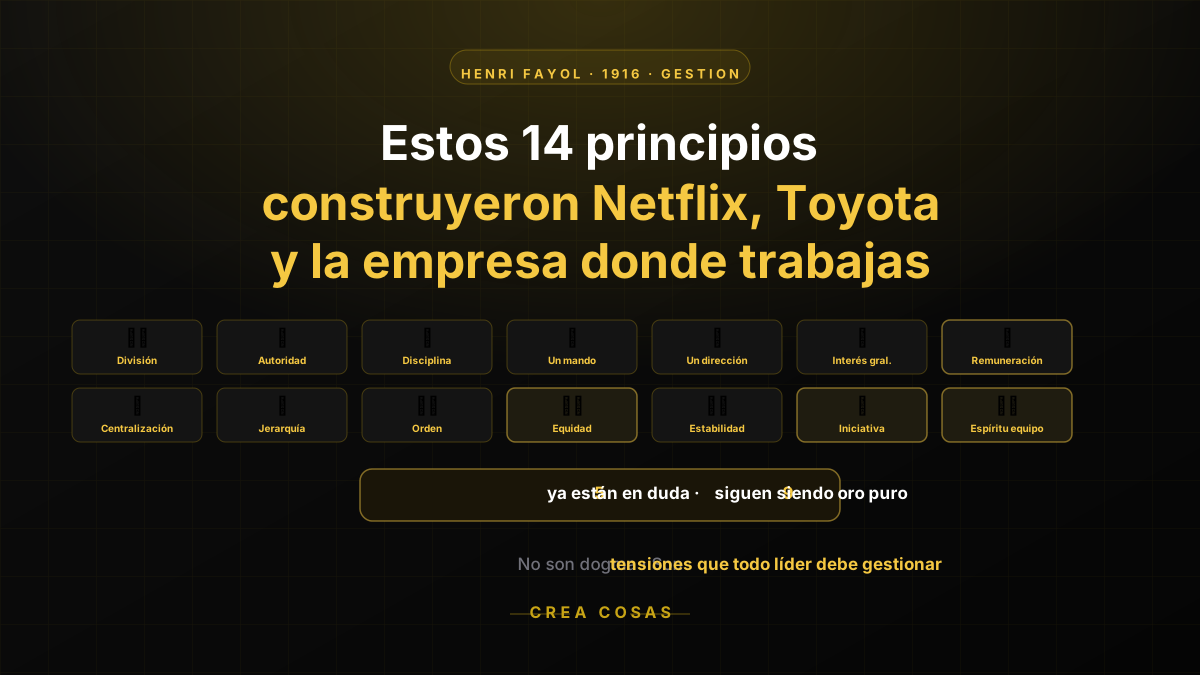
Fayol's 14 Principles: What Each One Means, with Modern Examples
Fayol's 14 principles one by one: what each principle says, a current example and how to apply it today, with a summary table at the start to review the full list.
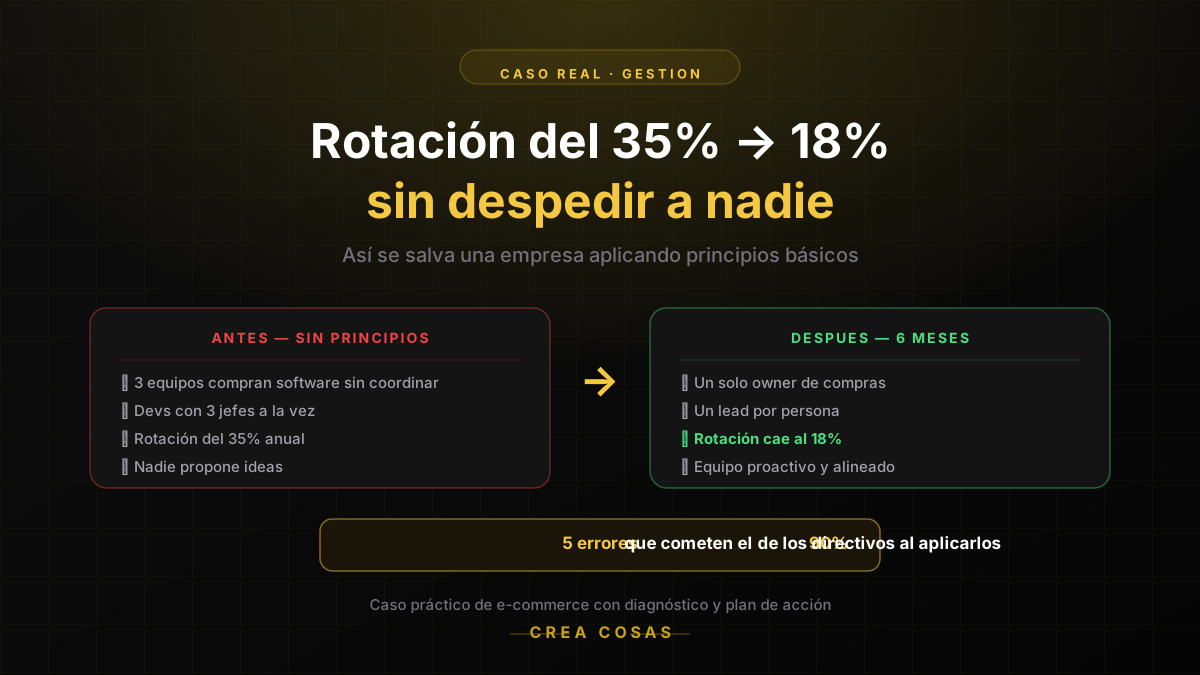
Administrative Principles: What They Are, with a Practical SMB Case
What administrative principles are, how they differ from functions and processes, and how to apply them step by step in a practical case of an e-commerce SMB.
Partnerships
Tools I use every day, on better terms for this community.