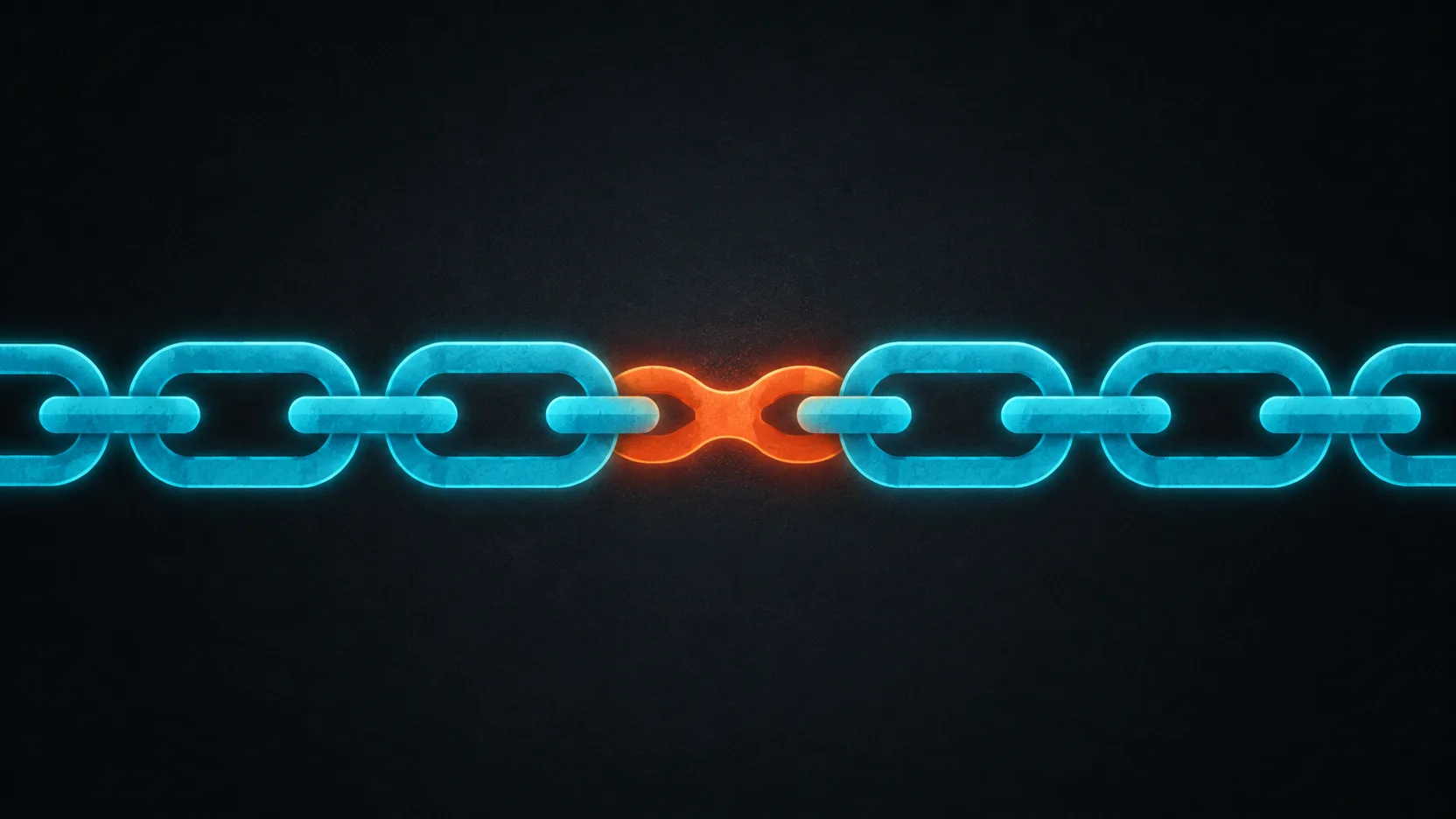
What to Watch in Your Business to Find the Bottleneck Before It Costs You Money
Published on:
Reading time: 8 min
Topic: Management
Author: Leandro Valencia
The critical points of your value chain and the concrete metrics to review at each one, so you can spot bottlenecks before they turn into losses.
Table of Contents
- The idea you need to understand before measuring anything
- The three signals that give away a bottleneck
- The three cross-cutting metrics worth more than a dashboard
- How to set up the watch without losing your mind
- The mistakes that always repeat
- Where to start this week
Most small businesses measure one thing: how much they sold. It is the most tempting metric because it is the only one that feels real. The problem is that sales are the end of a long chain, and when the number drops, the damage has been happening for weeks at some point nobody was watching.
A bottleneck almost never announces itself. It disguises itself as "we're at full capacity", as "that week was weird", as a client who left without saying why. And in the meantime it keeps setting the pace for everything else.
The idea you need to understand before measuring anything
Your business is a chain of conversions. Someone doesn't know you and becomes aware of you. They ask a question and become a buyer. They buy and receive. They receive and pay. They pay and come back. Each of those steps takes something from the previous one and hands it to the next.
In any chain like this, there is one link that is slower than the rest, and that link defines the speed of the whole system. It is the constraint. If your real limit is that you can only produce 40 orders a week, investing in more advertising doesn't give you more sales: it gives you more angry customers waiting.
From there comes the practical rule: improving any part that isn't the constraint doesn't improve the business. It just moves the problem somewhere else and burns your money along the way. That's why watching is not about filling a dashboard; it's about finding where the plug is.
The three signals that give away a bottleneck
Before the metrics, learn to read the physical signals. They always show up in the same place.
- Where work piles up. Undispatched orders, unanswered emails, open tickets, unsent quotes, idle inventory. Whatever stacks up right before a stage points straight at that stage.
- Where everyone waits. If three people on the team can't move forward until someone approves, reviews or designs something, that person is the constraint.
- Where there is always urgency. The area that lives putting out fires, working nights and asking for "one more day" is not the one doing the worst work. It is usually the one that is saturated.
If all three point to the same place, you've found it. You don't need software for that; you need to walk the process.
What to watch at each link in the chain
These are the stages where small businesses burst, with the concrete metric worth watching at each one. Don't adopt them all. Pick one per stage.
1. Demand capture
What breaks: people arrive but you don't serve them in time, or people arrive who were never going to buy.
- First response time. How long passes between someone asking and someone answering. It is the most profitable and most ignored metric of all.
- Volume of new contacts per week, broken out by channel. Without separating by channel, the number doesn't tell you what to do.
- Cost of acquiring a customer, even calculated by hand.
2. Conversion
What breaks: you talk to many, close with few, and you don't know at which point they fall off.
- Close rate on qualified contacts.
- Length of the sales cycle. If it rises, something changed: the price, the message or the competition.
- Loss reasons. Write one line on why each negotiation fell through. Three months of that is worth more than any market study.
3. Production or delivery
This is where the bottleneck lives in most businesses that already sell.
- Lead time: from the moment the customer buys to when they receive. It is what the customer experiences.
- Work in progress (WIP): how many orders or projects you have open at the same time. When it rises and lead time rises with it, you are accepting more than you can deliver.
- Rework: what percentage has to be redone, corrected or returned. Rework consumes your constraint's capacity twice.
- On-time delivery. Not the average — the percentage of times you delivered when promised.
4. Suppliers and inputs
What breaks: your chain depends on a link you don't control.
- Real delivery time of each supplier, compared with what they promise.
- Concentration: what percentage of your critical inputs comes from a single supplier. If anything goes past 60%, you have a time bomb.
- Stockouts or days unable to produce for lack of material.
5. Cash and collection
A profitable business can die here, and it usually does so quietly.
- Average days to collect. Invoicing is not the same as collecting.
- Overdue receivables by age: 30, 60, 90 days.
- Real margin per product or service, with the costs it truly carries, including your time. There is almost always a star product losing money.
6. After-sales and retention
- Repurchase or renewal rate.
- Grouped complaint reasons. Don't count complaints, group them. Five different complaints are noise. The same complaint five times is a process defect.
7. People and knowledge
The most common bottleneck in small businesses is not a machine. It is a person, and a lot of the time it is you.
- Tasks only one person knows how to do. Each one is a single point of failure. Count them.
- How much of your week goes into tasks nobody else can do for lack of documentation, not for lack of talent.
The three cross-cutting metrics worth more than a dashboard
If you could only watch three numbers, I would pick these:
| Metric | What it tells you | Alarm signal |
|---|---|---|
| Total lead time | How long value takes to cross your business | Rises two periods in a row |
| WIP (open work) | How much you are trying to do at once | Rises while delivery doesn't |
| Flow efficiency | Of the total time, how much was real work | Below 15% |
Flow efficiency is the most revealing one. It is calculated by dividing the time someone actually worked on the order by the total time the order spent in your business. In most small operations it is below 10%. That is: 90% of the time, the work is waiting. That's where the money is, not in making people work faster.
How to set up the watch without losing your mind
- Pick five to seven numbers. Not one more. A thirty-indicator board never gets reviewed.
- Define the threshold before looking at the data. Write down today which value you consider normal, which one is an alert and which one is a crisis. If you define the threshold after seeing the number, you will always convince yourself that it's fine.
- Give it a fixed cadence. Operations weekly, money monthly, strategy quarterly. Half an hour, same day, no exceptions.
- Watch the trend, not the data point. One bad number is noise. Three periods in the same direction is information.
- Record the cause, not just the figure. Next to each number, write one line about what happened. In six months you will have the history that no software gives you.
The mistakes that always repeat
Optimizing the wrong link because it's the easiest to improve. Confusing being busy with producing. Measuring only money, the latest indicator of all. Accepting more work than the constraint can handle because saying no is scary. And building a beautiful dashboard nobody opens by the second month.
Where to start this week
Take a sheet of paper and draw your complete value chain, from the first time someone hears your name to the moment they buy from you again. Mark where work piles up, where someone waits and where there are emergencies. Pick one single indicator for that point and measure it four weeks in a row.
With that you will know more about your business than any report can tell you. And when you fix that constraint, another one will appear somewhere else. That is not a failure, it's how it works: the constraint always moves, and your job is knowing where it is now.
If you want to build this system of indicators step by step with guidance, we work on it in depth at leotransforma.co.
Frequently asked questions
What is a bottleneck in a business?
It is the link in your value chain that runs slower than the rest and therefore sets the pace of the entire system. It is also called the constraint: no matter how much you speed up every other area, the whole business cannot move faster than that point. It can be a machine, a supplier, a collection process or, most common of all, a person.
How do I identify my company's bottleneck?
With three physical signals: where work piles up (undispatched orders, unanswered emails), where everyone waits for someone to approve or review something, and where there is always urgency and firefighting. If all three signals point to the same place, that is where the constraint is. You don't need software to find it: you need to walk the entire process.
Why doesn't improving something that isn't the constraint improve the business?
Because the total capacity of the system is set by the constraint, not by the other stages. If you can only produce 40 orders a week and you invest in more advertising, you don't sell more: you pile up more dissatisfied customers waiting. Improving a link that isn't the plug only moves the problem somewhere else and burns resources along the way. It is the core idea of the theory of constraints.
What is lead time and why should I measure it?
It is the total time that passes from the moment the customer buys until they receive what they bought. It is the metric that best reflects what the customer experiences with your business. The alarm signal is when it rises two periods in a row: it means you are accepting more work than your constraint can process.
What is flow efficiency and how is it calculated?
It is calculated by dividing the time someone actually worked on an order by the total time that order spent in your business, multiplied by one hundred. In most small operations it is below 10%: for the remaining 90% of the time, the work is waiting. Below 15%, it is worth investigating where the flow stops, because that is where the lost money is.
Related Posts
Keep exploring similar content that may interest you
Administrative Principles: What They Are, with a Practical SMB Case
What administrative principles are, how they differ from functions and processes, and how to apply them step by step in a practical case of an e-commerce SMB.

How to manage a project when you don't know what you're building
A method for managing projects under uncertainty: the minimum viable team, safe bets vs. R&D, vertical slices, and knowing when to hire or raise money.

Cheap Software Licenses on Eneba for Your Whole Team
Buy VPN, Office and software licenses on Eneba without getting the region or key type wrong. A guide to equip your team without paying list price.
Partnerships
Tools I use every day, on better terms for this community.