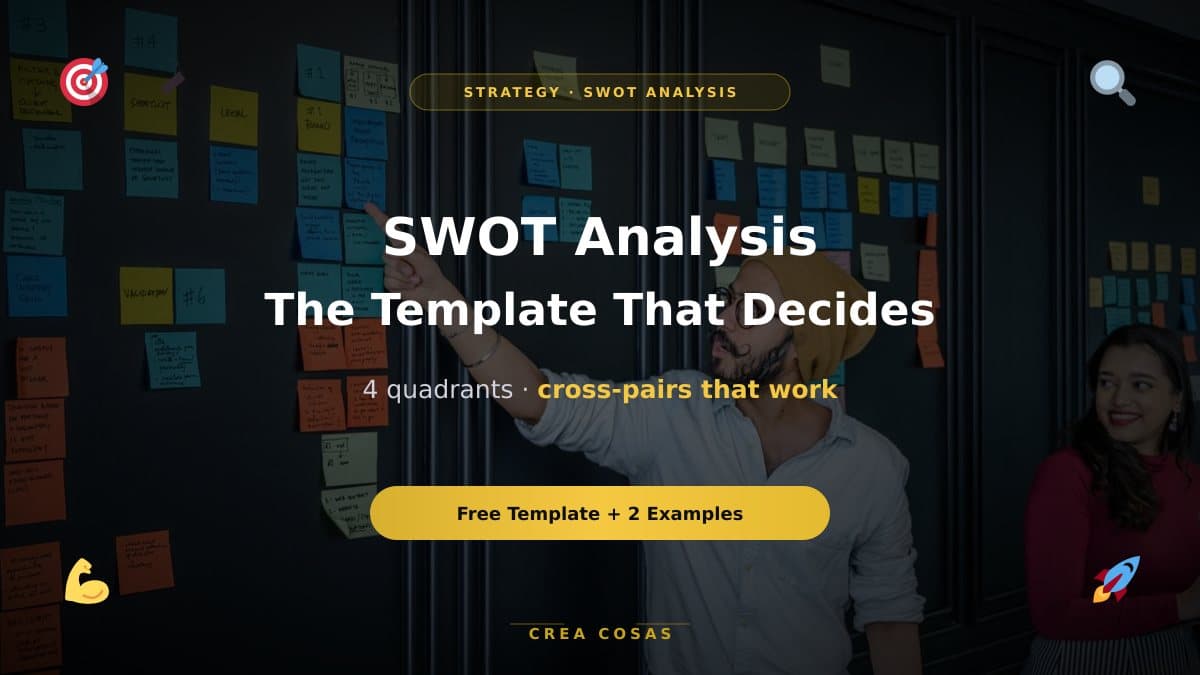
SWOT Analysis: What It Is and How to Do It (With Template)
Published on:
Reading time: 9 min
Topic: Strategy
Author: Leandro Valencia
What a SWOT analysis is, how to do it without generic statements, a ready-to-copy template, and 2 full examples: a coffee shop and a freelance consultancy.
Table of Contents
- What SWOT analysis is and why it works
- The SWOT template (copy it as is)
- The cross-pairs: where SWOT becomes a decision
- Example 1: a specialty coffee shop with one location
- Example 2: a freelance digital marketing consultant
- Mistakes that make a SWOT useless
- SWOT vs. other strategy frameworks
A SWOT analysis (also called DAFO or FODA) is a four-quadrant matrix — strengths, weaknesses, opportunities and threats — that lays out, on a single page, what your business controls and what it doesn't. What makes it useful isn't drawing the grid: done right, it separates what depends on you (strengths and weaknesses, internal) from what doesn't (opportunities and threats, external), and that avoids the most common planning mistake: treating a market problem as if it could be fixed with internal effort, or the other way around.
The real problem with SWOT isn't the tool. It's that almost everyone fills it in with generic statements ("good customer service," "the competition," "the economy") that are useless for deciding anything. This guide is about avoiding that: what goes in each quadrant, how to cross them so you get actions out of it, and two full examples you can copy and adapt.
What SWOT analysis is and why it works
SWOT stands for Strengths, Weaknesses, Opportunities and Threats. In Spain it's usually called DAFO; in Latin America, FODA. Same analysis, just a different order of the same four letters.
The matrix splits information along two axes that are rarely explained well:
- Internal vs. external. Strengths and weaknesses are yours: your team, your product, your cash, your brand. Opportunities and threats belong to the environment: the market, competitors, regulation, technology. You can change the internal side with a decision. You can take advantage of the external side, or guard against it, but you don't control it.
- Positive vs. negative. Strengths and opportunities work in your favor. Weaknesses and threats work against you.
When you mix the two axes — for example, writing "inflation" as a weakness — the analysis stops being useful, because inflation isn't something your business can fix internally. It belongs under threats. That's the first filter, and the one most people skip.
How to do a SWOT analysis step by step
1. Strengths: what you do better than most, with evidence
This isn't a list of nice qualities. It's a list of advantages you can defend if someone asks "why?". "Good service" isn't a strength if you can't say better than what, and how you know. On the other hand, "we reply on WhatsApp in under 10 minutes, measured over the last three months" is.
Ask yourself: what does your business do that a competitor would have a hard time copying quickly? It could be a relationship with a supplier, a loyal customer community, a specific technical skill, a location, or a structurally lower cost (not from selling cheap and losing margin).
2. Weaknesses: what's holding you back, without sugarcoating
This is where most people lie, because nobody wants to write down their own flaws. The useful filter: a weakness is something that, if fixed, would change a business outcome. "We don't have enough social media presence" is only a real weakness if you can tie it to something that's costing you sales.
Typical examples in a small business or freelance operation: depending on one person for everything, not having a system to track clients (check the guide to choosing a CRM if this is you), a tight cash flow, or not knowing what each sale actually costs you — the guide on how to calculate your selling price helps with that.
3. Opportunities: changes in the environment you can capture
These aren't wishes ("things going better"). They're real changes happening outside your business that you can capture if you move: a competitor that closed, a sales channel that's growing, a regulatory change that favors your sector, a consumption trend.
The test for whether something is a real opportunity: if you did nothing, would someone else grab it? If yes, it's an urgent opportunity. If the answer is "it'll still be there," it's an opportunity without urgency, and it can wait on the list.
4. Threats: what could happen to you, not what you're already feeling
Threats are also external, but negative: a new competitor with more capital, a rising cost for a key input, a concentrated client that's too much of your revenue, a platform you depend on (Instagram, a marketplace, a payment gateway) changing its rules.
Key difference from weaknesses: a threat exists even if your business were perfect. If 70% of your sales come from a single client, that's a structural threat, not a management flaw you can fix by "working harder."
The SWOT template (copy it as is)
STRENGTHS (internal, for you)        | WEAKNESSES (internal, against you)
- ___________________________        | - ___________________________
- ___________________________        | - ___________________________
- ___________________________        | - ___________________________
--------------------------------------------------------------------
OPPORTUNITIES (external, for you)    | THREATS (external, against you)
- ___________________________        | - ___________________________
- ___________________________        | - ___________________________
- ___________________________        | - ___________________________
Three bullets per quadrant are enough. A list of fifteen "strengths" isn't an analysis, it's a way of not deciding anything.
The cross-pairs: where SWOT becomes a decision
This is the part almost nobody does, and it's what turns a nice-looking matrix into a list of actions. Cross the quadrants two at a time:
| Cross-pair | Question | What it produces |
|---|---|---|
| Strength + Opportunity | Which strength do I attack this opportunity with? | Where to invest first |
| Weakness + Threat | Which combination could sink me? | The risk to solve right now |
| Strength + Threat | What do I defend myself with against this threat? | The plan if things get rough |
| Weakness + Opportunity | What am I missing out on by not fixing this? | What to fix before someone else does |
Each cell of this table, filled in with your own SWOT, should end up as a sentence with a verb and a date. Not "improve customer service," but "answer WhatsApp in under 10 minutes starting Monday, with an automatic message outside business hours."
Example 1: a specialty coffee shop with one location
| For you | Against you | |
|---|---|---|
| Internal | Strengths: direct relationship with three coffee farms · barista with 8 years of experience · office-district location | Weaknesses: depends on a single location with no backup plan if rent rises · no loyalty system, every customer feels new each time · nobody else knows how to roast if the manager is out |
| External | Opportunities: the office district is growing with new buildings · demand for home-delivery coffee subscriptions with no strong local competitor | Threats: a big chain announced an opening three blocks away · green coffee prices rose 18% over the last year |
Cross-pairs that matter. Strength (relationship with the farms) + opportunity (subscription with no competitor) = launch a monthly coffee-bean subscription before the chain opens and before anyone else does. Weakness (one location) + threat (big chain) = that same subscription also reduces dependence on foot traffic, which is exactly what the new chain is going to take away.
Example 2: a freelance digital marketing consultant
| For you | Against you | |
|---|---|---|
| Internal | Strengths: 6 years of real case studies in the same niche (restaurants) · bills two U.S. clients in dollars | Weaknesses: all revenue depends on 3 clients · no signed contract with one of them |
| External | Opportunities: more local restaurants are looking for social media presence after the delivery boom · there are restaurant-owner communities she's never pitched to | Threats: generative AI tools are pushing down the price clients expect to pay for content |
Cross-pairs that matter. Weakness (3 clients concentrate everything) + threat (AI pushing prices down) = the most urgent risk of both examples: if one of those three clients leaves right when the market is pushing prices down, there's no cushion. The action isn't "get more clients" in the abstract, it's formalizing the missing contract this week — check essential contracts for freelancers — and using the strength (real restaurant case studies) to get into those owner communities, which is the opportunity nobody has captured yet.
Mistakes that make a SWOT useless
Writing the same thing in all four quadrants with different words. If "lack of marketing" shows up as a weakness and "do more marketing" as an opportunity, you didn't learn anything new, you just repeated it twice.
Confusing internal with external. "The competition" isn't a weakness, it's a threat (it's external). "Not enough capital" isn't a threat, it's a weakness (it's internal, even if something external caused it).
Doing it alone, once. A SWOT built by one person repeats that person's own blind spots. If you have a partner, a team, or even a couple of trusted clients, ask them what they'd put in each quadrant before calling it done.
Stopping at the matrix. If the document stays at the four quadrants and never reaches the cross-pair table, you did a diagnostic exercise, not a strategic one. A SWOT is only as good as its cross-pairs.
SWOT vs. other strategy frameworks
SWOT diagnoses where you stand today. It doesn't tell you which strategy to follow next — for that there are complementary frameworks: Porter's Five Forces look specifically at how tough competition is in your sector, and the Business Model Canvas describes how the whole business operates, block by block. If you're coming from either of those and need to turn them into measurable goals, the OKR vs. KPI guide is the natural next step.
Frequently asked questions
Is SWOT the same as DAFO or FODA?
Yes. SWOT (Strengths, Weaknesses, Opportunities, Threats) is the same analysis as DAFO (used in Spain) and FODA (used in Latin America), just with the letters in a different order.
How often should I redo my business's SWOT analysis?
There's no fixed schedule. It makes sense to redo it when something big changes: a new competitor shows up, you change your pricing, you launch a new product line, or a year has gone by and you want to check whether the threats you wrote down are still real. A SWOT you never revisit turns into an old photograph.
Does SWOT work for a freelancer, not just a company?
Yes, and it's often more honest: the freelancer is the product, so strengths and weaknesses get more personal (a skill, a language, the lack of a network), and the decisions that come out of the analysis are easier to execute because there's no one else to convince.
What do I do after filling in the matrix?
What matters isn't the matrix, it's the cross-pairs: strength plus opportunity (where to attack), weakness plus threat (what could sink you), strength plus threat (what you defend yourself with), and weakness plus opportunity (what you're missing out on by not fixing something). Each cross-pair should produce a concrete action with a date, not a loose idea.
Related Posts
Keep exploring similar content that may interest you
Porter's Five Forces Applied to Your Small Business (With Example)
What Porter's Five Forces are, how to apply them to a small business or freelancer in 2026, with a full example: rivalry, suppliers, buyers and substitutes.
How to build a pitch deck that raises investment: structure, examples and common mistakes
The structure of a 10-12 slide pitch deck (problem, solution, market, product, model, traction, team, competition and ask), what doesn't belong on each slide, and the mistakes that make an investor close the file.
OKR vs KPI: which goal system to use based on your team's size
KPIs measure the ongoing health of the business; OKRs mark the change you want to force in a cycle. When to use each if you're alone, on a team of 3-10 or 10-50, with LATAM examples.
Partnerships
Tools I use every day, on better terms for this community.