
Business Productivity: What It Is, How to Measure and Improve It
Published on:
Reading time: 11 min
Topic: Productivity
Author: Leandro Valencia
What business productivity is, what drives it, how to measure it with simple indicators and how to improve it in short cycles, with small-business examples.
Table of Contents
- Why it matters in a small business
- Factors that influence productivity
- People: motivation, trust and autonomy
- Tools and artificial intelligence: where they really help
- Common mistakes that slow down productivity
Business productivity is what your company gets out of the resources it uses: time, people, money and technology. Improving it does not mean working more hours. It means measuring well, removing what slows you down and deciding with data what deserves your energy. In this guide we explain how to do it step by step, with examples written for entrepreneurs and small teams.
In short:
- Productivity means producing more value with the same resources. It is calculated by dividing what you produce by what you consume.
- Internal factors (people, processes, technology, knowledge) you can change; external ones (economy, regulation, energy) you must understand.
- Start with one simple indicator and track its trend month by month.
- Put the process in order first, then add tools: technology on top of a broken process only speeds up the breakdown.
- A short cycle of measuring, testing and learning works better than a large annual plan.
What business productivity is
The International Labour Organization (ILO) describes productivity as the efficiency with which people, companies and economies use their resources to produce goods and services. Put simply: how much result you get for every euro, hour or machine you put in.
In practice, it is an organization's ability to use human, technological, financial and material resources efficiently to generate more value. That is why it is broader than labor productivity, which only looks at work.
Business productivity and labor productivity
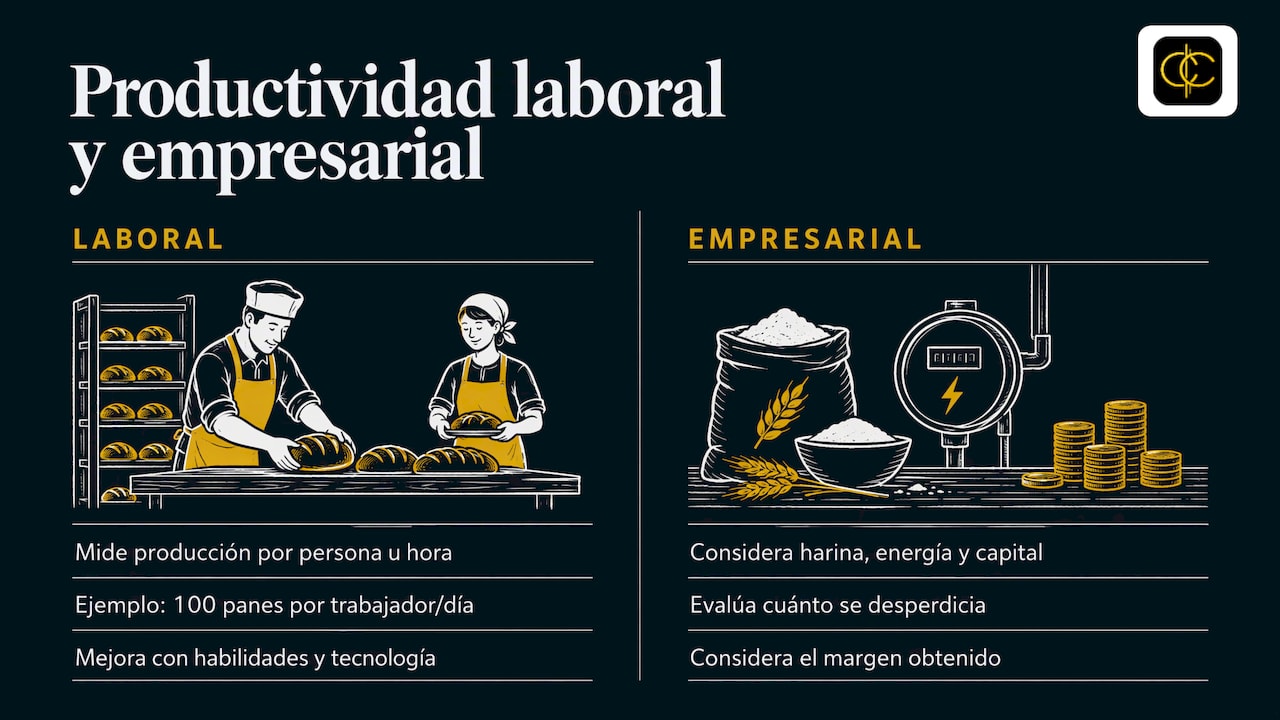
The ILO defines labor productivity as the volume of output per person employed or per hour worked, and notes that it also rises with better skills, better machinery or technological innovation, not only with individual effort.
For example: a bakery that produces 500 loaves a day with 5 employees has a labor productivity of 100 loaves per worker per day. Business productivity adds more questions: how much flour, energy and capital were used? How much was thrown away? How much margin was left?
This distinction helps you avoid a very common mistake: demanding more from people when the bottleneck is in the process, the tool or the price.
Why it matters in a small business
The ILO stresses that numerous studies show productivity contributes to higher profits, business growth and wages, and to lower prices for consumers. For an entrepreneur, this means something concrete: more capacity without hiring right away, more margin to invest and less personal burnout.
According to a McKinsey analysis of small businesses, SMEs can reach higher productivity by building four capabilities: technology, human capital, market access and financing. It is a useful map for spotting the area where you lack support.
Factors that influence productivity
Academic research groups them into two blocks. Bustos Flores distinguishes internal factors (labor, machinery and equipment, knowledge, technology and innovation) from external ones (structural changes in the economy, regulations, infrastructure, energy and tax measures). A systematic review of 71 studies in Latin America agrees on separating the factors outside management's reach from those that depend on its decisions.
For a small business, the useful table is this one:
| Factor | Type | What you can do |
|---|---|---|
| Team skills and motivation | Internal | Train, delegate with clarity, give autonomy |
| Processes and work organization | Internal | Document, remove steps, prioritize |
| Technology and software | Internal | Automate repetitive tasks once the process is in order |
| Knowledge and innovation | Internal | Test small ideas and learn fast |
| Regulation, taxes, energy | External | Anticipate and reflect it in prices and planning |
| Market economic conditions | External | Diversify clients and validate demand |
A document on productivity in Spain adds that capital invested per employee, R&D and the use of ICT also have an influence. Your real room for action is in the internal half: that is where you should focus your effort.
How to measure business productivity
What is not measured cannot be improved, but measuring too much also paralyzes. The ILO explains that productivity can be calculated for all factors combined (multifactor productivity) or for each factor separately, and that at company level it helps track it over time and compare it with others. An academic guide adds that partial measures, which relate output to one input such as labor or capital, are commonly used.
The base formula is:
Productivity = output obtained ÷ resources used
Simple indicators to start with
- Per hour worked: revenue or units produced ÷ total team hours.
- Per person: monthly revenue ÷ number of people.
- Of capital: revenue ÷ investment in equipment or software.
- Of process: time from when an order comes in until it is delivered.
- Of quality: percentage of deliveries with no errors or rework.
An illustrative example
Imagine a three-person design studio that bills €9,000 a month with 480 hours of work: €18.75 per hour. After streamlining its proposal and template process, it bills €9,600 with 440 hours: €21.82 per hour, a 16% increase without working more. The change did not come from effort, but from removing hours that generated no value. (The figures are made up and only illustrate the calculation.)
Also keep an eye on your margin. Raising revenue with badly calculated prices can reduce what you actually earn. With the profit margin and selling price calculator you can check that each product or service leaves the profit you expect before deciding where to invest your time.
How to improve business productivity step by step
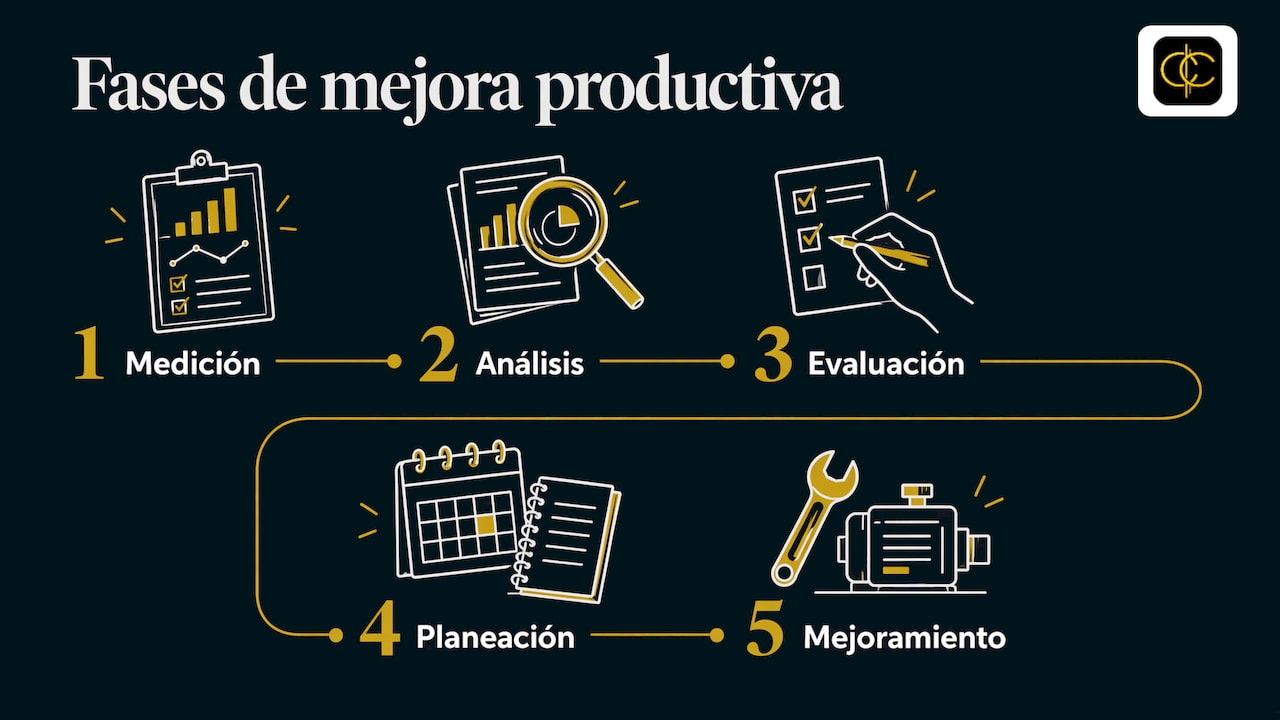
The productivity management manual of Mexico's Ministry of Labor, aimed at SMEs, presents it as a deliberate, structured and cyclical process with low-cost solutions. An academic book published by ECORFAN proposes tackling it in five phases: measurement, analysis, evaluation, planning and improvement. That cycle logic is the same as in agile methodologies. Here is how we apply it to a small business.
1. Pick one indicator and set your starting point
Just one. For example, revenue per hour worked. Note the value for the last four weeks. Without a baseline you will not know whether something worked. The typical mistake is starting with ten indicators and abandoning them by the second week.
2. Find the bottleneck
Map the path of an order or project, from the moment it arrives until it is paid. Mark where it waits, where work is repeated and where decisions are made too late. Usually two or three points explain most of the loss. If you need a guide, see how to find bottlenecks in the value chain or how to detect money leaks. And if you are not yet clear about your model, the Business Model Canvas template helps you see customers, value proposition, channels and costs on one page.
3. Prioritize by impact, not by urgency
List the tasks, estimate their impact on your indicator and the effort they require. Do high-impact, low-effort work first. Whatever is urgent but moves nothing gets delegated, automated or eliminated; the Eisenhower matrix helps you sort it.
4. Define roles and automate what is repetitive
Anything you do more than three times a month deserves a template, a checklist or an automation. Define who decides what: a lot of waste comes from tasks nobody knows belong to them.
5. Test in short cycles
Change one thing for two weeks, measure it and decide whether to keep it. This is agile thinking applied to the business: small iterations, fast learning, low risk. Avoid reorganizing everything at once, because you will not know what worked.
6. Account for the learning curve
Bustos Flores recalls, citing Hayes and Clark, that a new machine initially causes a drop in efficiency while the team learns to use it, with indirect costs that can last more than a year. The same happens with new software: plan time for adoption and do not switch tools every quarter.
7. Document and repeat
The Mexican manual includes, among its principles, documenting experiences and learning by doing. Write down what you changed, what result you got and what you will do next. That way improvement stops depending on your memory.
People: motivation, trust and autonomy
Training someone is not enough. A study by ACDE and the IDB in Uruguay argues that, beyond skills, a person must be motivated, and will only stay motivated if they see that their work benefits both the company and themselves, which is why trust is key. Among the conditions it sets for an improvement program to work are sharing benefits fairly, being transparent with information and negotiating goals.
Another useful clue: giving the team the power to decide how to do a task increases motivation and allows creativity to be used, and productivity gains often come from lower absenteeism and turnover rather than from how the job is designed.
If you lead a team, three concrete habits:
- Explain the why behind each goal, not just the what.
- Let each person choose the method once the result is clear.
- Share the improvements: if the team saves time, they should also feel it.
You will find more ideas in our leadership and productivity sections.
Tools and artificial intelligence: where they really help
Technology can free up hours, but the data calls for realism. A study by Repsol, Microsoft and Opinno with 8,000 participants (half using Copilot for Microsoft 365 and half as a control group) found a potential saving of 183 minutes per person per week and an average improvement of 18 percentage points in the quality of deliverables. Adjusted for real usage, the time that turns into productivity is around 30 minutes a week per person.
Glean's Work AI Index 2026, cited by Entrepreneur en Español, reports that 75% of knowledge workers feel AI makes them more productive, but only 13% believe it has significantly improved their organization's performance. The useful takeaway: a tool performs when it rests on a clear process. That is why the order is measure, organize and only then automate.
Criteria for choosing software without wasting time:
- It solves a bottleneck you have already identified.
- It integrates with what you already use.
- Your team can adopt it in weeks, not months.
- Its cost fits within the margin you calculated.
If you are looking for options by category (software, AI and code, servers, customer support), see our recommendations and the free tools for entrepreneurs.
Common mistakes that slow down productivity
- Confusing activity with results. Being busy is not the same as producing value. Measure outputs, not hours at your desk.
- Wanting to improve everything at once. One change per cycle, with its indicator.
- Buying tools before understanding the problem. Process first, then software.
- Ignoring external factors. Changes in costs, regulation or demand alter your numbers even if you work just as well.
- Deciding without data. Review your indicator and your margin once a month, and adjust.
- Forgetting the team. Without trust and participation, improvements do not last.
To decide better between several options, the strategy and management sections are also useful.
Frequently asked questions
What is business productivity in one sentence?
It is how efficiently a company turns its resources (people, money, technology and materials) into valuable goods or services. It is expressed as output divided by the resources used, and it lets you compare your business with itself over time.
How can I improve business productivity if I run a small business?
Pick one indicator, find the main bottleneck and change just one thing for two weeks. Measure the result, document what you learned and repeat. Then add automations and tools on top of a process that is already in order.
What are the most important productivity factors?
The internal ones, which depend on your decisions: people's skills and motivation, how work is organized, technology, knowledge and innovation. The external ones, such as the economy, regulation or energy, you cannot control, but you should factor them into your planning.
Which productivity indicators should I use?
To start, partial ones are enough: revenue or units per hour worked, per person or per euro invested. Add one for quality and one for delivery time. What matters is measuring them the same way every time and reviewing them regularly.
Does artificial intelligence improve my company's productivity?
It can save time on specific tasks, and some studies put that potential saving at hours per week. The effect on the whole organization depends on having a clear process, so start with one repetitive task and measure how much time you get back.
Step-by-step guide
Pick one indicator
Just one, such as revenue per hour worked, averaged over the last four weeks.
Find the bottleneck
Map the path of one order and mark where it waits, gets repeated or is decided too late.
Prioritize by impact
Do high-impact, low-effort work first; delegate or eliminate urgent tasks that move nothing.
Test in short cycles
Change one thing for two weeks, measure it and decide whether to keep it.
Document and repeat
Note what you changed and what result you got so you do not rely on your memory.
Frequently asked questions
What is business productivity in one sentence?
It is how efficiently a company turns its resources (people, money, technology and materials) into valuable goods or services. It is expressed as output divided by the resources used, and it lets you compare your business with itself over time.
How can I improve business productivity if I run a small business?
Pick one indicator, find the main bottleneck and change just one thing for two weeks. Measure the result, document what you learned and repeat. Then add automations and tools on top of a process that is already in order.
What are the most important productivity factors?
The internal ones, which depend on your decisions: people's skills and motivation, how work is organized, technology, knowledge and innovation. The external ones, such as the economy, regulation or energy, you cannot control, but you should factor them into your planning.
Which productivity indicators should I use?
To start, partial ones are enough: revenue or units per hour worked, per person or per euro invested. Add one for quality and one for delivery time. What matters is measuring them the same way every time and reviewing them regularly.
Does artificial intelligence improve my company's productivity?
It can save time on specific tasks, and some studies put that potential saving at hours per week. The effect on the whole organization depends on having a clear process, so start with one repetitive task and measure how much time you get back.
Related Posts
Keep exploring similar content that may interest you

Eisenhower Matrix: How to Prioritize Tasks (With Examples)
How to use the Eisenhower matrix to prioritize urgent and important tasks, with a founder's real week as an example and the mistakes that ruin it.

How to Use TikTok to Get Smarter (Train the Algorithm)
How to train the TikTok algorithm so it works in your favor: clean up your feed, plant what you actually want to learn, and use the app on purpose.

How to Adapt to Uncertainty When Technology Changes Every Month
Uncertainty in the AI era isn't solved by predicting the future, but by building systems that can afford to be wrong. A practical method for creators and entrepreneurs.
Partnerships
Tools I use every day, on better terms for this community.