
Cash Flow: What It Is, How to Calculate and Manage It
Published on:
Reading time: 9 min
Topic: Management
Author: Leandro Valencia
Learn what cash flow is, how to calculate it with the direct and indirect methods, which types exist, and which habits keep you from running out of cash.
Table of Contents
- Why it matters so much in a small business
- Economic and financial cash flow
- A 20-minute weekly routine
Cash flow is the money that actually comes into and goes out of your business over a period: collections minus payments. It is not what you have sold, it is what you have collected. That difference explains why a company with profits can run out of money to pay payroll, and why someone who learns to measure their cash makes much clearer decisions.
This guide covers the definition, the two formulas, an example with numbers, the types of cash flow worth separating, and a simple weekly routine so cash does not catch you by surprise.
In short:
- Cash flow is the difference between the collections and payments actually made in a period. It does not match accounting income and expenses.
- It is calculated with the direct method (inflows minus outflows) or the indirect method (net profit plus depreciation and provisions).
- It is classified into three activities: operating, investing and financing. Free cash flow is what remains after the necessary investments.
- Collecting better, aligning payment and collection terms, and setting your prices correctly are the most direct levers to improve it.
What a company's cash flow is
According to the CNMV glossary, cash flow (or cash flow from treasury) is the difference between the collections and payments actually made in a period as a result of the company's activity. It does not match income and expenses on an accrual basis, that is, those recorded in the accounts when they are generated, even if they have not yet been collected or paid.
A simple example: you invoice €10,000 in March, but your client pays at 60 days. In March's income statement there is revenue. In your bank account, nothing. If that month you have to pay rent and suppliers, your cash is negative even though your business is profitable.
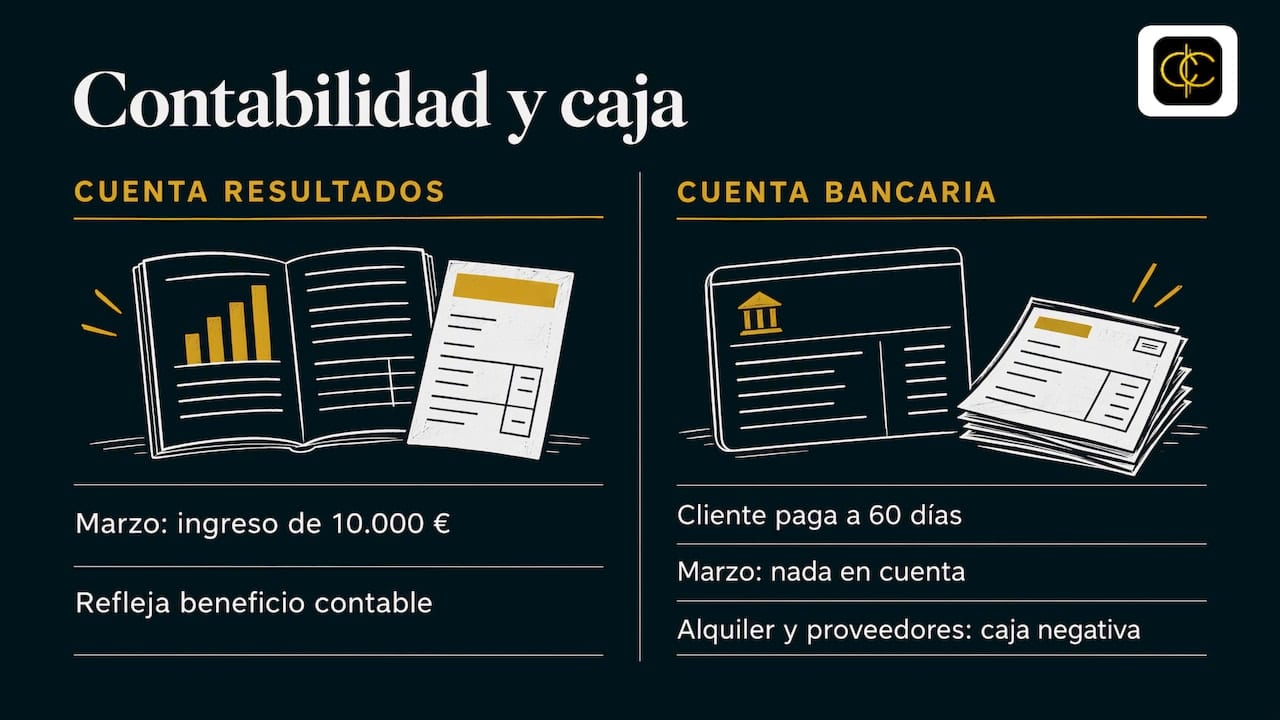
That is why Benavides Asociados puts it this way: accounting profit is what appears on the income statement, while cash flow is what is in the bank account.
Positive and negative cash flow
A positive cash flow means more money comes in than goes out: it lets you reinvest, pay down debt or build a cushion. A negative one means you have paid more than you have collected, which makes it harder to meet your debts. A negative month is not a catastrophe if you planned for it. The dangerous part is discovering it when there is no margin left.
Why it matters so much in a small business
Liquidity is the first muscle to fail in a small company. A study by the University of Murcia on 1,736 Spanish SMEs between 2010 and 2020 found that 991 (57.08%) entered an insolvency procedure, and it looked for early-warning indicators. The practical lesson is clear: the sooner you see the cash strain, the more options you have.
The Banco de España showed this on a large scale in 2020: in the first quarter of that year, 61% of companies would not have generated enough income to cover current payments, investments and depreciation, and close to 75% of those needs were financed with bank credit. Those who keep their cash under control depend less on emergency financing.
How cash flow is calculated
There are two common methods. Both reach the same idea, but they start from different points.
Direct method
Cash flow = cash inflows − cash outflows.
It is the most intuitive method and the most useful for someone running a business. IAS 7, the international standard that governs the statement of cash flows, recommends the direct method because it provides information that is useful for estimating future cash flows, which the indirect method does not offer.
An example from Benavides Asociados with a Spanish SME:
| Item | Monthly amount |
|---|---|
| Customer collections | €45,000 |
| Payments to suppliers | −€28,000 |
| Payroll | −€8,000 |
| Taxes and social security | −€3,500 |
| Cash flow for the month | €5,500 |
Indirect method
Cash flow = net profit + depreciation + provisions.
According to Banco Santander, depreciation and provisions are added back because they do not involve a physical outflow of money: they are accounting entries. This method starts from the accounts and is useful when you already have a closed income statement.
Which one to use
To manage day-to-day operations, use the direct method: actual collections and payments, week by week. The indirect method is useful for analyzing a closed financial year or for reading another company's financial statements.
Types of cash flow
Banco Santander classifies cash flows into three types, just like IAS 7:
- Operating: collections from sales, payments to suppliers and salaries. It is the pulse of your activity.
- Investing: purchases of machinery, equipment, property or acquisitions.
- Financing: loans received and their repayments, dividends or capital contributions.
IAS 7 explains that separating these flows makes it possible to assess the impact of each activity on the financial position. A healthy business generates cash through its operations, not only through loans.
Free cash flow
Free cash flow is the cash left after covering operating expenses and investments in assets. According to PNC, the equation is:
FCF = operating cash flow − CapEx (investments in assets).
With 500,000 USD of operating cash flow and 200,000 USD of investment, 300,000 USD remain to reinvest, distribute or reduce debt. The CNMV describes it as the company's effective liquidity.
If your business is small, keep three figures: operating cash flow, investments and free cash flow. The variants used to value companies (FCFF, FCFE) are the domain of analysts and investors.
Economic and financial cash flow
Economic cash flow looks at the cash the business generates before considering how it is financed; financial cash flow includes debt and its payments. For someone running a business, the useful question has two parts: does my activity generate cash on its own? And is anything left after I pay my loans?
From actual cash flow to projection
Measuring what has already happened is the first step. The second is projecting: estimating, month by month, the collections and payments ahead so you can see a deficit before it arrives. The logic is the same as in the example from the University of Zaragoza: January starts with €10,000, €25,000 comes in and €22,000 goes out, so it closes at €13,000, which becomes February's opening balance.
If you want to build your own with formulas, a four-month example and a minimum alert balance, follow the guide to projected cash flow in Excel. And if you are missing the general framework (sales, costs, break-even point), start with the basic financial plan for SMEs.
Where people go wrong
- Recording the sale on the day it is invoiced instead of the day it is collected.
- Forgetting payments that are not monthly: quarterly taxes, insurance, annual licenses.
- Making a projection once and never reviewing it.
- Ignoring price: if your margin is thin, no projection will save you. Calculate it with the profit margin and selling price calculator before setting sales targets.
How to keep cash flow healthy
The measures professionals repeat are simple. EFA highlights four: planning and budgeting reviewed regularly, control of accounts receivable (issue date, due date and status of each invoice), inventories kept in check so they do not tie up capital, and negotiating payment terms or discounts with suppliers.
Collect better
Scotiabank Mexico recommends setting payment terms from the quote, invoicing on time, sending reminders before the due date, and measuring how many days you take to collect. It also suggests sorting expenses into essential, adjustable and those that no longer add value.
Their argument deserves a pause: in many SMEs the cash is not missing, it is pending collection. Review your invoices before cutting expenses that help you sell and deliver. If you work for yourself or invoice a few clients, a well-structured document speeds up payment: the billing statement template gives you a ready-to-use format in PDF and Word.
Align payments and collections
If you collect at 60 days, try not to pay at 15. Asking suppliers for longer terms or offering customers a small discount for early payment brings the two clocks closer together.
Find the leaks
Sometimes the problem is not when money comes in, but where it goes: unused subscriptions, bank fees, waste or uncontrolled discounts. The guide to money leaks in a business helps you find them.
A 20-minute weekly routine
You do not need complex software to start. A sheet with three columns (week, expected collections, expected payments) is enough:
- Every Monday, record the expected collections and payments for the next four weeks.
- Calculate the estimated balance at the end of each week.
- Mark the first week in which the balance falls below your safety minimum.
- Decide what to move: bring a collection forward, delay a payment or hold off a purchase.
Consistency matters more than sophistication. Cash flow that you check every week avoids the surprises that a perfect but forgotten model would never catch.
To keep organizing your business finances, you will find more guides in management and strategy, and the free tools for entrepreneurs.
Frequently asked questions
What is cash flow in simple terms?
It is the money that comes into and goes out of your business over a period. If you collect more than you pay, it is positive; if you pay more than you collect, it is negative. It does not count sales you have invoiced but not yet collected.
What is the cash flow formula?
Using the direct method: cash inflows minus cash outflows. Using the indirect method: net profit plus depreciation and provisions. For free cash flow: operating cash flow minus investments in assets (CapEx).
Are profit and cash flow the same thing?
No. Profit is calculated with accrued income and expenses; cash flow is calculated with actual collections and payments. That is why a profitable company can still face cash strain if it collects late or invests heavily.
How often should I review my cash flow?
If your business is small, once a week for the next four weeks, and a 12-month projection reviewed every month. Always compare actual results with the forecast and adjust.
Frequently asked questions
What is cash flow in simple terms?
It is the money that comes into and goes out of your business over a period. If you collect more than you pay, it is positive; if you pay more than you collect, it is negative. It does not count sales you have invoiced but not yet collected.
What is the cash flow formula?
Using the direct method: cash inflows minus cash outflows. Using the indirect method: net profit plus depreciation and provisions. For free cash flow: operating cash flow minus investments in assets (CapEx).
Are profit and cash flow the same thing?
No. Profit is calculated with accrued income and expenses; cash flow is calculated with actual collections and payments. That is why a profitable company can still face cash strain if it collects late or invests heavily.
How often should I review my cash flow?
If your business is small, once a week for the next four weeks, and a 12-month projection reviewed every month. Always compare actual results with the forecast and adjust.
Related Posts
Keep exploring similar content that may interest you

Cash Flow Projection in Excel: Step-by-Step Example
How to build a projected cash flow in Excel for your small business: structure, formulas, a four-month example and warnings before you run out of money.

Digital transformation: taking a process to software
Digital transformation is not buying software: it is understanding, defining, improving and automating your processes so you can scale. A step-by-step method.
Basic financial plan for small businesses: projections and break-even
How to build a small-business financial plan with three sheets —assumptions, 12-month P&L and cash—, calculate break-even, and separate profit from cash.
Partnerships
Tools I use every day, on better terms for this community.