Behavior-Driven Development (BDD): Meaning and How to Start
Published on:
Reading time: 13 min
Topic: Technology
Author: Leandro Valencia
Behavior-driven development (BDD) explained: what it is, how to write a Given-When-Then scenario, how it differs from TDD, and how to start without coding.
Table of Contents
- Why it matters to founders and leaders
- Who does what: the Three Amigos meeting
- BDD vs TDD: building it right or building the right thing
- Cucumber and automation tools
- How to start with BDD step by step
Behavior-driven development, or BDD, is a way of building software in which business, development and testing first agree, using concrete examples in natural language, how a product should behave. Only after that is the code written. According to the official Cucumber documentation, it helps close the gap between business people and technical people through collaboration and small iterations.
If you lead a project, validate an idea or outsource software to an external team, BDD gives you something very practical: a way to check that everyone understands the same thing before you spend time and money on it. In this guide you will see what it means, how a scenario is written, how it differs from TDD, what the research says and how to start this week.
In short:
- BDD describes what a product must do through examples in everyday language, before any code is written.
- It works in three phases: discover, formulate and automate. Scenarios are written with the structure Given, When, Then.
- TDD verifies that the code works well; BDD verifies that what gets built is what the business actually needs.
- Studies point to more collaboration and a better understanding of requirements, in exchange for taking care of the maintenance of the scenarios.
- You can apply the logic of BDD to any project, even without a technical team, to validate ideas with clear examples.
What BDD is and what it means
BDD stands for Behavior-Driven Development. It is a collaborative approach: instead of starting from a list of features or from the code, the team starts with conversations about concrete situations. What does the user do? What should happen? What happens if something goes wrong?
The origins go back to the ideas of Dan North in the early 2000s. According to BMC, North proposed it as a response to the difficulty of explaining what to test, how much to test and why a test fails. BDD derives from TDD (test-driven development) and from acceptance testing.
The central idea is a shared vocabulary. The BDD Wiki presents it as a reformulation of existing good practices under a precise and consistent language, so that business people, developers, testers and analysts use the same words to talk about the same system. When everyone says "order confirmed" and means the same thing, weeks of misunderstandings are avoided.
The three principles behind the practice
That same wiki summarizes BDD in three ideas that are easy to remember:
- Everything is behavior: business and technology describe the system in the same way.
- Verifiable business value: every part of the system must provide something that can be checked.
- Enough is enough: upfront analysis has diminishing returns, so you talk just enough and move on.
The third idea is the one that connects most with an agile way of working: learn fast, in short cycles, without endless documents that nobody reads.
Why it matters to founders and leaders
BDD was born in the software world, but its logic is useful even if you do not program. Whoever hires a freelance developer, commissions an online store or coordinates a mixed team shares the same risk: asking for something, receiving something else and finding out too late.
BDD reduces that risk because it forces you to describe the expected result with verifiable examples. A requirement like "the customer can book an appointment" is ambiguous. A scenario like "if there is a free slot on Friday and the customer picks it and confirms, the appointment is booked and they receive an email" can be discussed, corrected and checked.
That exercise also helps you validate your idea: if you cannot describe the expected behavior in three or four examples, the idea probably is not ready to be built. To check whether there is demand before building anything, see how to run a no-code smoke test.
How BDD works: discover, formulate and automate
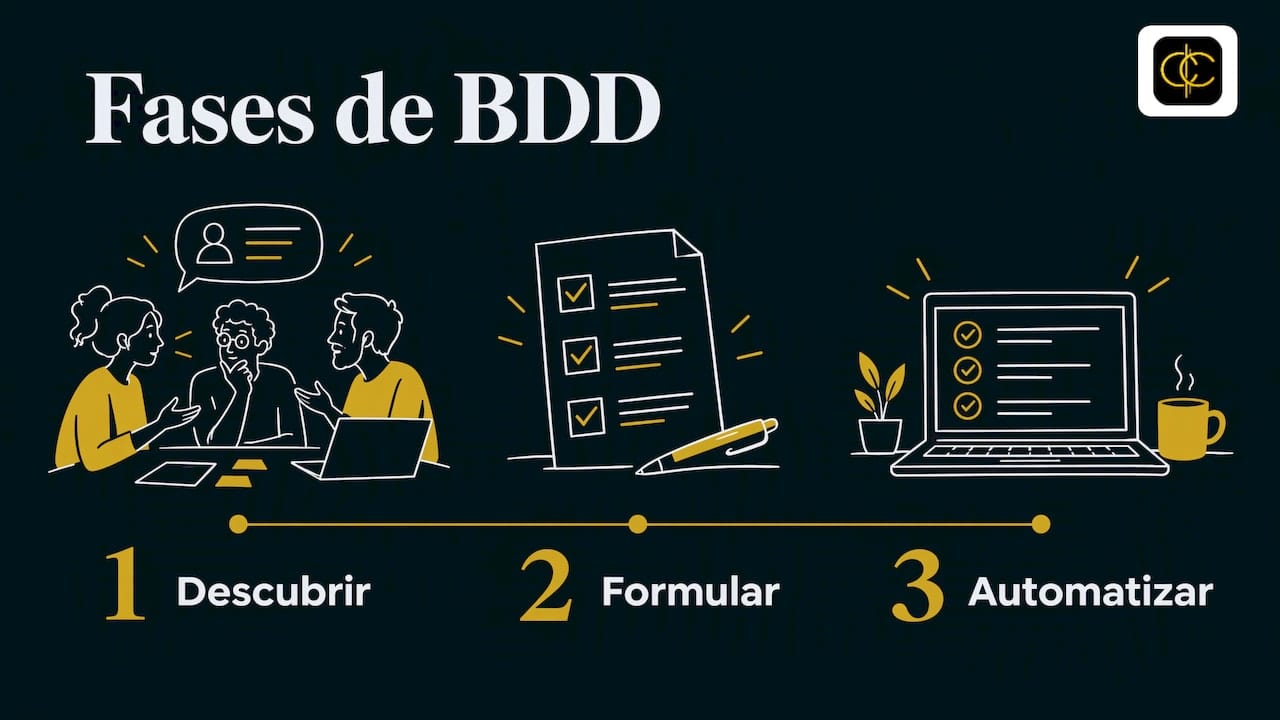
An academic paper from the Universidad Nacional de Quilmes (2022) describes three phases for each user story, and Cucumber presents them as an iterative cycle of three equivalent steps.
1. Discovery
It is a structured conversation. The team talks through concrete examples of a user story (a short description of what someone wants to achieve with the product) to make sure there is business value and a shared understanding. No code is written and no screens are designed: the team asks questions.
Useful questions at this stage:
- Who does this and why?
- What is the most common case?
- What happens if a piece of data is missing, if it is cancelled or if a payment fails?
- How will we know it is done?
2. Formulation
The agreed examples are written in a structured format, which becomes an executable specification. This is where the Given, When, Then structure appears, which you will see shortly.
3. Automation
The scenarios are turned into automated acceptance tests. That way, every time the product changes, you can check whether it still behaves as agreed. Code development can start with an automated test that guides it.
Automation is the technical part and the most expensive to maintain. The first two phases, by contrast, are pure conversation, and any team can do them with a blank sheet of paper.
How to write a Given-When-Then scenario
The structure is simple. According to the UNQ material, Given sets the initial state, When describes the action and Then the expected result. The format in which these are written is called Gherkin: an almost plain-text language with fixed keywords that both a business person and a tool can read.
A complete example
Imagine you run a massage business and want a booking page:
Feature: Appointment booking

  Scenario: Book a free time slot
    Given the therapist has a free appointment on Friday at 14:00
    And the customer is on the booking page
    When the customer selects that slot and confirms
    Then the appointment is booked
    And the customer receives a confirmation email
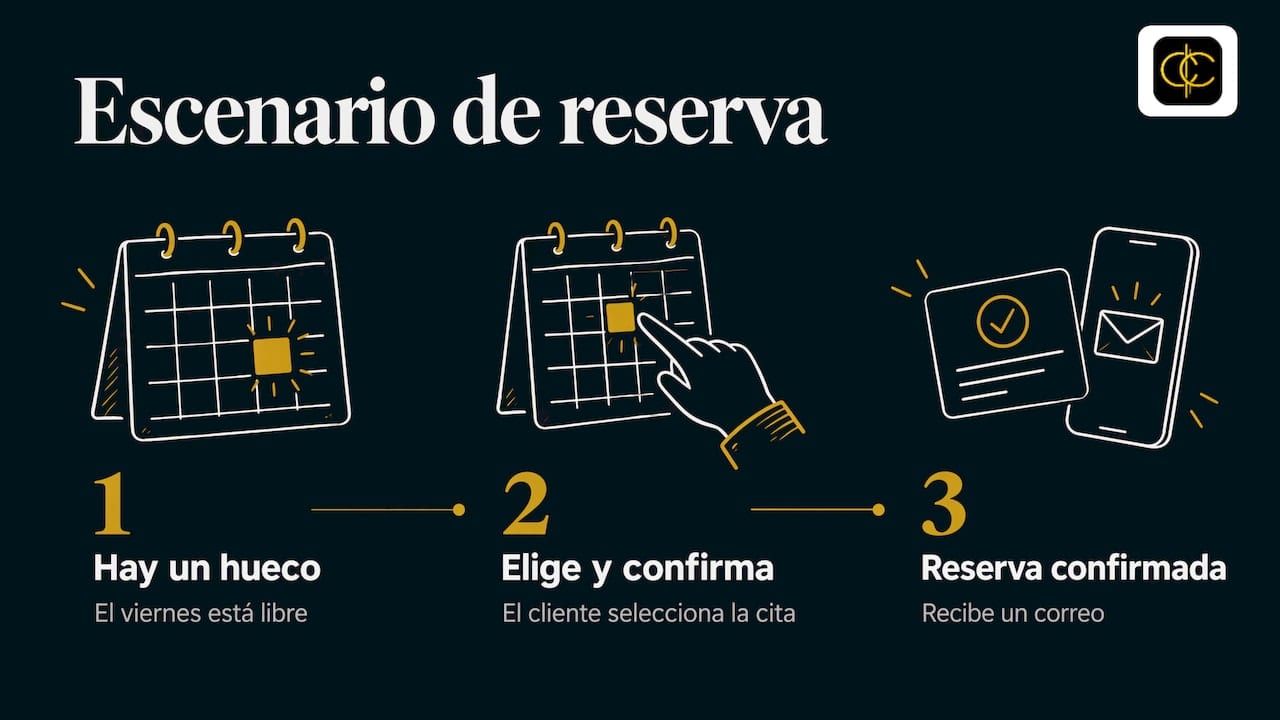
Notice three things. First, there is no talk of buttons, databases or technology: only what happens from the customer's point of view. Second, anyone in the business can read it and say "the case where the slot was already taken is missing". Third, it is verifiable: either the appointment is booked or it is not.
Another classic, more numerical example: if a user has a balance of €100, withdraws €30, then the balance must be €70. An example like this leaves little room for interpretation, and that is exactly what you are looking for.
Common mistakes when writing
- Giant scenarios. One that covers booking, payment, cancellation and email all at once becomes hard to read and maintain. One scenario, one behavior.
- Internal details. Describe what is observed, not how it is programmed.
- Vague words. "Fast", "easy" or "correct" cannot be checked. Replace them with figures or facts: "receives the email in under one minute".
- Examples without a requirement behind them. Every scenario should connect with something the business needs.
Who does what: the Three Amigos meeting
BDD works because different perspectives take part. The best-known practice is the "Three Amigos" meeting. The Cucumber documentation on roles divides the work like this:
| Role | What it contributes |
|---|---|
| Business (product owner) | Turns user stories into features and decides what is in scope |
| Testing | Generates scenarios and edge cases, with "what if...?" questions |
| Development | Adds steps to the scenarios and considers execution details and obstacles |
If you work alone or in a team of two, you wear those three hats yourself. Do the exercise anyway: first with the business hat, then with the hat of someone trying to break the plan, and finally with the hat of the person who has to build it.
BDD vs TDD: building it right or building the right thing
This is the most common question. TDD (Test-Driven Development) means writing a technical test first and then the code that passes it. BDD starts from that same idea, but moves up a level.
The UNQ paper explains that BDD works at the level of the application and its requirements, while TDD focuses on the level of the code. In addition, TDD can be used as the "make the tests pass" phase within BDD. They do not compete: they combine. Parasoft sums it up this way: in TDD the test is the contract for a specific functional requirement, while in BDD the behavior is the contract for a business requirement.
| TDD | BDD | |
|---|---|---|
| Starting point | A technical test | An agreed behavior |
| Key question | Does this code work? | Does this behavior matter to the user? |
| Who takes part | Developers | The whole team, including business |
| Language | Code | Natural language (Gherkin) |
| Level | Unit of code | Application and requirements |
As the practical approach by Sergio Perea puts it: TDD helps you build the solution well, and BDD helps you build the right solution.
BDD is also part of a broader family of approaches that put the specification at the center. If you work with AI agents that write code, the guide to Spec-Driven Development with BDD, DDD and API-First shows how everything fits together.
Cucumber and automation tools
When it is time to automate, you use a tool that reads the scenarios and runs them against the product. The best known is Cucumber: it reads .feature files written in Gherkin, links each step to code (the "step definitions") and tells you which scenarios passed and which failed. Parasoft adds that equivalent tools exist for other languages, such as SpecFlow in the .NET world.
If you do not program, you do not need to choose any tool to start. What matters is that whoever develops your product understands your scenarios. Your most valuable contribution is well-thought-out examples, not the testing software.
What the research says about its benefits
To decide whether it is worth it, it helps to look at data and not only at opinions.
- International survey. A University of Manchester study presented at SANER 2018 surveyed 75 professionals from 26 countries. The most cited benefits were specifications that end users can understand (67%), better communication among stakeholders (61%), executable specifications (52%) and a better understanding of the intent of the code (50%).
- Case study in Brazil. A PUCRS research project (2020) interviewed 42 people from an agile team building a mobile app. It recorded 31 positive impacts, such as more collaboration, clearer features and better project alignment, against 5 negative ones.
- Industrial evaluation. A study published in the Journal of Systems & Software (2021) identified as benefits a better understanding of the business aspects of requirements, higher requirement quality and the reuse of artifacts.
In practice, teams that adopt BDD usually gain a shared understanding of what "done" means before writing a single line of code, and that reduces rework.
How to get the benefits without overloading yourself
The same studies agree on one point: scenarios are an asset that must be looked after. The Manchester survey notes that maintaining them and locating failures in large suites requires attention, just like any set of automated tests. The Brazilian study points out that the first experience can be challenging because of the learning curve, especially when writing scenarios.
From this come some simple good practices:
- Start with a small feature, not the whole product.
- Write few scenarios, but well chosen: the main case and the two or three most important risks.
- Review the scenarios when the product changes, just as you would review a budget.
- Automate what adds value; the rest can stay as a written agreement.
How to start with BDD step by step
This is a routine you can apply this same week, whether or not you have a technical team.
- Pick a user story. One sentence: "As a [type of customer], I want [action] so that [benefit]." For example: "As a customer, I want to book an appointment online so that I do not have to call." If you are not yet clear on who that customer is, the buyer persona template can help you define them.
- Gather the three perspectives. Business, builder and tester. If you are alone, do it in three turns. A half-hour conversation per story is usually enough.
- Look for examples, not definitions. Ask "can you give me a real case?" every time someone says an abstract sentence.
- Ask about edge cases. What happens if the customer cancels, if there is no free slot, if the payment fails?
- Write the scenarios. Use Given, When, Then. One per behavior, in language anyone can understand.
- Agree on the definition of done. The story is ready when all of its scenarios pass.
- Automate what matters. If your product allows it, turn the key scenarios into tests that run by themselves.
- Review and adjust. Each short cycle teaches you something; incorporate it into the scenarios.
If you organize your work in sprints, you can carry the scenarios as acceptance criteria for each task. The guide to AI-assisted agile project management in Jira, Notion and ClickUp shows how to automate that part.
Every scenario you write is a decision made in advance. The more decisions you clarify before building, the fewer you will have to correct afterwards.
Frequently asked questions
What is BDD in simple terms?
It is a way of developing software in which the whole team agrees, using examples in everyday language, how the product should behave before it is coded. Those examples are written with a fixed structure (Given, When, Then) and can then be turned into automated tests.
What is Cucumber and what does it have to do with BDD?
Cucumber is a tool that runs BDD scenarios. It reads files written in Gherkin, connects each step to code and tells you which scenarios pass or fail. It is not required to practice BDD: the part of talking and writing examples works without it.
What is the difference between BDD and TDD?
TDD starts from a technical test on a unit of code and is practiced mainly by developers. BDD starts from a behavior agreed between business, development and testing. They complement each other: BDD defines what to build and TDD helps build it well.
Do I need to know how to program to use BDD?
Not for the first two phases. Discovering examples and writing scenarios in Given, When, Then only requires clarity and conversation. Automation does need a technical person, but your scenarios are the foundation that person will use.
How long does a BDD session last?
It depends on the story, but the Three Amigos meeting is usually a short conversation per user story, of 15 to 30 minutes. What matters is that it is brief, focused and ends with agreed scenarios.
Step-by-step guide
Pick a user story
One sentence: as [customer], I want [action] so that [benefit].
Gather three perspectives
Business, the builder and the tester. If you are alone, do it in three turns.
Ask for examples and edge cases
Replace every abstract statement with a real case and ask what happens if something fails.
Write the scenarios
Given, When, Then: one scenario per behavior, in language everyone understands.
Agree when it is done
The story is ready when all of its scenarios pass.
Automate what matters
Turn the key scenarios into automated tests and review them in every cycle.
Frequently asked questions
What is BDD in simple terms?
It is a way of developing software in which the whole team agrees, using examples in everyday language, how the product should behave before it is coded. Those examples are written with a fixed structure (Given, When, Then) and can then be turned into automated tests.
What is Cucumber and what does it have to do with BDD?
Cucumber is a tool that runs BDD scenarios. It reads files written in Gherkin, connects each step to code and tells you which scenarios pass or fail. It is not required to practice BDD: the part of talking and writing examples works without it.
What is the difference between BDD and TDD?
TDD starts from a technical test on a unit of code and is practiced mainly by developers. BDD starts from a behavior agreed between business, development and testing. They complement each other: BDD defines what to build and TDD helps build it well.
Do I need to know how to program to use BDD?
Not for the first two phases. Discovering examples and writing scenarios in Given, When, Then only requires clarity and conversation. Automation does need a technical person, but your scenarios are the foundation that person will use.
How long does a BDD session last?
It depends on the story, but the Three Amigos meeting is usually a short conversation per user story, of 15 to 30 minutes. What matters is that it is brief, focused and ends with agreed scenarios.
Related Posts
Keep exploring similar content that may interest you
Spec-Driven Development: a BDD, DDD, MDE & API-First guide
What Spec-Driven Development is, why it's back with AI, and how to use it with BDD, DDD, MDE and API-First, with examples, comparison table and agent workflow.

Vercel Analytics vs Umami (and 6 Alternatives): Free Limits 2026
We compare the free limits of Vercel Analytics, Umami, Cloudflare, PostHog, GoatCounter, Plausible and Fathom in 2026 to help you pick web analytics.
Real AI API Costs in 2026: Caching and Model Routing
What a real task costs with Claude, GPT, Gemini or DeepSeek: price per million tokens, the caching formula and model routing to cut your bill.
Partnerships
Tools I use every day, on better terms for this community.