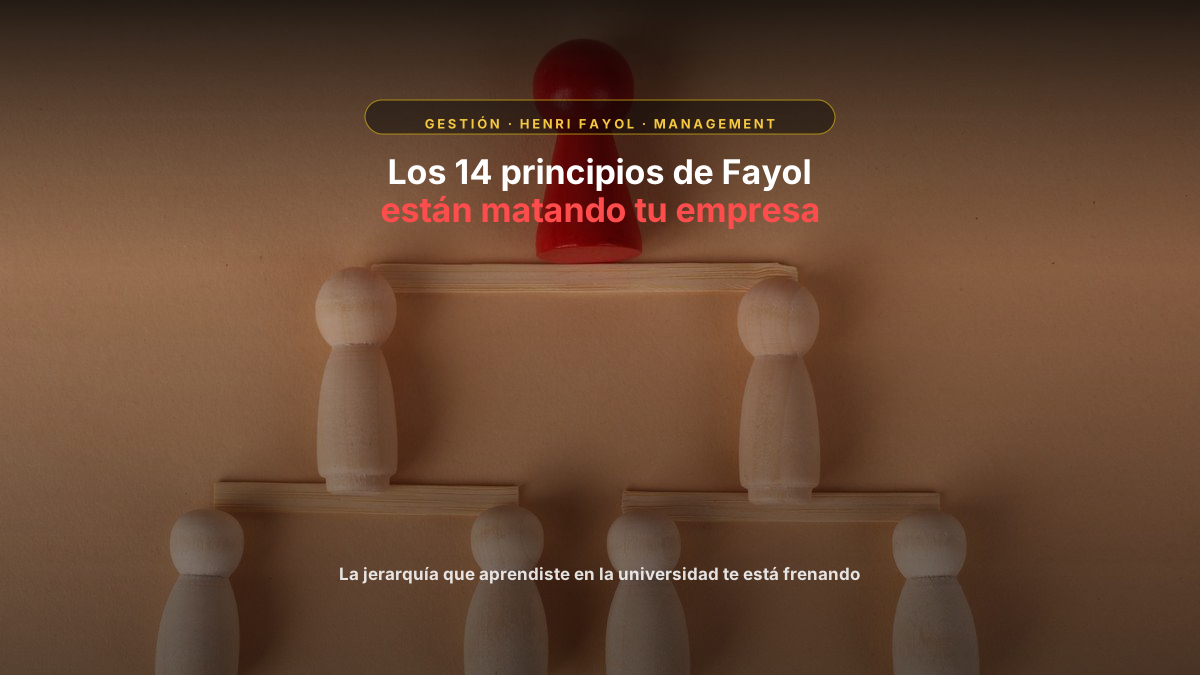
Criticism of Fayol: Why His 14 Principles Hold Your Company Back
Published on:
Reading time: 6 min
Topic: Strategy
Author: Leandro Valencia
The criticism of Fayol that few business schools teach: applied as dogma in 2026, his 14 principles hold back companies that could be agile instead.
Table of Contents
If you've studied business, economics, or Industrial Engineering, you've memorized them: Fayol's 14 principles. Division of work, unity of command, hierarchy, discipline. You've seen them in every textbook. Your boss has seen them. The consultant charging $1,500 a day quotes them with reverence.
I've covered them in detail in our guides on management principles, administrative principles and Fayol's 14 principles, and I respect them as history. But here's an uncomfortable thesis: applying them as dogma in 2026 is one of the reasons your company isn't moving.
Let's take them apart one by one, quietly, so the board doesn't hear us.
The common belief
The official narrative says Fayol was the first to systematize how to run a company. That his 14 principles are universal. That any organization applying them with discipline will be efficient. That big corporations succeed because they follow them, and the ones that fail do so because they violate them.
Business schools teach them in the first term. MBAs recite them. Consulting firms quote them in their sales pitches. It is, without question, the most influential management framework of the 20th century.
The problem: the 20th century ended 26 years ago.
Why it falls short
Let's revisit some of the most "respected" principles and how they work against a modern company.
1. "Unity of command" as an excuse for silos
The principle says: each person takes orders from a single boss. In 1916, in a factory with 3,000 workers, that made sense. Today, in a company where knowledge is distributed and projects are cross-functional, the principle gets read as "mine is mine, don't touch it."
Result: silos. Marketing doesn't talk to product. Product doesn't talk to sales. The customer notices the inconsistency. The fastest-moving companies (Spotify with its squads, Google with its cross-functional teams) break this principle on purpose, and win.
2. "Hierarchy" as a brake on speed
The hierarchy principle says information travels along the scalar chain: from director to manager, from manager to supervisor, from supervisor to worker, and back.
In a company of 5,000 people, a decision that should take 2 hours travels for 3 weeks through the chain. Meanwhile, a smaller competitor decides in 30 minutes and captures the market. The hierarchy Fayol designed to ensure coherence has become the main cause of slowness.
3. "Division of work" as a factory of incompetence
The principle rewards extreme specialization. But over-specialization produces:
- Fragility: if that one person leaves, the process stops.
- Boredom: people disengage when they repeat the same task for years.
- Blindness: the specialist doesn't understand the whole system, only their piece.
The most innovative companies look for T-shaped profiles (deep in one thing, capable across several) and rotate people between projects. They violate the division-of-work principle to gain resilience.
4. "Centralization" as an excuse to never let go of the decision
Fayol proposed centralization as a matter of degree. In practice, most large companies interpret it as "every important decision gets made at headquarters." Result: the people closest to the market — sales reps, support staff, operations — can't decide anything. They have to escalate, wait, escalate, wait.
The irony: the executive who decides is 2,000 miles from the problem; the salesperson living the problem can't solve it. Companies that deliberately decentralize (Netflix, Valve, Buurtzorg) move faster and have more engaged people.
5. "Stability of tenure" as an excuse not to change
The principle says low turnover is good. But extreme stability turns into rigidity: the same team for 15 years, the same way of thinking, the same shield against new ideas. Companies that never renewed their talent are disappearing. Blockbuster. Nokia. Yahoo. Stable until they died.
The alternative
I'm not proposing you burn Fayol's books. I'm proposing something more radical: read him the way you read Machiavelli or Sun Tzu — as a classic to know, contextualize, and move beyond, not as a manual to obey blindly.
Here are three principles for a post-Fayol company.
Principle 1 · Decisions at the lowest competent level
Every decision should be made at the lowest level that has the competence to make it. If the salesperson in front of the customer can approve a 10% discount, let them. If the technical team can choose a technology, let them choose it. Hierarchy doesn't decide: it enables.
Principle 2 · Teams before departments
Forget organizing by function (marketing, sales, product, operations). Organize around end-to-end teams: small groups that can deliver value to the customer from start to finish. Each team is cross-functional, autonomous, and accountable for an outcome, not a task.
Spotify called them "squads." Amazon called them "two-pizza teams." The name changes; the idea is the same.
Principle 3 · Culture before rules
Fayol trusted written rules and imposed discipline. Today we know culture beats any manual. A strong culture of initiative, transparency, and accountability makes 90% of the rules unnecessary. Without culture, rules get dodged; with culture, they're redundant.
How to apply it: 3 concrete actions
If your company shows the symptoms — slowness, silos, disengaged people, decisions that stall — try these three actions over the next 90 days.
-
Map your last 10 important decisions. How long did they take? How many people touched them? If the average is "3 weeks and 8 people," you have a hierarchy problem. Run an experiment: decisions under a certain amount, made by teams without escalation.
-
Find a silo and break it. Pick a clear dysfunction (marketing and product don't talk; sales and support blame each other). Form a cross-functional team with a shared goal, give it the authority to decide, and measure results in 90 days.
-
Ask your team which decisions they can't make. The answer will show you where centralization has gone too far. Delegate three of those decisions to the lowest possible level. It's scary, but it works.
Conclusion
Henri Fayol was a genius. In 1916 he systematized, for the first time, what it meant to run a company, and the business world owes much of its 20th-century progress to him.
But the companies that perform best in 2026 don't apply Fayol literally. They interpret him, loosen him, move past him. The ones that stick to the letter of the manual are the ones that end up in case studies about why big corporations lose to startups with a tenth of their capital.
Knowing Fayol's principles is like knowing the rules of grammar: necessary to write well, not enough to write something worth reading. Grammar gives you structure; voice gives you impact. Administration gives you structure; culture gives you speed, adaptability, and soul.
If you want the "obedient" version of Fayol, read our guide to the 14 principles. If you want to build a company that wins in 2026, start by questioning how many of those principles are, right now, holding yours back.
Does this resonate? Do you see it the other way around? Leave your critique in the comments. Let's debate it.
Related Posts
Keep exploring similar content that may interest you

Machiavelli for startups: power and survival
Discover how Niccolò Machiavelli's timeless teachings on realism, leadership, reputation, and strategic alliances can be applied by modern entrepreneurs to navigate the dynamic and competitive world of startups.

AI SWOT Analysis: 4 Prompts to Run Yours (With Examples)
How to do a SWOT analysis with AI: 4 copy-ready prompts, an e-commerce and a SaaS example, and how to turn the matrix into a CAME action plan.

Porter's Five Forces Applied to Your Small Business (With Example)
What Porter's Five Forces are, how to apply them to a small business or freelancer in 2026, with a full example: rivalry, suppliers, buyers and substitutes.
Partnerships
Tools I use every day, on better terms for this community.