
Potential vs Real Market: How to Calculate Your Own Size
Published on:
Reading time: 6 min
Topic: Entrepreneurship
Author: Leandro Valencia
What the potential and real market are, how to narrow one to the other with filters and an example, and the four elements a market study should analyze.
Table of Contents
- How to go from potential to real
- What it is for, according to the sources
- Common mistakes when estimating your market
- Next step
A market study tells you, before you invest, whether there are people willing to pay for what you want to sell, how many they are, at what price and who you are competing against. But one confusion sinks many projects: taking the potential market (everyone who could need it) for the real market (those who will actually buy from you).
This guide focuses on that difference and on the four elements your study should cover. If what you are looking for is the full process, with free sources, surveys and TAM, SAM and SOM, you will find it in our step-by-step market research guide.
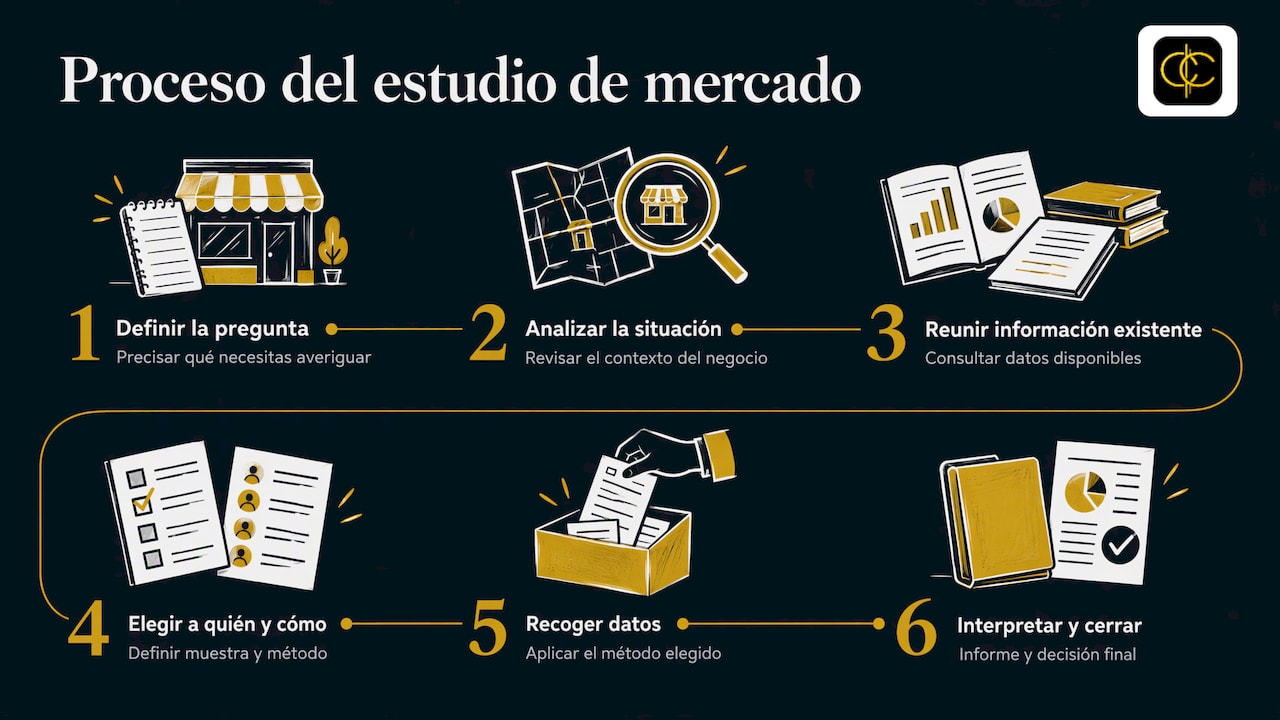
Potential market and real market
- Potential market: the group of people who could have the need. It is a theoretical ceiling.
- Real market: the part of that group who would actually buy, can pay for it and whom you can reach.
Elche Orienta, a public guidance service, recommends researching market needs, calculating how many people in the segment could be interested and identifying competitors and their audience in order to find underserved niches. It is the same path: from the broad to the reachable.
If you already know TAM, SAM and SOM, the correspondence is approximate: the potential market resembles the TAM, and the real market resembles the SAM or the SOM, depending on how many filters you apply.
A hypothetical example
Imagine you want to sell an online basic accounting course for self-employed workers in your province. The figures are made up and only illustrate the reasoning:
- Potential market: 20,000 self-employed workers in the province.
- Those who keep their own books instead of using an accountant: 4,000.
- Of those, the ones looking for online training according to your interviews and survey: 1,200.
- The ones you could reach in the first year with your channels: 300.
If with those 300 people and your planned price you do not cover costs, the problem shows up before you spend a single euro on production. To check it, use the profit margin and selling price calculator or calculate your break-even point.
How to go from potential to real
Apply one filter per question, and note the source and date of every data point:
| Filter | Question | How to find out |
|---|---|---|
| Need | Do they have the problem often enough? | Interviews with people in your audience |
| Ability to pay | Can they pay your price? | Price question in the survey, competitors' prices |
| Reach | Can you get to them with your channels? | Where they look today and what it costs to reach them |
| Alternatives | What do they use now and why would they switch? | Reviews and competitors' websites |
To define who you will interview, first fill in the buyer persona template. And remember: saying "I'm interested" is free. Paying, booking or leaving a contact detail are stronger signals; if you want to measure them, see how to run a fake door test.
The four elements your study should analyze
Researching a market is not asking whether people like your idea. The French official body Service Public Entreprendre describes the study as a detailed analysis of four elements:
- The supply: the product or service you will sell.
- The demand: the customers who will buy it.
- The environment: time, place, trends, technologies, competitors and regulation.
- The way you sell: distribution channels and commercial strategy.
Use it as a checklist: if at the end you cannot write a paragraph on each one, you are missing information. To order your hypotheses on a single page, the Business Model Canvas template helps you see which ones you still need to test.
The four markets
Entrepreneurship academic material widens the view to four markets: suppliers, competitors, distributors and consumers. If you only look at demand and prices, you can overlook something that sinks the project, such as your key supplier not having the capacity to supply you. Add one question for each: who supplies me, who competes with me, who helps me reach the customer and who buys from me.
What it is for, according to the sources
The manual from Andalucía Emprende, an Andalusian public body, defines a market study as a systematic search for relevant information to support decision-making, which helps assess a project's risks more realistically. According to Emprendedor.com, the information gathered helps develop new products, improve existing ones, identify opportunities, set prices, decide distribution and promotion, and reduce the risk of failure.
It is worth doing before launching an idea, before setting prices or changing audience, when entering a new segment or city, and when sales stall and you do not know whether the problem is the product, the message or the channel. If you are not yet sure the idea deserves the effort, start with validating your business idea without money.
Common mistakes when estimating your market
- Sticking with the potential market. "There are 20,000 self-employed workers" is not a sales figure.
- Looking only at demand and price. Ignoring suppliers, competitors and distributors can lead to serious mistakes when approving or rejecting a project.
- Asking an audience that is not yours. Friends, family or followers who already like you give kind answers, not representative ones.
- Leading questions. If the question contains the answer, the data is worthless.
- Not saving the source and date. A data point without a date gets stale without you noticing.
- Not deciding. If the study does not end in a criterion to continue or stop, it gets shelved.
Frequently asked questions
What is the difference between potential market and real market?
The potential market is the whole group of people who could have the need you solve. The real market is the part of that group who would actually buy, can pay your price and whom you can reach through your channels.
How do I know if my market is big enough?
Start from the potential market and filter down to the group you could reach and who would pay your price. If with that number and your unit margin the business covers its costs, the size is big enough to start.
What should a market study analyze?
Four elements: the supply (what you sell), the demand (who buys it), the environment (competitors, trends, regulation) and the way you sell (channels and sales strategy).
Can I do a market study without a budget?
Yes, to validate an idea at an early stage. Combine free official statistics, competitor analysis and well-prepared interviews. It is a solid basis for deciding whether a bigger study is worth the investment.
Next step
Write down your potential market, apply the four filters and settle on a number you can defend. Then follow the full process in the market research guide and explore the rest of the tools for entrepreneurs.
Frequently asked questions
What is the difference between potential market and real market?
The potential market is the whole group of people who could have the need you solve. The real market is the part of that group who would actually buy, can pay your price and whom you can reach through your channels.
How do I know if my market is big enough?
Start from the potential market and filter down to the group you could reach and who would pay your price. If with that number and your unit margin the business covers its costs, the size is big enough to start.
What should a market study analyze?
Four elements: the supply (what you sell), the demand (who buys it), the environment (competitors, trends, regulation) and the way you sell (channels and sales strategy).
Can I do a market study without a budget?
Yes, to validate an idea at an early stage. Combine free official statistics, competitor analysis and well-prepared interviews. It is a solid basis for deciding whether a bigger study is worth the investment.
Related Posts
Keep exploring similar content that may interest you
Break-even point: formula, how to calculate it and examples
Learn the break-even point formula in units and in sales, with worked examples for a coffee shop, a freelancer and a store with several products.
Smoke test: validate demand without code before building
How to run a smoke test with a fake door landing page, a refundable pre-order and 50–100 USD in ads to measure payment intent and CAC before you build.

Jobs to Be Done (JTBD): What It Is, Examples and How to Apply It
What Jobs to Be Done is and how to use it: the 4 forces of progress, timeline interviews with ready-to-use questions and a plan to validate your product.
Partnerships
Tools I use every day, on better terms for this community.