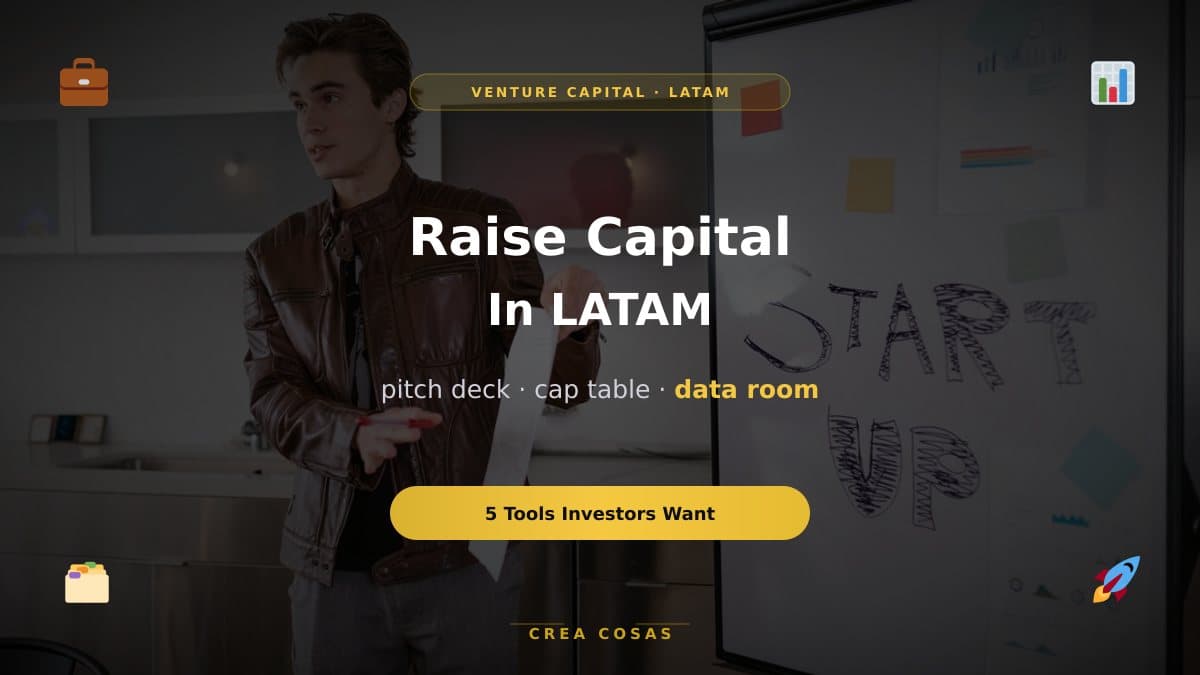
Raising Venture Capital in LATAM: 5 Things Investors Ask For
Published on:
Reading time: 5 min
Topic: Entrepreneurship
Author: Leandro Valencia
What to prepare before raising capital in LATAM: pitch deck, validated Canvas, traction metrics, financial model and data room, with a 4-week plan.
Table of Contents
Raising capital for a startup in Latin America no longer works on the strength of a good story alone. Funds have become more selective and look above all at efficiency: how much revenue you generate for every dollar you spend, and how long your cash lasts.
The good news is that what they ask for is predictable. This guide walks through the five tools an investor expects to see, the most common mistakes with each one, and a four-week plan to have them ready before the first meeting.
The 5 tools, in a table
| Tool | What it is for | What it must include | Common mistake |
|---|---|---|---|
| 1. Pitch deck | Telling the story and the potential | Problem, solution, market, traction, team, how much you are raising | Too many slides and too little evidence |
| 2. Validated Business Model Canvas | Showing how you create and capture value | Segments, value proposition, costs and revenue | Blocks full of untested assumptions |
| 3. Traction metrics | Proving the business works | LTV, CAC, CAC payback, churn, NRR | Showing vanity metrics (visits, downloads) |
| 4. Financial model | Projecting and justifying the use of money | Monthly P&L for 24–36 months, burn rate, runway, hires | Top-down projections with no support |
| 5. Data room and cap table | Making due diligence possible | Fully diluted cap table, SAFEs, IP assignment, organized folders | A messy Drive with no permission control |
What funds in the region look at today
- Efficiency before growth at any cost. They want to see a path to profitability or, at the very least, cash that lasts 18 months or more after the round.
- Traction backed by hard data. Recurring revenue, retention and paying customers weigh more than a huge market narrative.
- A healthy cap table. They check whether many SAFEs or convertible notes have piled up, and whether founders keep a stake that keeps them motivated through the next rounds.
Before projecting anything, check the real profitability of your operation with the profit margin calculator.
The 5 tools, one by one
1. The pitch deck (10 to 12 slides)
It is the front door. Its job is to get the second meeting, not to answer every question. It must make clear:
- The urgent problem: what concrete pain your customers have, and why now.
- The solution and what makes it hard to copy: why your approach is far better than the current alternative.
- Recent traction: month-over-month growth, recurring revenue and reference customers.
- The team: why you are the ones who can execute it.
- The ask: how much money you are looking for and which milestones you will reach with it over the next 18 months.
2. The validated Business Model Canvas
The investor does not want a theoretical exercise. They want to see the logic of how you make money:
- How you capture value: subscription, transaction fee or pay-per-use.
- Channels that scale: how you will bring down acquisition cost as you grow.
- What is validated and what is not: mark which blocks have market evidence.
You can build it with the interactive Business Model Canvas and review these Canvas examples.
3. Traction metrics
These are the ones that turn a conversation into an offer (term sheet). The benchmarks usually cited for SaaS:
- LTV:CAC of 3:1 or more: each customer is worth at least three times what it costs to acquire them.
- CAC payback in under 12 months.
- Net Revenue Retention above 100%: your current customers spend more over time. If yours is below that, review how to reduce churn in B2B SaaS.
4. The financial model (24 to 36 months)
Investors read the logic behind the numbers:
- Bottom-up: if you project multiplying revenue by five, the model must show the salespeople you hire or the marketing spend that makes it possible.
- Runway: how many months of operation the round buys before you need the next milestone.
- Explicit assumptions: price, conversion, churn and acquisition cost, each with its source.
5. The data room and the cap table
An orderly data room conveys professionalism and shortens due diligence from weeks to days. A standard structure:
- 00 Summary: executive summary, pitch deck and index.
- 01 Legal and incorporation: certificates, bylaws and minutes.
- 02 Cap table and financing: fully diluted cap table, signed SAFEs and employee option plan.
- 03 Finance and metrics: financial statements, financial model, bank statements and indicators.
- 04 Intellectual property and technology: IP assignments signed by founders and developers, trademarks and architecture.
- 05 Customers and traction: main contracts, pipeline and churn metrics.
- 06 Team: org chart, key contracts and confidentiality agreements.
- 07 Taxes and compliance: tax returns, audits and regulatory history.
If you do not yet have the basic contracts with partners and developers, start with the essential contracts for freelancers and startups.
4-week plan
- Week 1: legal and cap table. Confirm that every founder and every developer signed the IP assignment to the company, and consolidate all SAFEs and notes into a fully diluted cap table.
- Week 2: financial model and data room. Build folders 00 to 07 and check that the traction metrics and the model assumptions tell the same story.
- Week 3: pitch deck. Write the 10 to 12 slide version and test it with mentors and with founders who have already raised capital.
- Week 4: investor pipeline. Make a list of 30 to 50 funds that invest in your stage and vertical, and look for a warm introduction for each one.
If you do not have traction to show yet, the step before is to validate demand. See how to do it with a smoke test and a landing page.
Step-by-step guide
Clean up legal and the cap table
Signed IP assignment and all SAFEs in a fully diluted cap table.
Build the financial model and data room
24–36 month P&L and numbered folders from 00 to 07.
Iterate the pitch deck
10 to 12 slides tested with mentors and founders who have already raised.
Run the fund pipeline
List of 30 to 50 funds that invest in your stage and your vertical.
Frequently asked questions
What do investors ask for before investing in a startup?
At a minimum, a clear pitch deck, real traction metrics, a financial model with explainable assumptions, a tidy cap table and the legal documentation for due diligence. At early stages, what weighs most is evidence that someone pays for what you do, and the team that executes it.
What is a SAFE?
A Simple Agreement for Future Equity, created by Y Combinator: the investor puts money in today and receives shares in the next round at a valuation, usually with a valuation cap or a discount. It is fast and cheap, but if many SAFEs pile up without being modeled, founder dilution can come as a surprise.
What is a fully diluted cap table?
It is the table showing who owns what percentage of the company if all pending instruments were converted: SAFEs, convertible notes and employee options. It is the one investors look at, because it reflects real ownership.
How many slides should a pitch deck have?
Between 10 and 12 is usually enough: problem, solution, market, product, traction, business model, competition, team, finances, and how much you ask for and what for. The goal of the deck is to get the second meeting, not to explain everything.
Related Posts
Keep exploring similar content that may interest you

Y Combinator Published What Startups It Wants to Fund: What It Means for Latin America
Y Combinator published its Fall 2026 Requests for Startups list: crypto as payment rails, agents for field work, physical-world data, AI-native compliance, and more. Which of these thirteen ideas are buildable from Latin America — and which aren't.
Smoke test: validate demand without code before building
How to run a smoke test with a fake door landing page, a refundable pre-order and 50–100 USD in ads to measure payment intent and CAC before you build.
Stripe vs Paddle vs Lemon Squeezy: Which Payment Gateway in LATAM
Stripe, Paddle, Lemon Squeezy and Mercado Pago to charge a SaaS from Latin America: real fees, Merchant of Record, digital VAT and a 10,000 USD simulation.
Partnerships
Tools I use every day, on better terms for this community.