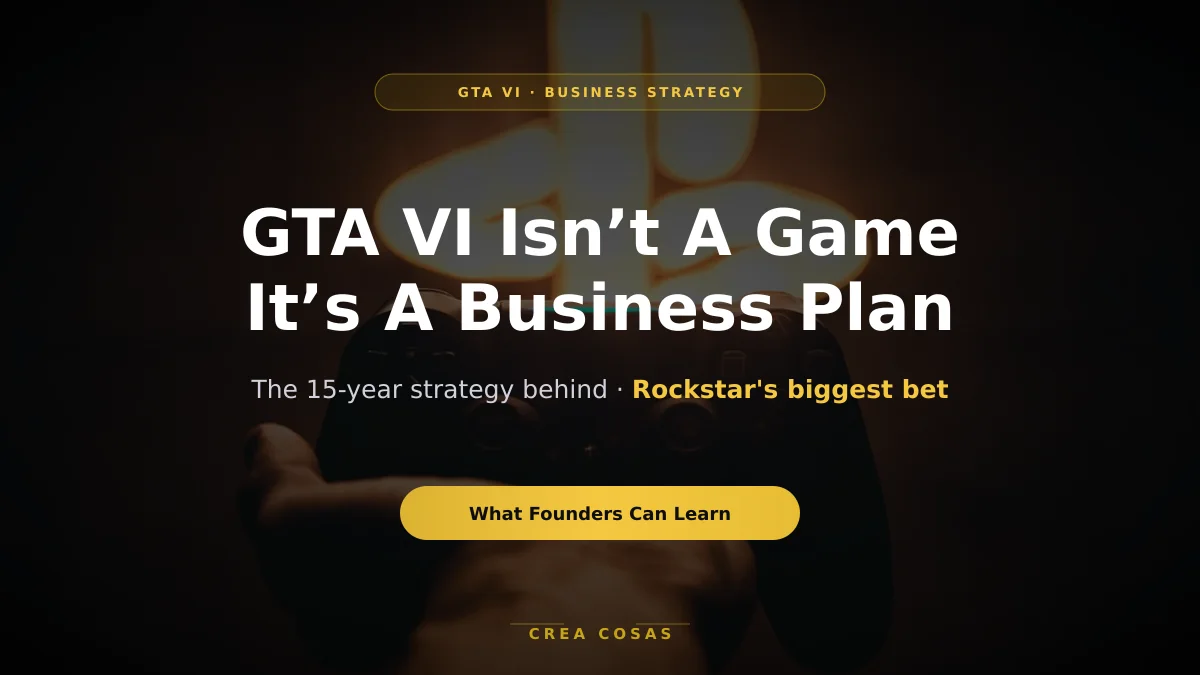
GTA VI: The Best Business Strategy in the World Right Now
Published on:
Reading time: 7 min
Topic: Strategy
Author: Leandro Valencia
GTA VI isn't just a game: it's a 15-year business model. Here's why video games are the most scalable platform there is for building a business and a brand.
Table of Contents
- Three seconds to win you over
- GTA VI isn't a game, it's a 15-year business plan
- Why software is the most scalable business there is
- Games as a service: selling once isn't enough
- Learning by playing: the brand recall that advertising can no longer achieve
- What an entrepreneur can learn from GTA VI
- Conclusion
- Sources
Three seconds to win you over
Today a brand has less than three seconds to earn your attention. An ad on Reels, a banner, a pre-roll you skip without thinking. We're so flooded with advertising that we've learned to ignore it almost by reflex.
And meanwhile, there's a company that for more than a decade has gotten millions of people to spend hundreds of hours, of their own free will, inside its product. To pay to get in. To come back every week. To talk about it without anyone paying them to.
That company is Rockstar Games, and its next move, GTA VI, arrives on November 19, 2026. In this article I want to argue something that sounds exaggerated at first glance: GTA VI is probably the best business strategy that exists today. And the reason isn't the game itself, but what it represents: video games as the most powerful platform for building business and brand in the long run.
GTA VI isn't a game, it's a 15-year business plan
To understand the GTA VI bet you have to look at its predecessor. GTA V came out in 2013 and, thirteen years later, it's still selling. According to Take-Two's August 2026 report, it has already surpassed 230 million units across three console generations, and the full series is approaching 475 million (Game Developer).
Think about it from an entrepreneur's logic:
- One development, three generations of hardware. GTA V launched on PS3, then on PS4 and later on PS5. The same product, repackaged and sold again to the same customers and to the new ones.
- A product that became a platform. GTA Online, the multiplayer mode, is still generating recurring spending from players more than a decade later. In the last reported quarter, that spending grew 3% compared to the previous year.
- A brand that sells itself. Rockstar spent years announcing almost nothing, and even so the first GTA VI trailer broke YouTube viewing records. Expectation is the marketing.
Take-Two projects between $8.0 and $8.2 billion in net sales for its fiscal year 2027, largely thanks to GTA VI. No movie, series or advertising campaign has a life curve like that. That's why I say GTA VI isn't a launch: it's the second phase of a business plan that started in 2013 and will probably run until 2040.
Why software is the most scalable business there is
A video game is, first of all, software. And software has a property that almost no other business has: it costs a lot to create once, but almost nothing to reproduce it a thousand times more.
If you sell shoes, every new pair needs leather, labor and transportation. If you sell a game, copy number 230 million costs practically the same as number two: a file that gets downloaded. That's called near-zero marginal cost, and it's the reason software companies can grow without their costs growing at the same pace.
On top of that, add three more advantages:
- Instant global distribution. On the same day, a player in Aguadas and another in Tokyo buy the same product.
- Continuous improvement. A physical product stays as it left the factory. Software is updated, fixed and grows after being sold.
- User data. Every play session tells you what people enjoy, where they get bored and what they're willing to spend on.
The initial investment for a game like GTA VI is gigantic and risky. But once the world is built, every new player is almost pure profit. That's the math that makes the bet make sense.
Games as a service: selling once isn't enough
Here's the hard part. The "games as a service" model means you don't sell a finished product, but an experience that stays alive: updates, events, new content, a community to take care of. GTA Online has been running this way for more than ten years.
That implies an enormous commitment to the user:
- You have to keep investing in development after launch.
- You have to listen to the community, even when it criticizes.
- You have to maintain servers, security and balance in the game's economy.
- If you fail, people leave and don't come back.
Many companies have tried and failed, precisely because they underestimated that commitment. A poorly executed game as a service is a bottomless expense.
But when it works, it completely changes the relationship with the customer. It's no longer a sale, it's an emotional subscription. The player doesn't buy a product: they buy a place they want to return to. And a customer who comes back by choice for years is worth many times more than one who buys once. It's the same principle behind any recurring-revenue business, taken to the extreme.
Learning by playing: the brand recall that advertising can no longer achieve
Think about how you learned to ride a bike. Nobody gave you a presentation. You tried, you fell, you tried again. You learned by doing. A video game works the same way: it puts you in a situation, lets you make mistakes without real consequences and rewards you when you succeed.
That's why gamification is one of the best ways to teach a process or an idea. And it doesn't matter whether the world resembles reality or is totally fictional: what sticks is the experience of having lived it.
Compare it with traditional advertising:
| Traditional ad | Gamified experience | |
|---|---|---|
| Attention time | Seconds, often interrupted | Hours, by one's own decision |
| The person's role | Passive spectator | A protagonist who makes decisions |
| Relationship with the brand | Something you skip | A place you return to |
| Recall | Forgotten at the next scroll | Associated with your own emotions and achievements |
When someone spends 200 hours in Vice City driving through streets, listening to the in-game radio and living stories, they're not watching an ad. They're building memories. And memories are the most powerful form of brand recall that exists.
This isn't exclusive to AAA games. Duolingo turned learning languages into a daily streak. Many companies already use simulators to train their people. The lesson is the same: if you want someone to remember your idea, let them live it, not just see it.
What an entrepreneur can learn from GTA VI
You don't need Rockstar's budget to apply this logic. These are the takeaways I'm leaving with:
- Build once, sell many times. If your business depends on your time, think about which part you can turn into software, a course or a digital product.
- Create a place, not an ad. A community, an app or an experience people want to return to is worth more than a thousand paid impressions.
- Think in decades, not campaigns. GTA V has been making money for 13 years. What are you building today that will still be alive in 2035?
- Take on the commitment to the user. Recurring revenue demands listening, updating and caring for your community. If you're not willing, sell closed products.
- Teach by playing. Challenges, levels, rewards and visible progress make people learn and remember your brand.
Conclusion
GTA VI arrives in November 2026 and will probably break every record in the entertainment industry. But the interesting part isn't how much it will sell on day one. What's interesting is that Rockstar understood something many companies still haven't: in a world saturated with three-second ads, the brand that wins is the one people want to live.
And you, if you had to turn your business into a game, what would it look like? Tell me in the comments.
Sources
Related Posts
Keep exploring similar content that may interest you
How to build a pitch deck that raises investment: structure, examples and common mistakes
The structure of a 10-12 slide pitch deck (problem, solution, market, product, model, traction, team, competition and ask), what doesn't belong on each slide, and the mistakes that make an investor close the file.
OKR vs KPI: which goal system to use based on your team's size
KPIs measure the ongoing health of the business; OKRs mark the change you want to force in a cycle. When to use each if you're alone, on a team of 3-10 or 10-50, with LATAM examples.
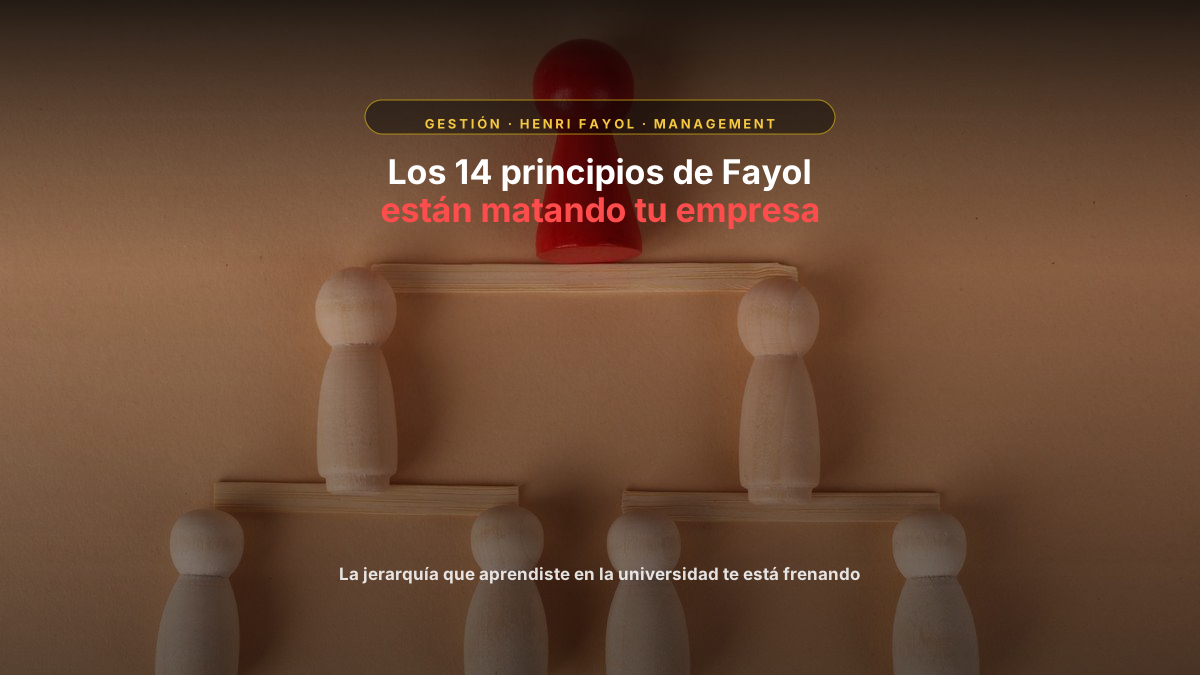
Why Fayol's 14 Principles Are Killing Your Company
Fayol's 14 principles are taught as dogma in every business school. In 2026, applying them to the letter is sinking companies that could be agile instead.
Partnerships
Tools I use every day, on better terms for this community.