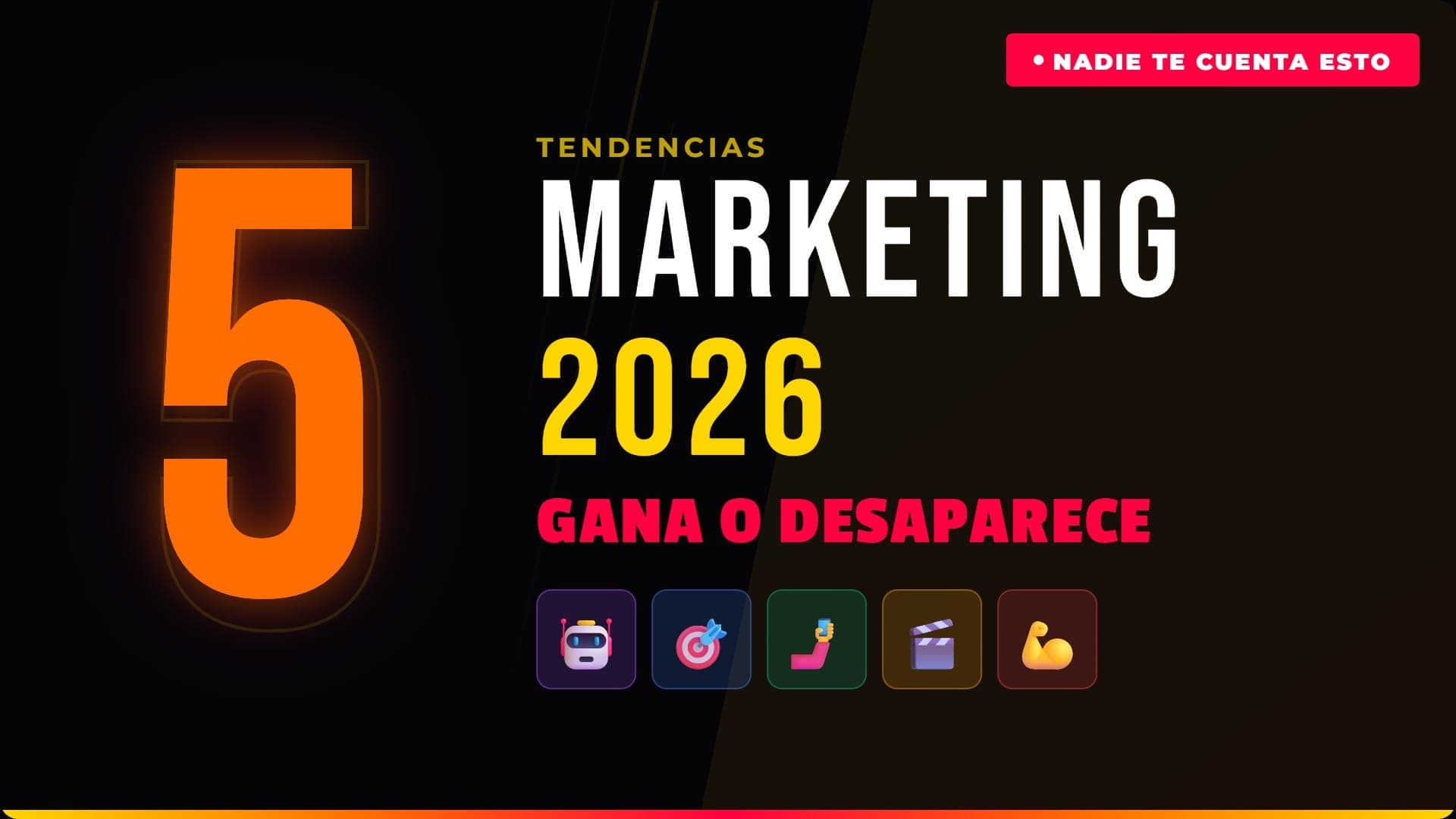
Marketing Trends 2026: 5 Strategies That Actually Work
Published on:
Reading time: 11 min
Topic: Marketing
Author: Leandro Valencia
Discover the most important marketing trends for 2026 and how to apply them with intention: invisible AI, niche positioning, UGC, storytelling, and radical transparency to build trust and drive conversions.
Table of Contents
- Quick Comparison of the 5 Marketing Trends for 2026
Frequently Asked Questions About Marketing Trends in 2026
- What are the most important marketing trends for 2026?
- Should I stop using AI in my marketing?
- Why does UGC often outperform traditional ads?
- Do I need a big audience for algorithms to favor my content?
- What does built in public mean in practice?
- Does this apply only to B2C brands?
- Which trend should I prioritize first?
- Conclusion: The Future of Marketing Is More Human
Introduction: The Big Mistake Large Brands Keep Making
Some of the biggest brands in the world have started to confuse efficiency with relevance. They automate more, publish faster, and polish everything to perfection, yet they still fail to create trust. The result is visible across social media: audiences are tired of content that feels manufactured, predictable, and emotionally empty.
That is the real context for marketing in 2026. The conversation is no longer about who has access to more tools. It is about who can use those tools without sacrificing clarity, personality, and credibility. The brands growing now are not rejecting technology, but they are using it with much more discipline.
Why This Matters Right Now
Digital platforms have become brutally efficient at filtering generic content. Audiences also recognize artificial messaging much faster than before. If something feels copied, inflated, or detached from real experience, it loses impact almost immediately.
This is not a temporary reaction. It is a broader correction after years of over-automation, weak brand voice, and content created for volume instead of resonance.
What You Will Learn in This Guide
- Why visible AI can damage brand trust and where AI is actually useful
- Why niche positioning now beats broad reach on major platforms
- How UGC and microinfluencers create stronger buying intent than traditional ads
- Why storytelling is becoming the real unit of marketing value
- How transparency can become a competitive advantage for both personal brands and companies
If you run a business, build a personal brand, or want to understand where digital marketing is heading in 2026, this guide will give you a more useful framework than the usual trend roundups.
Trend 1: Invisible AI — Use Artificial Intelligence Without Making It Obvious
The issue is not AI itself. The issue is obvious AI. When people can tell that a brand let the machine speak for them, the content loses weight. It feels lazy, risk-free, and distant.
Audiences do not reject efficiency. They reject the absence of human judgment. That is why visible AI often triggers skepticism even when the output is technically correct.
The Problem: Audiences Distrust Content That Feels Machine-Made
Consumers have become much better at spotting synthetic tone, repetitive phrasing, and over-structured messaging. The moment something feels too generic, people assume the brand optimized for speed instead of substance.
This matters because trust is fragile. In practice, content that "smells like AI" often underperforms not because the information is wrong, but because the delivery feels impersonal.
The Better Approach: AI in the Backend, Human in the Frontend
AI is extremely useful for research, outlining, ideation, pattern detection, and workflow support. It can save time in the invisible part of the process. But the final layer should still carry human voice, human selection, and human priorities.
Think of AI as production infrastructure, not as your public identity. Let it accelerate thinking, not replace perspective.
Practical Steps
1. Use AI to prepare, not to publish. Generate options, compare angles, build outlines, and surface blind spots. Then rewrite the final message in your own voice.
2. Audit content for artificial tone. Read it aloud. If it sounds interchangeable, over-polished, or emotionally flat, it still needs human work.
3. Keep your visible layer unmistakably yours. Your examples, opinions, phrasing, and imperfections are not a weakness. They are what make the content believable.
Key Takeaway
The most effective use of AI in 2026 is invisible. Use it to improve process quality, not to erase the human qualities that make people pay attention.
Trend 2: Niche Over Mainstream — Generic Content Is Losing
For years, brands were told to speak to the broadest possible audience. That approach now creates weaker positioning, weaker content, and weaker distribution. Platforms reward relevance, not vagueness.
In practical terms, narrow clarity beats broad ambition. Specific messages travel further because they create stronger identification.
The Problem: Generic Content Competes With Everything
If you publish broad advice for everyone, you are competing with endless alternatives that sound almost the same. Your message becomes harder to remember and easier to ignore.
Algorithms now map user interests with far more precision. That means a highly specific message can outperform a broad one even from a much smaller account.
What the Platforms Reward in 2026
TikTok, YouTube, and Instagram increasingly favor content that matches strong intent. A message aimed at "everyone" gives the platform very little to work with. A message aimed at a recognizable niche gives the platform a clear audience to distribute it to.
That is why specificity is not a creative limitation. It is a distribution advantage.
Practical Steps
1. Define your audience in one precise sentence. Not "entrepreneurs" or "small businesses." Something like "freelance designers who want to raise prices without losing clients."
2. Speak to concrete problems. Avoid generic claims like "grow online." Instead say exactly what outcome, obstacle, and context you are addressing.
3. Measure qualified response, not vanity metrics. Comments, leads, saves, replies, and conversions matter more than raw reach.
Key Takeaway
In 2026, clarity is leverage. A smaller but highly aligned audience is far more valuable than broad attention from the wrong people.
Trend 3: UGC and Microinfluencers — Content That Does Not Feel Like Advertising Converts Better
People do not trust polished claims as easily as they used to. They trust evidence, context, and believable recommendation. That is why UGC and microinfluencers continue to outperform traditional brand advertising in many categories.
The format matters as much as the message. When content feels native, personal, and grounded in real usage, resistance drops.
The Problem: Traditional Advertising Starts With a Trust Deficit
Most audiences assume ads are engineered to persuade at any cost. That assumption creates distance before the message even begins. UGC changes the frame. It feels closer to review, testimony, or lived experience than to corporate promotion.
Microinfluencers create a similar effect. Their audiences are smaller, but often more focused and more engaged.
Why It Works
UGC works because it reduces perceived distance between the product and the person evaluating it. Instead of a brand declaring value, a creator demonstrates context.
That context is what drives conversion. Buyers want to see how something fits into real life, not just how it looks inside a campaign.
Practical Steps
1. Work with creators who match the audience, not just the metrics. Relevance and credibility matter more than follower count.
2. Give creators room to sound natural. Over-scripted UGC often loses the exact authenticity you are paying for.
3. Build repeatable creator systems. Document which creators drive qualified traffic, which formats convert, and which hooks consistently work.
Key Takeaway
When marketing feels less like persuasion and more like proof, people respond with less resistance and more intent.
Trend 4: Storytelling Over Mere Action — Execution Needs Narrative
Many brands document activity without creating meaning. They show launches, campaigns, meetings, packaging, and milestones, but they never explain why those moments matter. Action alone rarely holds attention. Story does.
In 2026, attention increasingly goes to content that gives context, tension, and transformation, not just motion.
The Problem: Activity Without Meaning Is Forgettable
Posting "what happened" is not enough. Audiences want to know what changed, what was learned, what risk was taken, or what conflict was resolved.
Without that narrative layer, even real work can feel flat.
What Strong Storytelling Adds
Good storytelling creates emotional orientation. It helps the audience understand the stakes, the decision, the obstacle, and the payoff. That is what makes ordinary business moments memorable.
You do not need fiction. You need interpretation.
Practical Steps
1. Frame actions around a before and after. What was the problem? What changed? Why does that change matter?
2. Look for tension, not just process. The most engaging part is often the doubt, tradeoff, or mistake inside the process.
3. Turn small moments into meaningful stories. A first client, a pricing decision, a product revision, or a rejected idea can all become strong content with the right framing.
Key Takeaway
The content that performs best is not always the most polished. It is the content that makes people feel the significance of what happened.
Trend 5: Built in Public — Radical Transparency as a Competitive Advantage
Perfection has started to create suspicion. Audiences know that real work involves uncertainty, iteration, and imperfect decisions. When a brand only shows clean outcomes, it can feel edited beyond credibility.
That is why built in public has become more powerful. Sharing process, friction, and decision-making creates a stronger sense of reality.
The Problem: Perfection Signals Distance
Highly controlled branding often removes the very signals that make a project trustworthy. People do not need chaos, but they do need signs that something real is being built by real people.
Transparency does not mean exposing everything. It means sharing enough of the process to make trust plausible.
What Built in Public Actually Means
Built in public is not oversharing for attention. It is the practice of documenting progress, lessons, experiments, and decisions in a way that invites the audience into the journey.
Done well, it creates loyalty because people stop feeling like spectators and start feeling involved.
Practical Steps
1. Share decisions, not just outcomes. Explain what you chose, what you rejected, and why.
2. Show revision, not only success. Progress is more believable when people can see the evolution.
3. Use transparency strategically. Reveal the parts of the process that deepen trust and clarify your thinking.
Key Takeaway
Radical transparency works because it replaces polished distance with informed trust.
Quick Comparison of the 5 Marketing Trends for 2026
| Trend | Core Shift | Main Benefit |
|---|---|---|
| Invisible AI | AI supports from behind the scenes | Greater efficiency without losing trust |
| Niche over mainstream | Specificity beats broad messaging | Better distribution and stronger positioning |
| UGC and microinfluencers | Proof beats polished promotion | Higher credibility and conversion |
| Storytelling over mere action | Meaning beats activity | Stronger attention and retention |
| Built in public | Transparency beats perfection | Deeper trust and brand loyalty |
5 Quick Ways to Start This Week
Tip 1 — Invisible AI
Use AI to create topic clusters, outlines, or content angles, then rewrite the final piece entirely in your own voice.
Tip 2 — Niche
Write one sentence that clearly defines who your content is for, what they want, and what is getting in their way.
Tip 3 — UGC
Find three smaller creators in your niche and test a simple collaboration with minimal scripting.
Tip 4 — Storytelling
Document one real decision, challenge, or change this week and explain why it mattered.
Tip 5 — Built in Public
Publish one honest update about something unfinished, uncertain, or recently improved.
Frequently Asked Questions About Marketing Trends in 2026
What are the most important marketing trends for 2026?
The strongest shifts are invisible AI, niche-driven positioning, UGC and microinfluencers, stronger storytelling, and more transparent brand building.
Should I stop using AI in my marketing?
No. The better approach is to use AI in research, planning, and internal support while keeping public-facing communication clearly human.
Why does UGC often outperform traditional ads?
Because it feels more credible, more contextual, and less engineered than polished brand messaging.
Do I need a big audience for algorithms to favor my content?
Not necessarily. Strong relevance and specificity can outperform follower count.
What does built in public mean in practice?
It means documenting real progress, decisions, and lessons in a way that makes your process more visible and trustworthy.
Does this apply only to B2C brands?
No. These principles also work in B2B, especially where trust, expertise, and positioning drive sales.
Which trend should I prioritize first?
Start with niche clarity. If you do not know exactly who you are talking to, every other tactic becomes weaker.
Conclusion: The Future of Marketing Is More Human
All five trends point in the same direction. The market is rewarding brands that feel clearer, more specific, more grounded, and more honest. Technology still matters, but it is no longer the differentiator on its own.
The real advantage in 2026 is not sounding more optimized than everyone else. It is sounding more real while still operating with discipline. The brands that win will be the ones that use technology to strengthen human communication, not to replace it.
In a market full of polished sameness, authenticity is no longer a soft brand value. It is a growth strategy.
You can also watch this breakdown on YouTube Watch the full video here.
Related Posts
Keep exploring similar content that may interest you
SearchFit SEO in Claude Code: Install, Setup, and a Gym SEO Case Study
SearchFit SEO explained: what it is, how to install it in Claude Code, and how to use it step by step — with a real gym SEO case study covering scored audits, keyword clustering, schema markup, and optimized content.
Rank Your Website on Google and Bing in 2026 (Real Data)
My process for getting organic traffic on Google, Bing and AI: keywords, article clusters, Search Console, Bing Webmaster Tools and IndexNow, with real numbers.

How to index your website in Baidu and Naver from Latin America
A real-world guide to getting indexed in Baidu and Naver from Latin America: accounts, ICP filings, sitemaps, push API, hreflang and the most common mistakes, with links to the official documentation.
Partnerships
Tools I use every day, on better terms for this community.