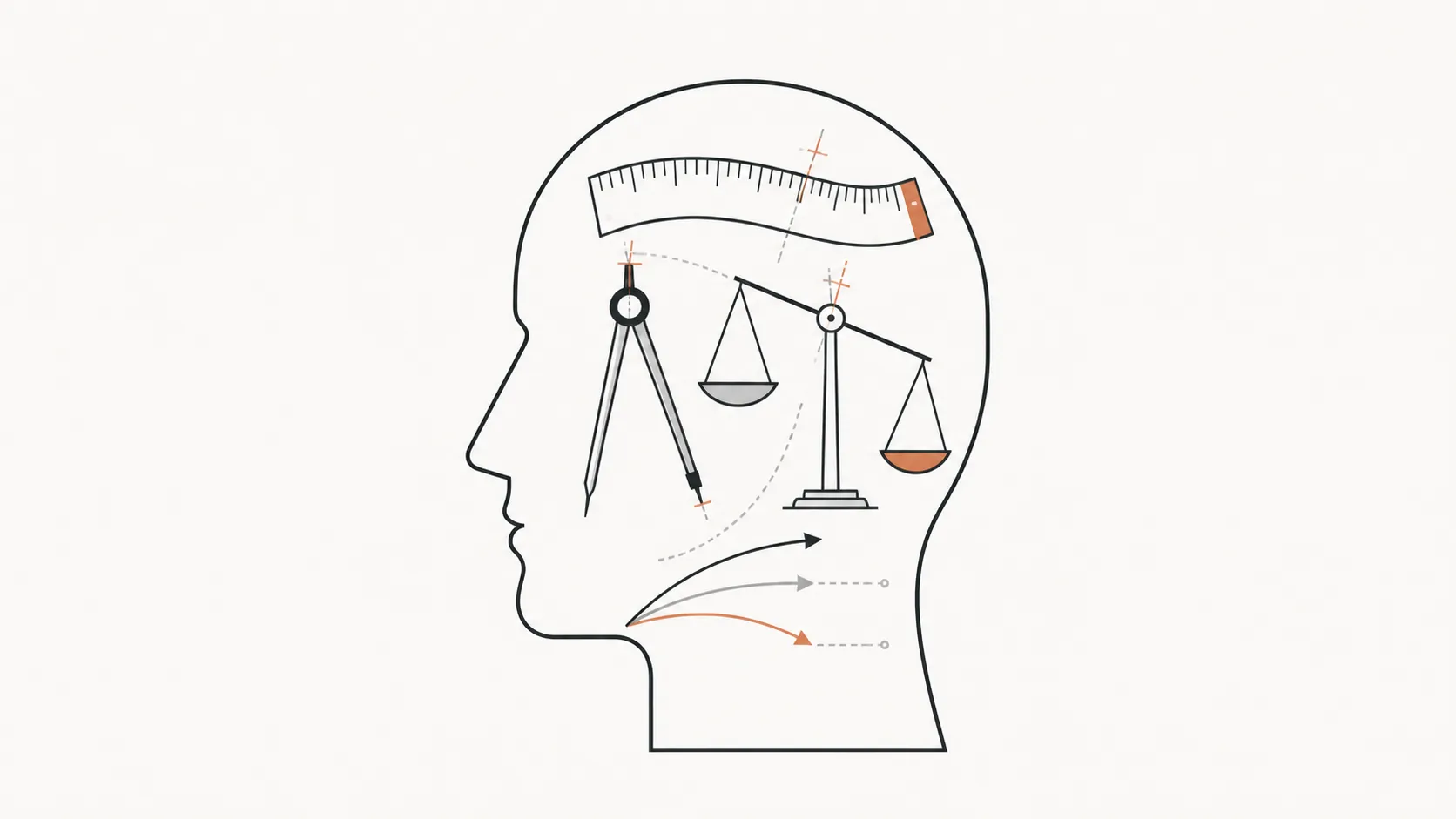
Cognitive Biases for Entrepreneurs and Freelancers: How to Spot Them and Decide Better
Published on:
Reading time: 12 min
Topic: Leadership
Author: Leandro Valencia
A practical guide to cognitive biases applied to business: 8 biases with real cases, a comparison table with mitigation strategies, and a reflection on deciding with judgment.
Table of Contents
- What a Cognitive Bias Is (Without the Textbook Psychology)
- Why Biases Hit Harder When You Work for Yourself
The 8 Biases That Cost the Most Money (With Real Use Cases)
- 1. Sunk Cost Fallacy: Continuing Because You Already Invested
- 2. Confirmation Bias: Looking for the Yes You Already Brought With You
- 3. Overconfidence: The Plan That Only Works If Everything Goes Right
- 4. Anchoring Bias: Whoever Says the First Number Wins
- 5. Survivorship Bias: Learning From the Ones Who Won
- 6. Status Quo Bias: Not Deciding Is Also Deciding
- 7. Availability Bias: What You Remember Feels Like What Happens
- 8. Planning Fallacy: It Always Takes Longer
- Comparison Table: Biases and Strategies to Mitigate Them
- A Simple Protocol to Apply This Week
- Final Reflection: Thinking Well Is an Act of Humility, Not Intelligence
- Frequently Asked Questions About Cognitive Biases
What a Cognitive Bias Is (Without the Textbook Psychology)
A cognitive bias is a systematic gap between what you believe and what's actually there. The key word is systematic: it's not a random error, it's an error that repeats itself in the same direction every time. That's why it's predictable. And that's why you can design against it.
Daniel Kahneman and Amos Tversky explained it with two modes of thinking: one fast, automatic, and intuitive, which handles 95% of your day without you noticing; and another slow, deliberate, and costly, which only activates when you force it to. Biases are the price you pay for having a fast system. They're not a factory defect — they're the factory.
The practical conclusion is uncomfortable: you can't eliminate your biases. Decades of research show that simply knowing about them barely protects you from them. What you can do is change the environment where you decide — the processes, the formats, the moments — so the bias has less room to operate. You fight it with design, not willpower.
Why Biases Hit Harder When You Work for Yourself
An entrepreneur or freelancer operates under exactly the conditions that amplify any bias:
- Slow, noisy feedback. A client doesn't tell you why they didn't hire you. A product takes months to confirm whether it worked. Without clear feedback, you don't learn — you just accumulate opinions.
- Total emotional involvement. You're not evaluating a project, you're evaluating something of your own. Critical distance is nearly impossible.
- Zero counterweight. No one forces you to justify the decision out loud to someone who might say no.
- Tiny sample sizes. Three happy clients look like a trend. They're not.
There's a data point that illustrates this well. A classic study by Cooper, Woo, and Dunkelberg of nearly 3,000 entrepreneurs found that 81% gave themselves 7 or more chances out of 10 of succeeding, and 33% gave themselves a flat 10 out of 10 — absolute certainty — despite the fact that real survival rates for new businesses are far worse. Interestingly, when rating the odds of other businesses like theirs, the same entrepreneurs were much more realistic. The bias isn't that we can't calculate. It's that we stop calculating when the subject is us.
The 8 Biases That Cost the Most Money (With Real Use Cases)
1. Sunk Cost Fallacy: Continuing Because You Already Invested
You've spent four months building a feature nobody asked for. You know it isn't working. And yet you keep going, because stopping now would mean "losing" those four months.
You wouldn't lose them — they're already lost. The only rational question is whether investing the next month there pays off more than investing it in anything else. The past isn't information about the future; it's just the price of admission.
Where it shows up in your business: toxic clients you keep because you've had them for two years, services with no margin that you "already have set up," a website half-redone, a partner who no longer contributes.
2. Confirmation Bias: Looking for the Yes You Already Brought With You
You have an idea and go out to "validate" it. You ask ten people if they like it. Everyone says yes, because asking "do you think it's a good idea?" is asking for a compliment, not a data point.
Confirmation bias doesn't distort your answer — it distorts your question. You filter your sources, phrase things poorly, and interpret anything ambiguous in your own favor.
Where it shows up: idea validation, customer interviews, reading metrics (you notice the one that went up), choosing references that "confirm" your method.
3. Overconfidence: The Plan That Only Works If Everything Goes Right
It's the best-documented bias and the most dangerous, because it disguises itself as an entrepreneurial attitude. You estimate revenue using your best-ever conversion rate, calculate capacity assuming you'll work without interruptions, and promise dates based on a scenario where nothing fails.
Careful: a certain amount of overconfidence is functional. Without it, no one would quit a salary to build something. The problem isn't the boldness; it's boldness without a cushion.
Where it shows up: financial projections, client budgets, hiring decisions, launches.
4. Anchoring Bias: Whoever Says the First Number Wins
The first number that enters the conversation becomes the center of gravity for everything that follows. If the client says "we have around $800," your $2,500 proposal is already on the defensive. If you state your rate first, whoever negotiates is negotiating against your anchor.
Where it shows up: rate negotiations, competitor pricing (which you copy without knowing their costs), timeline estimates someone threw out in a meeting, the first figure in your funding round.
5. Survivorship Bias: Learning From the Ones Who Won
You read biographies of successful founders, listen to podcasts by people who made it, copy the routines of whoever bills seven figures. You're studying exclusively the survivors.
The canonical example is Abraham Wald in World War II: the military wanted to armor the parts of returning planes that showed the most bullet holes, until he pointed out they should armor the other parts — planes hit there never made it back. The data that's missing is the data that would tell you the most.
Where it shows up: benchmarking, "best practices," success stories, content strategies copied from whoever already has an audience.
6. Status Quo Bias: Not Deciding Is Also Deciding
You've kept the same rate since 2023. You're still using the tool you hate. That client who drains you is still on your roster. None of those are decisions you made — they're decisions you stopped making.
Changing has a visible, immediate cost. Not changing has an invisible, deferred one. The brain prefers the second, even when it's bigger.
Where it shows up: pricing, tools, client portfolio, positioning, service structure.
7. Availability Bias: What You Remember Feels Like What Happens
One client complained loudly by email and you spend the week redesigning the entire service. Meanwhile, the thirty who were satisfied and silent don't register in your head. What's vivid, recent, and emotional weighs more than what's frequent.
Where it shows up: prioritizing improvements, reacting to reviews, choosing channels ("I got a client through LinkedIn, so LinkedIn works"), fears that block launches.
8. Planning Fallacy: It Always Takes Longer
It's the time-based version of overconfidence, and it has the most damning evidence behind it. Bent Flyvbjerg, analyzing hundreds of megaprojects across more than a hundred countries, found that nine out of ten go over budget, with overruns above 50% being far from exceptional — and the number hasn't improved across decades of comparable data.
If that happens with professional engineering teams and multi-million-dollar budgets, your estimate of "I'll have this ready by Friday" doesn't stand a chance.
Where it shows up: delivery dates, project scope, launches, any sentence that starts with "in two weeks."
Comparison Table: Biases and Strategies to Mitigate Them
| Bias | How It Sounds in Your Head | Where It Costs You Money | Strategy to Mitigate It |
|---|---|---|---|
| Sunk cost | "I've already invested too much to quit now" | Clients, services, and projects you should have closed months ago | Ask yourself: if I were starting today from zero, would I choose this? Define an exit condition in writing before starting any project |
| Confirmation | "Everyone I talked to sees it clearly" | Products nobody buys after months of "validation" | Formulate the opposite hypothesis and go look for evidence that supports it. Replace "do you like it?" with "what do you do today to solve this?" |
| Overconfidence | "I can cover this with my current conversion rate, no problem" | Cash flow, broken promises, premature hires | Work with three scenarios (pessimistic, base, optimistic) and plan around the pessimistic one. Log your predictions and review them after 3 months |
| Anchoring | "Their budget is X, let's adjust to that" | Eroded rates, margins that don't cover your real cost | Calculate your price before the meeting and put it in writing. Speak the numbers first. If you get anchored low, reframe around value, not discounts |
| Survivorship | "That's how the one who made it did it" | Copied strategies that don't apply to your context | Actively look for failure cases in your niche. Always ask: how many people tried this exact thing and it didn't work? |
| Status quo | "Let's just leave it as is for now" | Frozen prices, outdated tools, draining clients | Schedule a fixed quarterly review of pricing, portfolio, and stack. Turn "not changing" into a decision you have to justify |
| Availability | "This has been happening a lot lately" | Misplaced priorities, overreactions to isolated cases | Demand a number before acting: how many cases, out of how many total? Decide based on aggregate data, never on the most recent anecdote |
| Planning fallacy | "I'll have this ready by Friday" | Delays, unbilled hours, reputation | Use the outside view: how long did your last three similar projects actually take? Estimate from that track record, not your gut, and add an explicit buffer |
A Simple Protocol to Apply This Week
Biases aren't fixed by reading about biases. They're fixed with rituals that don't depend on your mood:
- The decision log. Before any relevant decision, write two lines about what you expect to happen and why. Reread it in 90 days. It's the only honest mirror you'll ever have, because your memory rewrites the past to always make you look consistent.
- The pre-mortem. Before launching, imagine six months have passed and the project failed completely. Write the explanation. This shift in perspective unlocks objections you'd never raise in optimist mode.
- The outside view. For any estimate, don't ask "how long do I think this will take?" but "how long did similar cases actually take?"
- The uncomfortable counterpart. Someone — a colleague, a mentor, a community — whose explicit job is to tell you why your idea wouldn't work. Not a friend who cheers you on: a sharp-minded contrarian.
None of these four rituals cost money. All four cost the one thing that's genuinely scarce: being willing to look bad to yourself once in a while.
Final Reflection: Thinking Well Is an Act of Humility, Not Intelligence
There's something almost comic about all this. We spend our lives convinced we're deciding, when in reality we're almost always justifying. Spinoza put it better than anyone: human beings believe themselves free only because they're conscious of their actions and ignorant of the causes that determine them. Bias doesn't feel like bias from the inside. It feels like common sense, like intuition, like experience.
And the Stoics had already arrived at the useful part of the idea. Epictetus distinguished between the impression — what appears in your mind without your asking for it — and assent, that tiny instant when you make it your own. The impression isn't yours, and you can't avoid it. Assent is. All the work fits into that tiny gap between what your head proposes and what you decide to believe.
That's why I distrust the promise of "eliminating biases." It sounds like control, and it's actually the opposite: it's accepting that your judgment is an imperfect instrument and building, around it, a scaffolding that compensates for what you can't fix from the inside. Like a carpenter who doesn't trust his own hand but trusts his square instead. Not because his hand is bad, but because he knows no hand is perfectly straight.
That, to me, is the connection to building something. Creating anything means holding a permanent tension: you need enough confidence to start something that's statistically likely to fail, and enough honesty to see in time when it's failing. Too much of the first and you spend years building something nobody wanted. Too much of the second and you never build anything.
A creator's maturity isn't measured by being right more often. It's measured by needing to be right less, and by building systems that warn you before the mistake gets expensive. In the end, deciding well isn't a personality trait or a gift. It's a habit, and like every habit, it's either built on purpose or inherited by neglect.
Frequently Asked Questions About Cognitive Biases
Can cognitive biases be eliminated? No. Debiasing research shows that simple awareness of a bias barely reduces its effect. What does work is changing the decision environment: checklists, written decisions, pre-mortems, historical data, and external counterweights.
What's the most expensive bias for an entrepreneur? It depends on the stage. Early on, confirmation bias (building something nobody wants). During operations, sunk cost (holding on to what no longer pays off). During planning, the planning fallacy.
Does intuition actually help, then? Yes, but only in environments with fast, clear, and repeated feedback — where you've actually been able to learn. A salesperson with thousands of conversations has reliable intuition about a call. Nobody has reliable intuition about a new market.
How do I catch a bias in the moment? By the feeling of certainty without effort. If an important decision felt obvious and cost you nothing, that's exactly the moment to pause and write down why.
Related Posts
Keep exploring similar content that may interest you
Cognitive biases: thinking fast and slow
Discover how invisible cognitive biases, like confirmation bias or loss aversion, impact your decisions and learn to master them to think clearly and lead your company to success.

How to ask better questions: customers, teams, decisions
A practical guide to learning how to ask questions: why we ask badly, 7 types of questions with a table, the PADA method, templates for customers and 1:1s, common mistakes, and a 30-day plan.

Top 10 Leadership and Team Management Books for Entrepreneurs
10 books on leadership and team management for when the business grows and you can no longer do it all yourself, with direct links to Amazon Spain and the US.
Partnerships
Tools I use every day, on better terms for this community.