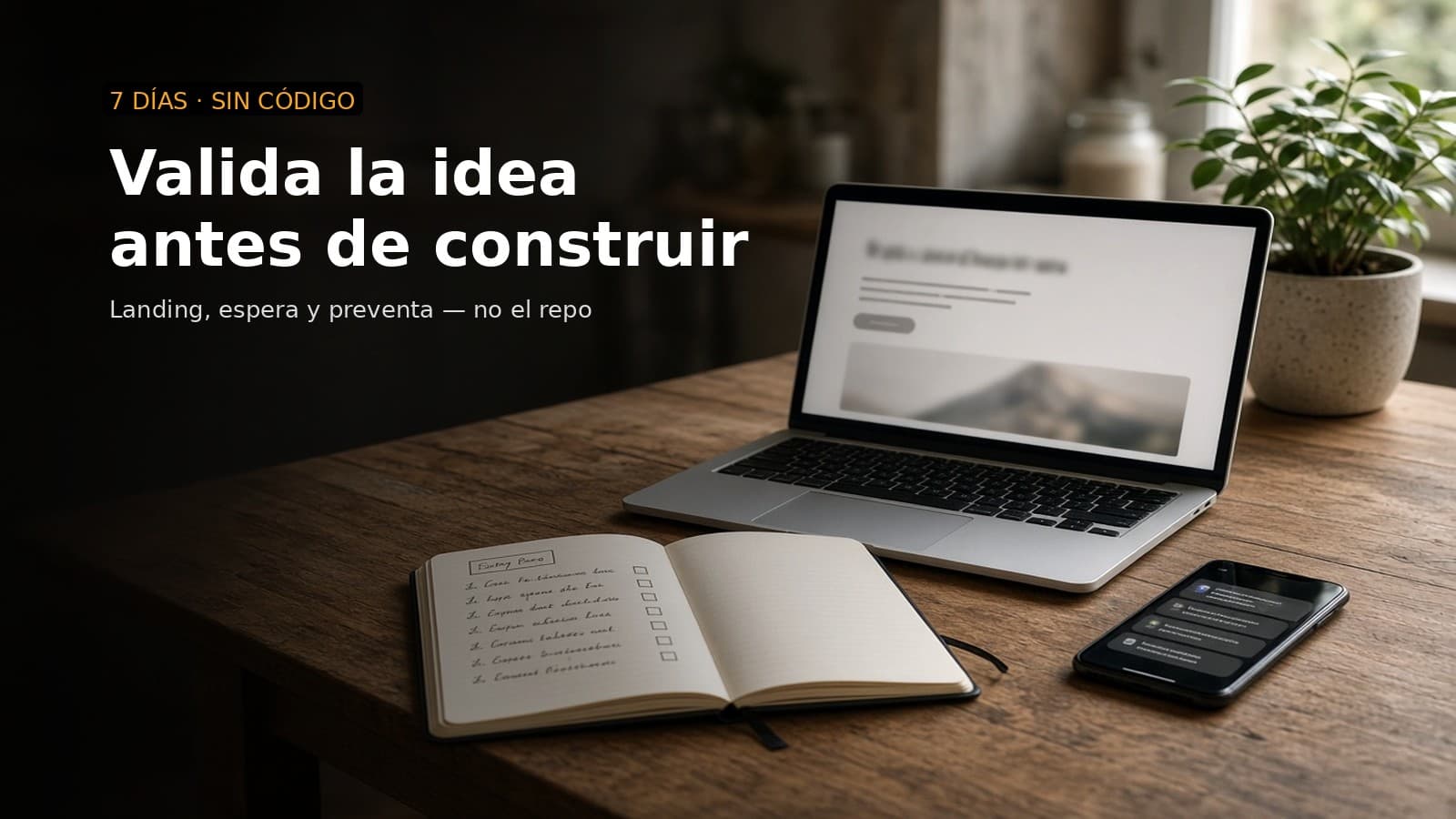
How to validate a business idea in one week without spending on development
Published on:
Reading time: 12 min
Topic: Entrepreneurship
Author: Leandro Valencia
A 7-day plan to validate an idea without coding: landing page, waitlist, fake door, pre-sale and a number that decides whether you continue or kill it.
Table of Contents
- What you're measuring
- Sunday night: offer, price and the killing number
- Day 1 — The ugliest landing page that's still understandable
- Day 2 — Waitlist, fake door and the spreadsheet
- Day 3 — The pre-sale, or you're not validating price
- Day 4 — Traffic: outreach or a cheap ad
- Day 5 — You only talk to whoever raised their hand
- Day 6 — Counting, without reinterpreting
- Day 7 — One of three decisions, in writing
- What counts as validated
There's one type of validation we already covered: going out to talk to people, writing hypotheses, and not selling during the interview. If you still don't know whether the problem exists, go to the Steve Blank method and do that week first. This post is the other kind. The one people skip because it feels "fake": building a storefront, putting a price on it, and seeing if anyone tries to buy. No repo. No agency. No "the MVP in Rails".
The question of these seven days isn't "is the idea good?". It's is there enough demand, with this message and at this price, to justify building? That isn't answered with a filled-in Canvas —the Canvas says how you think the business works; if you're missing the canvas, it's in how to build a business model—. It's answered with a page, a button that can be pressed, and a number you wrote on Sunday, before seeing any results.
If by the end of the week you haven't touched that number, you didn't "iterate the branding". You lost. That's the point.
What you're measuring
This week tests the offer: who, what, at what price, with what time promise. It doesn't test that you know how to build. It doesn't test retention. It doesn't test that the channel will be cheap forever. A fake door that converts doesn't authorize you to raise a round. It authorizes you to spend the next four weeks building, or to charge a pre-sale and deliver it by hand.
It doesn't test the problem either if nobody from the right audience saw the page. A hundred visits from friends aren't a hundred visits. Ten emails from the "entrepreneurs" WhatsApp group aren't a waitlist. If the traffic is contaminated, the number is useless: neither to kill nor to continue.
That's why the criterion gets written down before. If you write it on Saturday, you'll move the goalposts until your idea survives. Always.
Sunday night: offer, price and the killing number
Don't open Carrd yet. A one-page document:
Offer, one line. Not the category. Not "an AI platform for SMBs". Something someone can relay: "Weekly ad closings for ecommerces already selling between 5 and 20 thousand dollars a month, without getting locked into an agency."
Who stays out. If you don't exclude, you don't know who to send the link to. "Ecommerce owners who've never paid for ads" isn't the same product.
Visible price. A number. Not "from". Not "book a demo". If you're embarrassed to put it up, the week is already teaching you something and it's still Sunday.
What you deliver for the first 10 units. It can be ugly: you in Notion, on Zoom, in a spreadsheet. The pre-sale deliverable isn't the dream product. It's what you can fulfill if three people pay you tomorrow.
The number that kills the offer. Hard examples, so you copy the shape and write your own:
- B2B service / high ticket: 30 cold outreach → if there aren't 3 deposits or 5 calls booked with the price already seen, it dies.
- Cheap product or workshop: 100–150 non-friend visits → if there aren't 12–20 emails with the price on the page and at least 3 payments or deposits, it dies.
- Unpaid fake door: click on "Buy" from at least 8–10% of cold visits, and of those clicks half leave an email or a deposit. Anonymous clicks don't count.
Write it at the top of the spreadsheet. Friday is non-negotiable.
One ethical rule: if you charge, you deliver or refund. The fake door can be a button that doesn't charge. The moment money is involved, you stopped "validating" and started selling.
Day 1 — The ugliest landing page that's still understandable
Artifact: a page with five blocks. Not nine. Not a vision video.
- Headline with the result and the who. "Ad closings for 5–20k/month ecommerces. First experiment in 14 days."
- Three bullets of what's included and one of what's not included. The "no" filters.
- Price and what happens if you don't deliver (refund, an extra month, whatever you can sustain).
- One single CTA. "Reserve your spot — 150 USD deposit" or "Join the list — the price is 790 USD, this is not a free newsletter".
- Who you are, in three lines. Why you can deliver the first ten units by hand.
Carrd, Framer, a public Notion, a Google Doc with a big title. Pick the one you publish today. If on Sunday you're choosing typefaces, you already lost Monday.
Don't put up logos of clients you don't have. An invented testimonial invalidates the week: you'd be measuring your ability to lie. By the end of the day you have a URL you can send to a stranger. If you can't send it, it isn't ready.
Day 2 — Waitlist, fake door and the spreadsheet
Form (Tally, Typeform or Google Form). Name, email, what they do today to solve this, whether they'd pay the published price (yes / no / only if X changes). A "yes" without having seen the price is worthless.
Fake door. The main button says Buy or Reserve, not "I want more info". If you can't charge yet, the click leads to an honest screen: "Not ready yet. You can leave the deposit and join the first batch, or leave your email." Two buttons. You measure both.
Spreadsheet. Date, source, cold traffic?, saw the price, clicked buy, left email, paid deposit / paid in full, one-line note. If you don't separate cold from friend, on Friday you'll lie to yourself with an 18% conversion that was your cousin.
The fake door isn't a dark trick. It's a question with a body: do you press the button when there's a price? People are generous with opinions and stingy with clicks.
Day 3 — The pre-sale, or you're not validating price
A waitlist with the price on the page beats a blind list. It's still not money. Day 3 exists so that it can be paid.
- Mercado Pago, Stripe or bank transfer link for the deposit (10–30% of the price, or one month).
- A Calendly whose only slot says "onboarding — you've paid the deposit".
- A closed cap: "I'm taking 5 this month". If the cap is 200, it isn't a cap.
Write down what happens if you don't build the dream: you deliver the manual version, or you refund. Without that sentence you're measuring romanticism.
If the ticket is B2B and nobody will pay 150 USD to a stranger, the equivalent is heavier, not lighter: a letter of intent with an amount, a purchase order, or prepayment of the pilot. "Let's book something next month" doesn't go in the success column. "Send me the deposit invoice" does.
By the end of Wednesday, a stranger has to be able to give you money without talking to you on WhatsApp first. If the only path is a call with you, you're measuring your charisma.
Day 4 — Traffic: outreach or a cheap ad
A landing page without visits is a private diary. Today you look for people who don't owe you a favor.
Outreach (best default if the ticket is high). 30 real sends. LinkedIn, email, or the channel where that person already is. Short script, no "let me introduce my startup":
Saw you [do X]. I put up a page for [result] at [price]. I'm not asking for feedback. If it's useful, here's the link. If not, don't even reply.
Don't attach a PDF. Don't ask for "15 minutes to pick your brain". The click to the landing is the answer. Count sends, not profile impressions.
Cheap ad (best default if the ticket is low). 20–50 USD, one ad, one narrow audience. Destination: the landing page, not the Instagram. Turn it off if the visits are from another country, 17 years old, or people looking for jobs. You're buying signal, not reach.
Doesn't count: asking friends to "drop by and give opinions"; a post asking for likes; the founders' group where everyone validates each other. They contaminate the denominator.
If you don't reach the N of visits or outreach you wrote on Sunday, on Friday you can't declare the offer a failure. You can declare that you didn't run the experiment.
Day 5 — You only talk to whoever raised their hand
Today you don't do fifteen discovery interviews. That's the other post. Today you talk to whoever clicked, left an email or paid, and nobody else.
Fifteen minutes. Three questions:
- What did you believe you were buying when you pressed the button?
- What almost stopped you? (price, trust, "I already have something")
- If I deliver it by hand next month, what has to be there no matter what?
Write down their words. You'll rewrite the headline with that, if there's a Saturday. Don't use the call to convince. If you start selling, you stop hearing why everyone else didn't pay.
If nobody raised their hand, don't improvise interviews with friends. Read the landing page out loud. It's usually a cowardly headline, a blurry who, or a hidden price. Fix it once and send ten more outreach. Don't redesign.
Day 6 — Counting, without reinterpreting
Filter "cold traffic = yes" and fill in, no prose:
- cold visits / outreach sent
- % who saw the price (if you didn't measure it, assume they didn't see it)
- buy clicks
- emails
- deposits or payments
Diagnosis:
Few visits, good click or deposit %. Distribution, not offer. Extend the same experiment 3–4 days, same copy. Don't rebuild the product.
Enough visits, almost nobody clicks. The message or the who is wrong. Not "the market isn't ready". Change one variable: headline, price, or audience.
They click and don't pay / don't leave an email. Curiosity, not commitment. Price, distrust, or a CTA that promised "info" and charged.
They pay at the number's pace. Offer validated for hand-built delivery. You still don't have a company. You have permission.
Compare against Sunday's number once. If you're within one body (2 deposits instead of 3, with pipeline), you can give it 72 extra hours with the same rules. If you're at a fifth, no. You're negotiating.
Day 7 — One of three decisions, in writing
A ten-line memo. Nobody else has to read it. You do, in a month, when you want to "pivot" on a mood.
A. Kill this offer. Not "kill entrepreneurship". This promise, this who, this price. What's kept is the learning ("the under-5k folks don't pay; the 20k ones ask about Slack, not ads").
B. Change one variable and repeat the seven days. One single change. If you change three, the second experiment teaches you nothing.
C. Build, by hand, for whoever already paid or is on the hot list. Delivery calendar. None of "now I'll finally build the platform". The platform shows up when the manual version truly hurts.
If you chose C and have nobody to deliver to, you chose wrong. Building without a buyer is the habit this week existed to cut.
What counts as validated
Yes: money (deposit, prepaid month, purchase order); a stranger who, seeing the price, asks "when do I start?"; the same objection repeated that you can design around (that doesn't validate this offer: it validates the next experiment); a fake door % on cold traffic above the threshold written before.
No: likes and "great idea"; "looks good to me" from friends, your partner, or a mentor who isn't the client; a waitlist without the price on the page; "I'd buy it if it had X, Y and Z" (that's a free spec); your enthusiasm. You had that on Sunday too.
Shortcut: validated is when the no hurts because someone already said yes with a card or a deposit. Everything else is weather.
This week doesn't hand you a closed model —the Canvas gets filled after you know someone pays—. It doesn't give you the problem map if nobody from the segment ever talked to you: in that case stop and do the interviews from the Blank post. And three deposits aren't unit economics. They're permission to learn that in month two, not month eight with a product nobody asked for.
Frequently asked questions
What if I don't want to charge until the product exists?
Then you're not validating price. You can use fake door + email, with a higher threshold and cold traffic. It's weaker. It's honest. Don't call it a pre-sale.
Is Carrd + a form an MVP?
It's a demand experiment. The MVP is what you deliver afterwards to whoever paid: by hand, ugly, functional. Confusing the storefront with the product is how people spend a quarter "validating" without having served anyone.
Can I validate two ideas in the same week?
No. You'll mix traffic, copy and excuses. One offer. One number. One memo.
Seven days don't prove you're a founder. They prove whether this offer deserves next month. Development is expensive not because of hosting: it's expensive because it makes you fall in love. Write the number on Sunday. Don't edit it on Saturday.
Related Posts
Keep exploring similar content that may interest you

Entrepreneurship Classes: What to Learn and How to Choose
Do entrepreneurship classes actually work? Topics a good course should cover, formats (online, in-person, mentoring) and red flags to spot empty courses.
Entrepreneurship Learning Roadmap: What to Study and in What Order
A step-by-step learning roadmap for starting a business: the 6 stages, the skills to learn in each one, and the ordering mistakes that cost you time and money.
What Is Entrepreneurship? Definition, Types and Hard Truths
What is entrepreneurship really? A clear definition, its main types, common myths to drop, and how to know if you're ready to start a business in Latin America.
Partnerships
Tools I use every day, on better terms for this community.