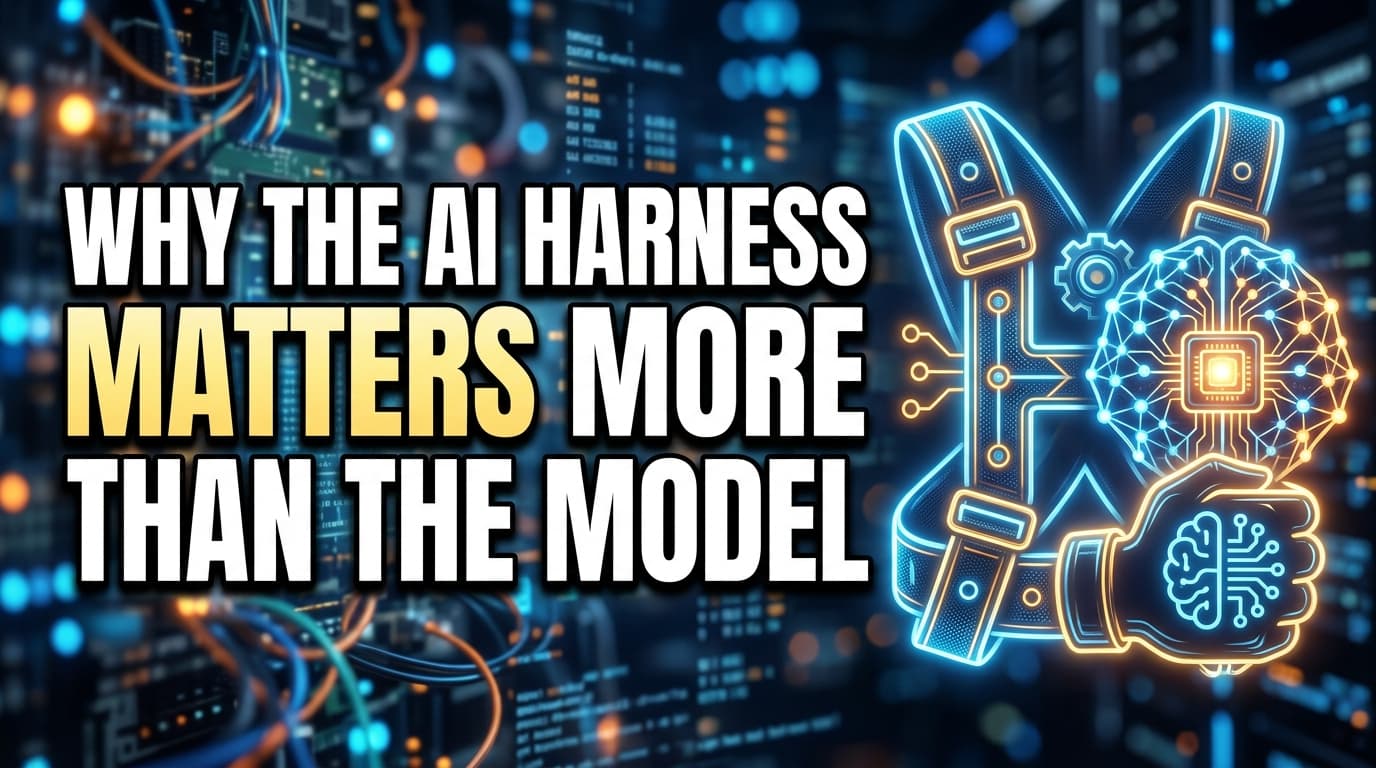
2026 AI Tier List: Why the Harness Matters More Than the Model
Published on:
Reading time: 8 min
Topic: Technology
Author: Leandro Valencia
An editorial comparison of Cursor, Claude Code, Antigravity, OpenCode, Hermes, VS Code, Orca, and Herder: why in 2026 your competitive edge comes from the AI harness, not just the model.
Table of Contents
- What is a harness?
- Editorial tier list of AI development tools
- Uncomfortable truth 1: "unlimited" subscriptions are disappearing
- Uncomfortable truth 2: the terminal is reclaiming the throne
- Uncomfortable truth 3: VS Code is no longer the default standard
- Uncomfortable truth 4: open source brings sovereignty
- Uncomfortable truth 5: orchestrators will matter more than assistants
- The minimalist harness: the case of P
- Conclusion: don't buy the model, design the system
- Frequently asked questions
What is a harness?
The harness is the abstraction layer between a developer's intent and the model. It isn't a chat window or a pretty interface — it's the infrastructure that manages project context, memory across sessions, persistent instructions, filesystem access, command execution, automated tests, tool-calling through MCP, permissions, and orchestration of parallel subagents.
The model is the engine. The harness is the whole vehicle — dashboard, navigation system, and brakes included. An extraordinary model inside a poorly designed harness produces mediocre results. A slightly less powerful model, connected to the right context with strong tools and a solid verification loop, delivers far more real value.
The question is no longer "which model is best?" It's: which system turns that model into reliable results?
Editorial tier list of AI development tools
This isn't a universal benchmark — each tool solves a different problem, and the right pick depends on the distance between your intent and what you need the agent to actually execute.
| Tier | Tools | Best for |
|---|---|---|
| S | Cursor, Claude Code, Antigravity CLI | Intensive development on real repositories |
| A | OpenCode, Hermes Agent | Open, local, self-hosted, or persistent workflows |
| B | VS Code with AI extensions | Compatibility and traditional integration |
| Specialists | Orca, Agent Herder | Supervising and orchestrating multiple agents |
| Purist | P | Building a fully custom environment |
Uncomfortable truth 1: "unlimited" subscriptions are disappearing
The fixed-subscription model had one clear advantage: it let you budget AI as a predictable monthly fee. But a single complex task can burn through thousands or millions of tokens, especially once advanced models, long contexts, external tools, and autonomous sessions get involved.
GitHub Copilot is moving to an AI credit system: usage is metered by actual consumption, and each plan includes a monthly allowance that can be extended with additional spend. Unlike Anthropic or Google, Microsoft doesn't own every model it integrates, so it absorbs an "API tax" that's getting harder to subsidize with a flat rate.
The consequence is structural: AI coding tools are starting to behave like cloud infrastructure rather than a conventional subscription. Real cost will depend on how many agents you run in parallel, how much context you send, which model you pick for each task, and how many times you repeat a process. The next competitive edge won't just come from better pricing — it'll come from designing workflows that waste less context and know when to reach for an expensive model versus a cheap one.
Uncomfortable truth 2: the terminal is reclaiming the throne
For most AI tools today, the CLI version genuinely beats its desktop counterpart. This usually happens because big tech companies staff separate teams for each interface: the graphical app gets more design budget, while the CLI gets more stability and functional focus.
Claude Code is a clear example — as a terminal-native agent, it launches subagents, runs remote commands, and renders messages without the overhead of a heavy graphical layer. Google Antigravity follows a similar pattern — its CLI is lightweight and stable — even though its desktop app still carries editor bugs the CLI doesn't have.
The terminal isn't automatically better than the desktop. Its edge shows up when you need automation, reproducibility, remote SSH access, CI/CD integration, and continuity between sessions without depending on a graphical window. The desktop is great for observing; the terminal is usually better for operating.
Uncomfortable truth 3: VS Code is no longer the default standard
Visual Studio Code is still flexible, but its architecture is built to protect Microsoft's ecosystem. Integrating open or competing models — like GLM, Kimi, or Qwen — often requires a proxy that pretends to be an OpenAI API to "trick" the editor, rather than a native integration.
Cursor, by contrast, integrates the editor, context, and multiple models natively and noticeably faster. With SpaceX's acquisition of Cursor underway, deeper integration with models like Grok seems likely — something Microsoft will struggle to match without rethinking VS Code from the ground up.
The relevant question is no longer how many extensions an editor has, but whether it understands the whole project, can modify several files without losing coherence, runs tests, controls permissions, and delegates tasks to subagents.
Uncomfortable truth 4: open source brings sovereignty
Closed tools tend to offer a more polished experience; open ones offer something different: full control.
OpenCode is the go-to harness for local or private models. Its terminal UI (TUI) lets you manage multiple sessions with an efficiency closed environments can't match, and it's the natural place to get the most out of models like Fable 5, which currently stands out for quality against more closed alternatives.
Hermes Agent goes a step further: it's not just a code generator, but an infrastructure assistant capable of living on a VPS, cloning projects, fixing errors, building out plans, and notifying you when the work is done — all autonomously.
But autonomy without security is simply an elegant way of handing over the keys to a server. Every autonomous harness should run with least-privilege access, isolated environments, activity logs, and human review before executing irreversible changes.
Uncomfortable truth 5: orchestrators will matter more than assistants
The next leap isn't a smarter single agent — it's coordinating several specialized agents: one analyzes the repository, another designs the solution, another writes tests, another reviews security. Without coordination, that just produces noise, conflicts, and wasted spend.
Orca stands out for including a mobile app that lets you supervise agents on the go. Agent Herder is a terminal-based orchestrator with a plugin system for managing multiple agents that talk to each other — a kind of tmux evolved for the AI era.
The future of AI-assisted development will look less like chatting with a chatbot and more like running a small organization of digital agents.
The minimalist harness: the case of P
Not everyone wants a full platform. For purists looking for the kind of total control Vim or Neovim offer, there's P: a core that ships with nothing by default, no native MCP support, just skills and basic functions until the user installs what they need.
It's the tool for people who want to bring their own API keys and hand-configure every behavior of the agent. Its advantage is total sovereignty; its cost is that you maintain the entire environment yourself.
Conclusion: don't buy the model, design the system
The debate over which model is "the best" will keep dominating social media every week. But for shipping real projects, benchmarks aren't enough. Productivity comes from the combination of model, context, tools, memory, permissions, orchestration, tests, and human judgment.
An excellent model without tests can produce dangerous code. An autonomous agent without limits can save hours or create technical debt that's impossible to trace. The real asset isn't a tool subscription — it's the workflow you build around it.
The final question isn't technical, it's strategic: are you going to stay a user of the usual tools, or are you going to act as the architect of your own harness?
Frequently asked questions
What is an AI harness? It's the layer that connects a developer's intent to the model: it manages context, memory, permissions, command execution, automated tests, and tool-calling via MCP. It's what determines whether a powerful model turns into reliable results or mediocre ones.
What is the best AI coding tool in 2026? There's no single winner. Cursor, Claude Code, and Antigravity CLI lead for intensive development on real repositories; OpenCode and Hermes Agent are ideal for open or self-hosted workflows; Orca and Herder solve the problem of supervising multiple agents.
Why did GitHub Copilot move to a credit system? Because Microsoft doesn't own every model it integrates and pays a real API cost per token consumed. The credit system shifts that variable cost onto users based on actual usage, instead of subsidizing it with a flat rate.
Is the terminal (CLI) or the desktop better for working with AI agents? It depends on the use case. The terminal wins on automation, remote access, CI/CD integration, and continuity between sessions. The desktop is still useful for visually observing an agent's work, but it tends to carry more bugs and overhead than its CLI counterpart.
Related Posts
Keep exploring similar content that may interest you
Claude Code vs OpenCode: 5 truths about AI and soft skills
Lock-in, $1,000 monthly bills and air-gapped privacy: what nobody tells you about Claude Code and OpenCode, and why your soft skills now beat syntax.
How to Install Superpowers in Claude Code Step by Step
Install Superpowers in Claude Code via the official marketplace or GitHub: how to verify it is active and fix the common errors that actually appear.
Orca vs Herder: Which AI Agent Orchestrator to Choose
Orca vs Agent Herder compared: mobile app vs terminal, requirements, pricing, and when each one makes sense for supervising several AI agents at once.
Partnerships
Tools I use every day, on better terms for this community.