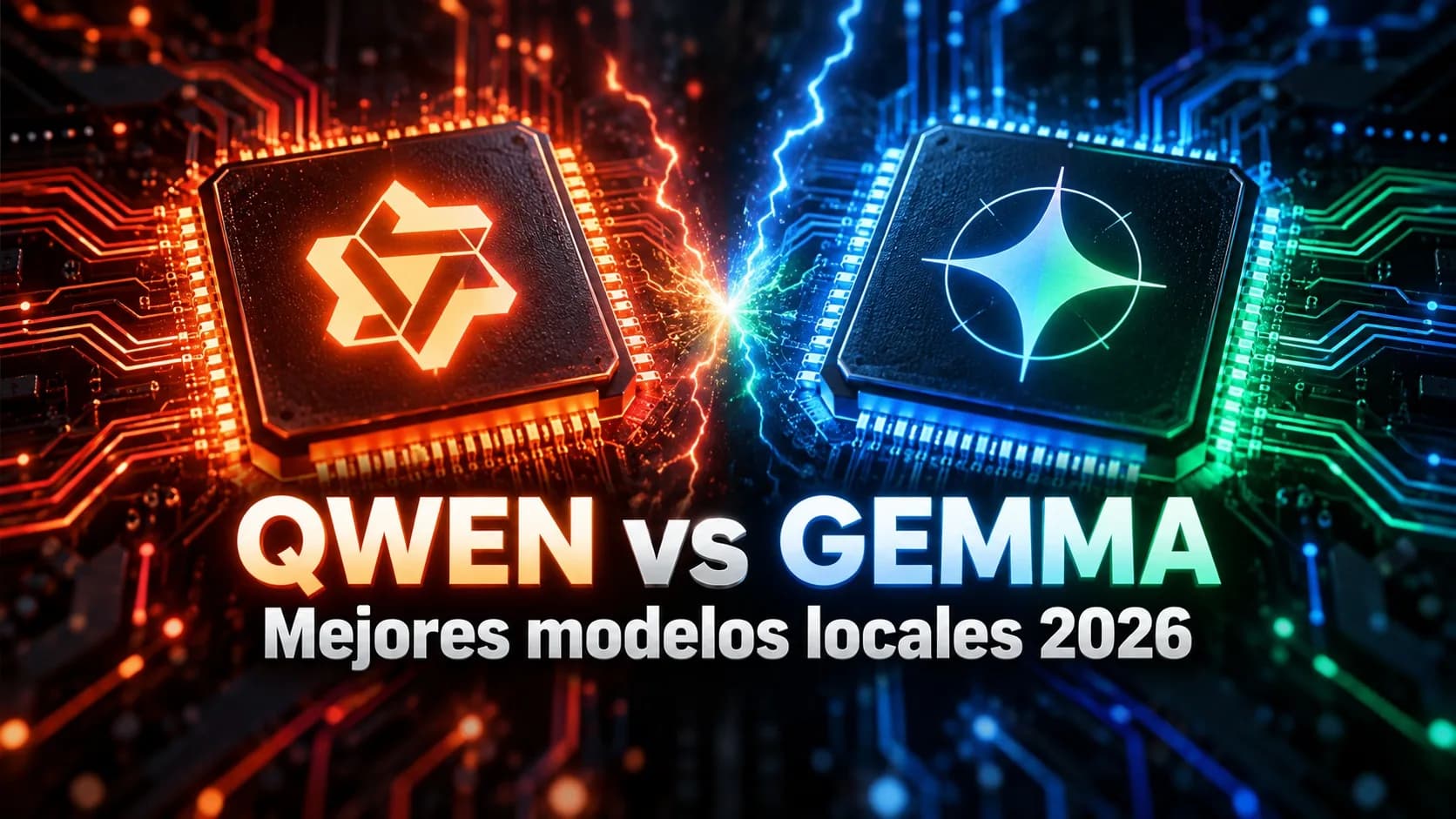
Qwen vs Gemma: How to Choose Your Local Ollama Model
Published on:
Reading time: 8 min
Topic: Technology
Author: Leandro Valencia
Practical guide to choosing between Qwen and Gemma when running local AI models: coding, modest hardware, multilingual tasks, and everyday use with Ollama.
Table of Contents
- Qwen and Gemma, in one sentence each
- When Qwen usually wins
- When Gemma usually wins
- How to try them yourself without committing
- Common mistakes when comparing Qwen and Gemma
- The practical conclusion
If you already decided to run language models on your own machine, sooner or later you hit the same fork: Qwen or Gemma. They are the two families that dominate Ollama's catalog for general use today, and both are good options — which, paradoxically, makes the decision harder, not easier. If you still are not sure what each one is or which size to install, this guide complements the best Ollama models in 2026, where we cover the full catalog with quantization, RAM, and context.
The goal here is narrower: give you a criterion for deciding between Qwen and Gemma based on what you are actually going to do with the model, without relying on a benchmark table that will be outdated in a month. Alibaba and Google iterate these families constantly — new versions, new sizes, new variants — so instead of anchoring yourself to a number that can change tomorrow, you will leave with a decision framework that still works even if the versions change.
Qwen and Gemma, in one sentence each
Qwen (Alibaba) is the family that bets on broad coverage: many sizes, long context windows, solid multilingual support, and, within the same family, a branch dedicated specifically to programming (qwen3-coder). If your use case changes often — today you summarize a document, tomorrow you code, the day after you translate something — Qwen gives you a single ecosystem with the right variant for each task.
Gemma (Google) bets on efficiency and naturalness: models designed to run well on modest hardware thanks to "effective parameter" variants (the e2b, e4b tags) and training-aware quantization (QAT), plus a writing style many people perceive as less robotic. It also brings something Qwen does not offer: native audio input in its edge variants and in the unified 12B model.
Neither is "the best" in the abstract. The right question is not which family wins, but which one wins for what you are going to do.
The decision framework: four questions before you choose
1. What is your main task?
If you code regularly — especially if you work with a full repository and not just loose snippets — the qwen3-coder branch is trained specifically for that, with a high proportion of code in its training and reinforcement aimed at making generated code actually run. Gemma has no direct equivalent focused on code at that level; it is competent for general programming tasks, but that is not its declared specialty.
If your use is more writing, summaries, emails, document analysis, or general conversation, both families perform well and the difference starts depending more on size and quantization than on the family itself.
2. What hardware do you have?
Here Gemma has a design advantage: the e2b and e4b variants are designed from training to run with less memory than their names suggest, and the -it-qat versions (training-aware quantization) cut consumption even further without the typical quality loss of compressing a model after training. If your machine has 8 GB of RAM or less, or if you want something to run on an edge device, start there.
Qwen also publishes small sizes (2B, 4B) that work well on modest machines, but its strength as a family shows more from medium sizes (9B and up), where the quality-to-weight ratio becomes very competitive.
3. Do you need broad multilingual support?
Qwen usually stands out here. It is a family trained with a strong multilingual emphasis from the start, which is especially noticeable in Asian languages and in translation between less common language pairs. If your work constantly involves content in several languages, it is the most reasonable starting point.
Gemma also handles several languages well, but its distinctive strength is elsewhere: the quality and naturalness of text in the languages where it is already strong, more than the breadth of coverage.
4. Does input modality matter to you?
If you need the model to understand audio directly — a voice note, a snippet of a call — Gemma is the option, because its edge variants and its unified 12B model support it natively. No Qwen variant offers this today. If you only need text and image, both families cover you without issue, including tool calling and reasoning mode in most of their sizes.
When Qwen usually wins
- Agentic programming or work over full repositories (
qwen3-coder). - Varied multilingual work, especially with Asian languages.
- When you want a single family that covers from simple tasks to serious reasoning, with many intermediate size steps.
- When you need very long context windows consistently across the whole family.
When Gemma usually wins
- Modest hardware or edge scenarios, thanks to effective-parameter sizes and QAT.
- Tasks where writing quality and a natural tone matter more than raw reasoning speed.
- When you need the model to process audio directly, without going through a transcriber first.
- Long documents with good memory/context density at medium sizes.
None of these rules is absolute. They are observable tendencies between the two families, not guarantees that a specific model will beat the other in your particular case. The only way to know for sure is to try both with your own task.
How to try them yourself without committing
You do not have to pick a family "forever". You can have both downloaded and decide by task:
ollama pull qwen3.5:9b
ollama pull gemma4:e4b-it-qat
With that you already have a reasonable representative of each family in a size manageable for 16 GB machines. Try the same real task — your email, your summary, your code snippet — on both and compare. It is more informative than any benchmark table, because it measures exactly what matters to you.
If your machine is more modest, swap in smaller versions of each (qwen3.5:4b and gemma4:e2b-it-qat); if you code regularly, add qwen3-coder:30b to the mix when you have the memory to hold it.
Common mistakes when comparing Qwen and Gemma
Comparing by version name instead of by size and quantization. A qwen3.5:4b and a gemma4:e4b-it-qat are not comparable just because both "fit" on your machine: they have different architectures and training objectives. Compare concrete use cases, not version numbers.
Assuming the newer family is always better for you. Alibaba and Google publish updates frequently, and not every update improves what matters to you. A new version can climb reasoning benchmarks and change nothing in writing quality, for example.
Sticking with third-party benchmarks without checking the source. The local-model catalog changes fast and many unverified or outright contradictory performance figures circulate across sites. Before deciding on a number, check the official catalog at ollama.com/library and, if the data really matters, the model's technical card at the original source (Alibaba or Google).
Ignoring Qwen's paid coding plan and assuming everything is free. Qwen weights and its CLI are free to use under the Apache 2.0 license and you can run them completely free with Ollama. Alibaba also offers separately a subscription plan for Qwen Code hosted in the cloud; it is a different offer, not a requirement to use the models locally.
Frequently asked questions
Qwen3.5:9b or gemma4:e4b, which do I pick?
It depends on the task, not on which is "better" in general. For programming or varied multilingual work, start with Qwen. For tighter hardware, a natural writing tone, or if you need to process audio, start with Gemma. Both fit comfortably on 16 GB machines and it is worth trying both with your own task before deciding.
Does "Qwen 4" already exist?
As of writing, Qwen3.5 is the confirmed official release from Alibaba, with sizes from 0.8B to 122B. Alibaba publishes updates to the Qwen 3 series frequently, so before installing check the available tags at ollama.com/library/qwen3.5 to confirm which version is current when you read this.
What is Qwen's coding plan?
It is a paid subscription Alibaba offers to use Qwen Code hosted on its infrastructure, aimed at teams that want the model without managing their own hardware. It is independent of running the same models free and locally via Ollama.
Which of the two families is better for programming?
For repository-scale coding tasks, the qwen3-coder branch is the option with training and tuning specific to that task. Gemma is competent at general programming, but it does not have an equivalent dedicated variant.
Which of the two is better if my machine is modest?
Gemma, thanks to its effective-parameter variants (e2b, e4b) and training-aware quantization (QAT), which reduces memory use without the typical quality loss of compressing a model after training.
The practical conclusion
There is no single answer to "Qwen or Gemma". There is a single answer to "Qwen or Gemma for coding on my 16 GB laptop", and you can build that one with the framework above: what you will do, what hardware you have, whether multilingual matters, and whether you need another modality besides text and image. Download a representative of each family, try them with your own task, and keep the one that best solves what you need — not the one that wins the benchmark table of the moment.
The sizes, tags, and capabilities cited in this guide correspond to Ollama's official catalog and to Alibaba and Google technical cards consulted in September 2026. Both families receive updates frequently: verify the current tags on ollama.com before downloading.
Related Posts
Keep exploring similar content that may interest you

9 AI tools you should be using (and what each one is for)
Practical guide to 9 AI tools —ChatGPT, Qwen, Codex, Ollama, Google Flow, Vibes, Perchance and Treblo— with what each does, who it's for, how much it costs, and when it makes sense to open it.

Best Ollama Models in 2026: Which One to Pick for Your RAM
Best Ollama models in 2026: what to install with 8, 16, 24, 32 or 64 GB of RAM, a comparison of Qwen 3.5, Gemma 4, gpt-oss and qwen3-coder, and the best local LLM.
How to Use Ollama: Run AI Locally Without Paying for Subscriptions
Ollama guide for running AI models on your own computer: how much RAM you need, install on Mac, Windows and Linux, commands, Modelfile and the local API.
Partnerships
Tools I use every day, on better terms for this community.