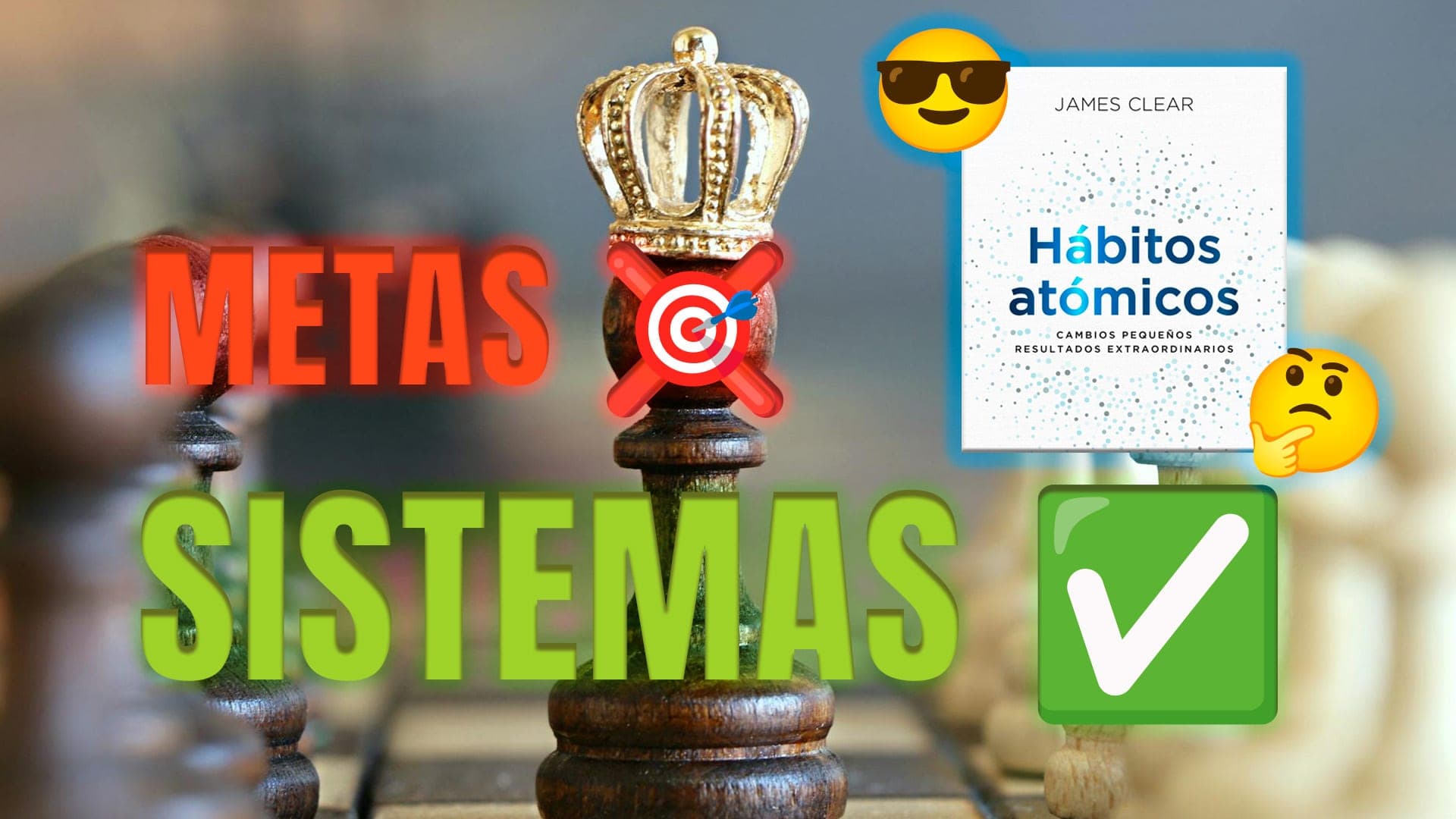
Atomic Habits: A Practical Summary to Change Your Life with Systems and Better Habits
Published on:
Reading time: 9 min
Topic: Productivity
Author: Leandro Valencia
Discover the best summary of Atomic Habits by James Clear: how to build good habits, break bad habits, improve by 1% every day, and create systems that change your life.
Table of Contents
- What Atomic Habits teaches and why it became so popular
- The 1% rule: how small habits create big change
- Identity and habits: real change starts with who you believe you are
- How to build good habits and break bad habits in real life
- Atomic Habits summary: the 3 key ideas you should remember
- Conclusion: why Atomic Habits is still one of the best books about habits
- Let’s talk
- Recommended video
I first read Atomic Habits in 2021, at a point when I had been trying for months to maintain a consistent content creation routine for my YouTube channel. I had enough drive to start, but not enough structure to sustain. Every week became an internal negotiation. The book did not give me extra motivation — that was not what I needed — but something far more concrete: a framework for understanding why my systems were failing before I was. Since then I have recommended it to every entrepreneur and team leader I work with, because the problems it describes are not about uncommitted people. They are about people who rely too much on intention and too little on design.
This summary focuses on what I consider the core ideas of the book, with emphasis on what actually changes when you apply them inside a project, a business, or a team — not only in personal habits.
If you are looking for an Atomic Habits summary, the most important idea in James Clear's book is this: your life does not change because of an ambitious goal. It changes because of the systems and habits you repeat every day.
Most people believe change comes from setting bigger goals. Lose weight. Read more. Earn more money. Learn a new skill. The problem is that almost everyone starts there, and still a huge number give up before seeing results.
Motivation is not always what fails. Very often, the real problem is the approach.
That is one of the strongest ideas in Atomic Habits by James Clear. The book is not really about willpower. It is about something much more useful: understanding that lasting change does not come from an inspiring goal, but from a system you can repeat even when you do not feel like it.
The core idea is uncomfortable, but freeing: you do not rise to the level of your goals; you fall to the level of your systems.
If you do not like your current results, looking only at the goal is not enough. You need to examine the daily mechanism producing those results. That is where real change begins.
What Atomic Habits teaches and why it became so popular
Goals are not useless. They have a clear function: they give you direction. They help you know where you want to go. The problem starts when you make the goal the center of everything.
Two people can want exactly the same thing and still end up with completely different results. Two students want to graduate with honors. Two entrepreneurs want to grow their businesses. Two athletes want to win a competition. The goal is shared. What changes is what they do every day.
That is the difference between a goal and a system.
A goal is the desired outcome. A system is the set of actions, routines, and decisions you repeat consistently. If you focus only on the result, you depend on spikes of motivation. If you design the system, you reduce friction and increase the chances of acting even on ordinary days.
A goal can excite you for a week. A well-designed system can support you for years.
That is why so many people feel they already "know" what they should do, but still cannot sustain it. They do not lack information. They lack structure.
The 1% rule: how small habits create big change
One of the best-known ideas in the book is that small improvements, repeated consistently, produce disproportionate results over time.
Improving by 1% sounds insignificant. Reading five pages. Doing ten push-ups. Saving a small amount. Going to bed fifteen minutes earlier. Leaving your workout clothes ready the night before. None of that seems powerful enough to change your destiny.
But accumulated change works like compound interest.
Habits rarely transform your life in a visible way within a week. That is exactly why so many people quit. The initial effort feels large, while the immediate reward feels tiny or nonexistent. You go to the gym for several days and the mirror does not change. You read for weeks and feel no progress. You practice a skill and still make mistakes.
Still, real progress is usually silent at first. It builds below the surface until one day it becomes impossible to ignore.
The opposite is also true. Small negative decisions, repeated for months, create a trajectory too. Procrastination rarely destroys a life in a single afternoon. It does it in tiny daily doses that seem harmless.
The right question is not, "What huge change can I make this week?" The right question is, "What small improvement can I repeat long enough for it to become part of me?"
Identity and habits: real change starts with who you believe you are
This is probably the most powerful idea in the entire book.
Many people try to change from the outside in. First they chase a result. Then they try a behavior. But they continue thinking about themselves in the same way. That is where friction appears.
It is not the same to say, "I want to run three times a week" as it is to say, "I am a person who takes care of my body." It is not the same to say, "I want to publish content" as it is to say, "I am someone who creates and shares ideas consistently." It is not the same to say, "I want to read more" as it is to say, "I am a reader."
When identity and behavior contradict each other, maintaining the habit becomes exhausting. You always feel like you are acting against your own nature.
James Clear suggests reversing the process. Instead of obsessing over the result first, start by deciding who you want to become. Then use your habits as evidence. Every repetition is a vote for that identity.
You read today: you vote for becoming a reader.
You write today: you vote for becoming a creator.
You train today: you vote for becoming a disciplined person.
You do not need to prove it with one perfect action or one flawless week. You need enough votes for your new identity to become believable in your own eyes.
That is when the habit stops feeling like punishment and starts feeling like alignment.
How to build good habits and break bad habits in real life
Theory is only useful if it lands in real decisions. If you want to apply the ideas in Atomic Habits in a practical way, start by simplifying. This approach works both for building good habits and breaking bad habits.
First, stop designing heroic habits. Design habits that are ridiculously easy to start. If you want to read, begin with two pages. If you want to write, begin with five minutes. If you want to exercise, start with a routine so small that you cannot justify skipping it.
Second, remove friction. Your environment matters more than it seems. Keeping the book visible helps. Leaving your phone far away helps. Preparing your workout clothes helps. If a good habit depends on too many decisions, you will turn it into something optional.
If you want to break a bad habit, apply the opposite logic: increase friction. Make the distraction harder to reach. Log out of social networks. Put the phone away. Block apps during key hours. Changing the environment is often more effective than relying on pure self-control.
Third, connect the habit to a clear identity. Do not just say, "I want to be more productive." That is too abstract. Say, "I want to become a person who honors what they schedule." That identity guides daily decisions much better.
Fourth, do not focus on doing it perfectly. Focus on not breaking the chain for too long. Failing once is normal. Failing twice in a row starts building a pattern.
Imperfect consistency almost always beats occasional intensity.
Atomic Habits summary: the 3 key ideas you should remember
The deeper message is not that you need to become a discipline machine or obsess over optimizing every minute. The message is more human and more sustainable: your life changes when your repetitions change.
Goals can inspire you, but they cannot sustain change by themselves. Systems can. Small improvements can. The right identity can.
If you feel stuck today, do not ask only what you want to achieve a year from now. Ask what kind of person you need to become and what small action can prove it today.
That is usually the true starting point of transformation.
You do not need to rebuild your life in one week. You need to build small but consistent daily evidence of the person you want to become.
That is what makes it atomic: something so small it looks irrelevant, until time proves otherwise.
Conclusion: why Atomic Habits is still one of the best books about habits
Atomic Habits became influential for a simple reason: it changes the conversation. Instead of promising fast results, it teaches you how to build processes that survive low motivation, tiredness, and imperfection.
If you keep only one idea, let it be this: stop depending on exciting goals and start creating repeatable systems. Make small improvements. Protect your identity. Then come back tomorrow.
Transformation rarely arrives as an epic moment. Most of the time, it comes disguised as routine.
Let’s talk
If this article made you think, there is one question worth answering honestly:
What small habit, repeated for a year, could completely change your life?
Recommended video
Related Posts
Keep exploring similar content that may interest you

Gamification for entrepreneurs: boost your productivity
What gamification is and how entrepreneurs can use it to beat procrastination. Mechanics, tools, steps, and the mistakes that ruin your system.

12 Weeks for Exponential Success Bill Gates Style
A comprehensive 12-week guide to revolutionizing your mindset and work methods, adopting Bill Gates' high-impact strategies for unprecedented personal and professional growth.

How to Use TikTok to Get Smarter (Train the Algorithm)
How to train the TikTok algorithm so it works in your favor: clean up your feed, plant what you actually want to learn, and use the app on purpose.
Partnerships
Tools I use every day, on better terms for this community.