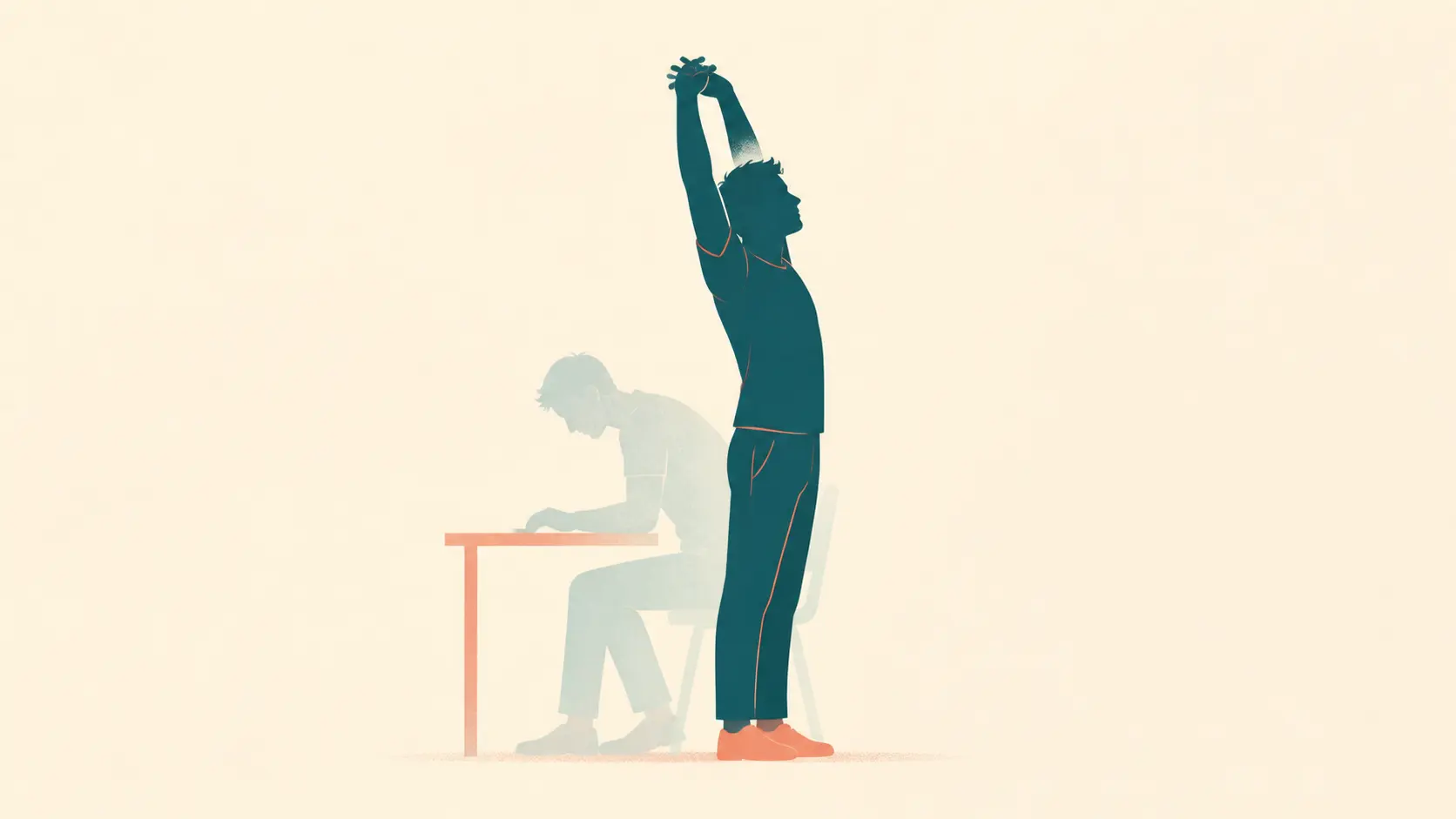
Active breaks: why your body and your business need them
Published on:
Reading time: 8 min
Topic: Productivity
Author: Leandro Valencia
What the WHO and Colombian regulations actually say about active breaks, how to do them right, and which games help you unplug without losing the thread of your day.
Table of Contents
- What an active break is (and what it isn't)
- What the evidence says
- The regulatory framework: it's not optional
- How to do them right
- The other break: the mental one
- Games that work for unplugging (and what they teach you on the side)
- What to take away
- Sources
You've been in the same chair for four hours. Your neck is stiff, your eyes are dry, and there's a vague feeling that you're working a lot but moving forward very little. You blame the workload, when the real problem is simpler: you haven't moved.
Active breaks have a bad reputation. In many companies they became that awkward moment when someone from HR shows up with a speaker and everyone has to clap. That caricature made a lot of people dismiss the idea without looking at what's behind it. Behind it there's evidence, there's regulation, and there's a real consequence on how you feel at six in the evening.
What an active break is (and what it isn't)
An active break is a short interruption of the task —usually 5 to 10 minutes— where you change posture, move your body, and rest the systems you've been straining for hours: your eyesight, your back, your wrists, your attention.
It's not the same as checking your phone. Swapping one screen for another is not a break: it's the same posture, the same visual strain, and the same cognitive load with different content. If you get up from your desk to keep reading things sitting somewhere else, you didn't take an active break. You made a transition.
What the evidence says
The World Health Organization updated its guidelines on physical activity and sedentary behavior in 2020, and there are two ideas in there worth separating. The first is the familiar one: 150 to 300 weekly minutes of moderate activity. The second is the one almost nobody mentions: you must limit sedentary time, and replacing sitting time with activity of any intensity —even light— already produces benefits. In other words: going to the gym three times a week doesn't cancel out eight daily hours of immobility. They're two different problems.
On microbreaks there's a 2022 meta-analysis that reviewed 22 independent samples with 2,335 participants. The result is honest, which is exactly why it's worth citing properly: microbreaks do reduce fatigue and increase vigor in a statistically significant way, though with small effect sizes. On performance the overall effect wasn't significant, but it did appear in tasks with lower cognitive demand, and a metaregression showed that the longer the break, the greater the effect on performance. Translation: five minutes help you feel better; if you come out of a task that left you drained, you'll need more than ten.
And the cost of not doing it has numbers. In Colombia, musculoskeletal disorders are the leading cause of occupational morbidity and account for around 82% of diseases classified as work-related. Globally, the WHO and the ILO estimated that long working hours —55 hours a week or more— caused 745,000 deaths from heart attack and stroke in 2016, with a 35% higher risk of stroke compared to 35 to 40 hour weeks.
The regulatory framework: it's not optional
Here it's worth distinguishing two levels. The WHO issues public health recommendations, not obligations. What obligates is each country's legislation.
In Colombia, Resolution 1016 of 1989 established the duty of companies to organize and maintain an occupational health program with subprograms in preventive and occupational medicine, and industrial hygiene and safety. That framework evolved into the Safety and Health at Work Management System (SG-SST for its Spanish acronym) regulated by Decree 1072 of 2015 under the PDCA cycle, with minimum standards defined in Resolution 0312 of 2019 according to company size and risk level.
The important nuance: no regulation literally says "do active breaks every two hours." What the regulation requires is that the employer identify biomechanical risk and apply controls. When the risk is prolonged posture and repetitive movements, the active break is one of the standard control measures, and the Ministry of Health published a specific protocol for it. If you're an employer and you have nothing in place against that risk, the problem isn't wellness: it's compliance.
If you're self-employed or building something on your own, nobody audits you. That's not an advantage. It means the only person responsible for your SG-SST is you.
How to do them right
A protocol that works and fits any schedule:
Every 50 to 60 minutes, stand up. Even if it's just 60 seconds. The goal isn't to exercise, it's to break the stillness.
Every 2 hours, a real 5 to 10 minute break. Neck and shoulder mobility, spinal extension, wrist and forearm stretches, and walking. Walking is the part people skip and the one that contributes the most.
For your eyes, the 20-20-20 rule. Every 20 minutes, look at something about 20 feet —roughly 6 meters— away for 20 seconds.
One long break a day that isn't eating in front of the computer. This is the hardest one and the one that pays off the most.
The other break: the mental one
There's a type of exhaustion that stretching doesn't fix. It's the head that won't let go of the problem: you keep ruminating over cash flow while you eat lunch, while you drive, while you try to sleep. That state isn't productivity, it's wear and tear with no return.
What works for that is an activity demanding enough to displace the rumination, but with no real consequences. It can be cooking, playing an instrument, walking without headphones. And yes, it can be video games, which are especially good at this because they impose a loop of clear goals and immediate feedback: exactly what your job usually doesn't give you.
With one warning that has to be said bluntly: playing seated is not an active break. It's mental rest, not physical. If you replace eight hours of seated work with three hours of seated gaming, you solved half the problem and aggravated the other. Movement is separate, always.
Games that work for unplugging (and what they teach you on the side)
I picked each of these for a concrete reason: each one trains something that also applies when you get back to your desk.
Dave the Diver (Global · Deluxe · LATAM) is the one that best represents the idea of this article. You dive during the day and run a restaurant at night, and the two dynamics feed each other: what you catch defines what you can serve. It's the most useful lesson for any entrepreneur: there's an exploration mode —getting supplies, clients, ideas— and an operations mode —delivering well what you already sold—. If you live in only one of them, the business breaks. The game forces you to alternate, and that alternation is the one almost nobody sustains in real life.
Settlement Survival is pure resource planning. It teaches you to spot bottlenecks before they burst and to understand that growth without installed capacity is an elegant way to go bankrupt. Anyone who has scaled sales without scaling operations recognizes the problem.
Helldivers 2 (LATAM · Global · Super Citizen) is coordination under pressure with friendly fire included. It trains you to communicate short and clear, to own mistakes without drama, and to retry immediately. It's the closest thing to a real team you'll find on a screen.
Crimson Desert (LATAM · Global · Deluxe), Skyrim (LATAM · Anniversary · Fallout 4 bundle) and the GTA series (V Premium · IV Complete · VI on Xbox LATAM, Xbox Global, Xbox Europe and PS5 Europe) serve the same purpose: open worlds where you can wander off the objective without punishment. It sounds trivial, but it recovers something that objective-driven work tends to switch off: curiosity without an agenda, which is where most good ideas come from.
Terraria drops you in without instructions and expects you to discover the system on your own. It's the entrepreneurial experience in game form: nobody is going to explain how the market works, you have to try.
NBA 2K27 has the virtue of the short format. A game fits in a long break and actually ends, without leaving you with that "one more mission" feeling at one in the morning.
And if you want the playful equivalent of experimenting cheap, random keys —hidden gem, black, GOTY, red— are low-cost bets. The same logic as validating an idea with the smallest possible version before committing budget.
What to take away
Active breaks won't make you more productive by magic; the evidence on performance is modest and it needs to be said. What they do, with backing, is reduce fatigue and sustain vigor throughout the day. And on the legal side, in Colombia controlling biomechanical risk isn't a courtesy from the employer: it's an SG-SST obligation.
Working yourself to exhaustion isn't discipline. It's a bad management decision, and like every bad decision, it gets paid later.
If you're going to buy games or software, Eneba gets you a 5% discount with my link. It's an affiliate link: you pay less and it helps me keep this blog running. The 5% applies with the code CreaCosas at checkout, as long as you arrive through the link.
And if what's exhausting you isn't the chair but the way you're managing your business, that's worked differently. That's what Transforma is about.
Sources
- WHO guidelines on physical activity and sedentary behaviour (2020)
- WHO — Every move counts towards better health
- Albulescu et al. (2022), "Give me a break!" — microbreaks meta-analysis, PLOS ONE
- Ministry of Health of Colombia — Active breaks protocol
- Decree 1072 of 2015 — Función Pública
- WHO/ILO — Long working hours increasing deaths from heart disease and stroke
Frequently asked questions
How often should you take active breaks?
A protocol that works: stand up for at least 60 seconds every 50 to 60 minutes to break the stillness, and every 2 hours take a real 5 to 10 minute break with neck and shoulder mobility, spinal extension, wrist and forearm stretches, and walking. For your eyes, apply the 20-20-20 rule: every 20 minutes, look at something about 6 meters (20 feet) away for 20 seconds.
Are active breaks mandatory in Colombia?
No regulation literally says you must do active breaks every two hours. What the SG-SST (Decree 1072 of 2015 and Resolution 0312 of 2019) does require is that employers identify biomechanical risk and apply controls; when the risk is prolonged posture and repetitive movements, the active break is one of the standard control measures, with a protocol published by the Ministry of Health.
Does checking your phone count as an active break?
No. Swapping one screen for another keeps the same posture, the same visual strain, and the same cognitive load with different content. If you get up from your desk only to keep reading sitting somewhere else, you made a transition, not an active break.
Is playing video games an active break?
No, it's mental rest. Video games work to displace work rumination because they impose clear goals and immediate feedback, but playing seated doesn't break the stillness: if you replace eight hours of seated work with three hours of seated gaming, you solved half the problem and made the other half worse. Movement is separate, always.
Do active breaks increase productivity?
The evidence deserves an honest reading: a 2022 meta-analysis with 2,335 participants found that microbreaks reduce fatigue and increase vigor in a statistically significant way, though with small effect sizes. On performance the overall effect was not significant, but it does show up in tasks with lower cognitive demand and grows with break duration.
Related Posts
Keep exploring similar content that may interest you
How to Use TikTok to Get Smarter (Train the Algorithm)
How to train the TikTok algorithm so it works in your favor: clean up your feed, plant what you actually want to learn, and use the app on purpose.
Iron Discipline: What It Is and How to Build It (Practical Guide)
Iron discipline meaning: the ability to keep acting on your goals when motivation is gone. What it really is, why willpower doesn't work, and how to build it with systems instead — a practical guide with steps, books, and common mistakes.
Gamification for entrepreneurs: boost your productivity
What gamification is and how entrepreneurs can use it to beat procrastination. Mechanics, tools, steps, and the mistakes that ruin your system.
Partnerships
Tools I use every day, on better terms for this community.