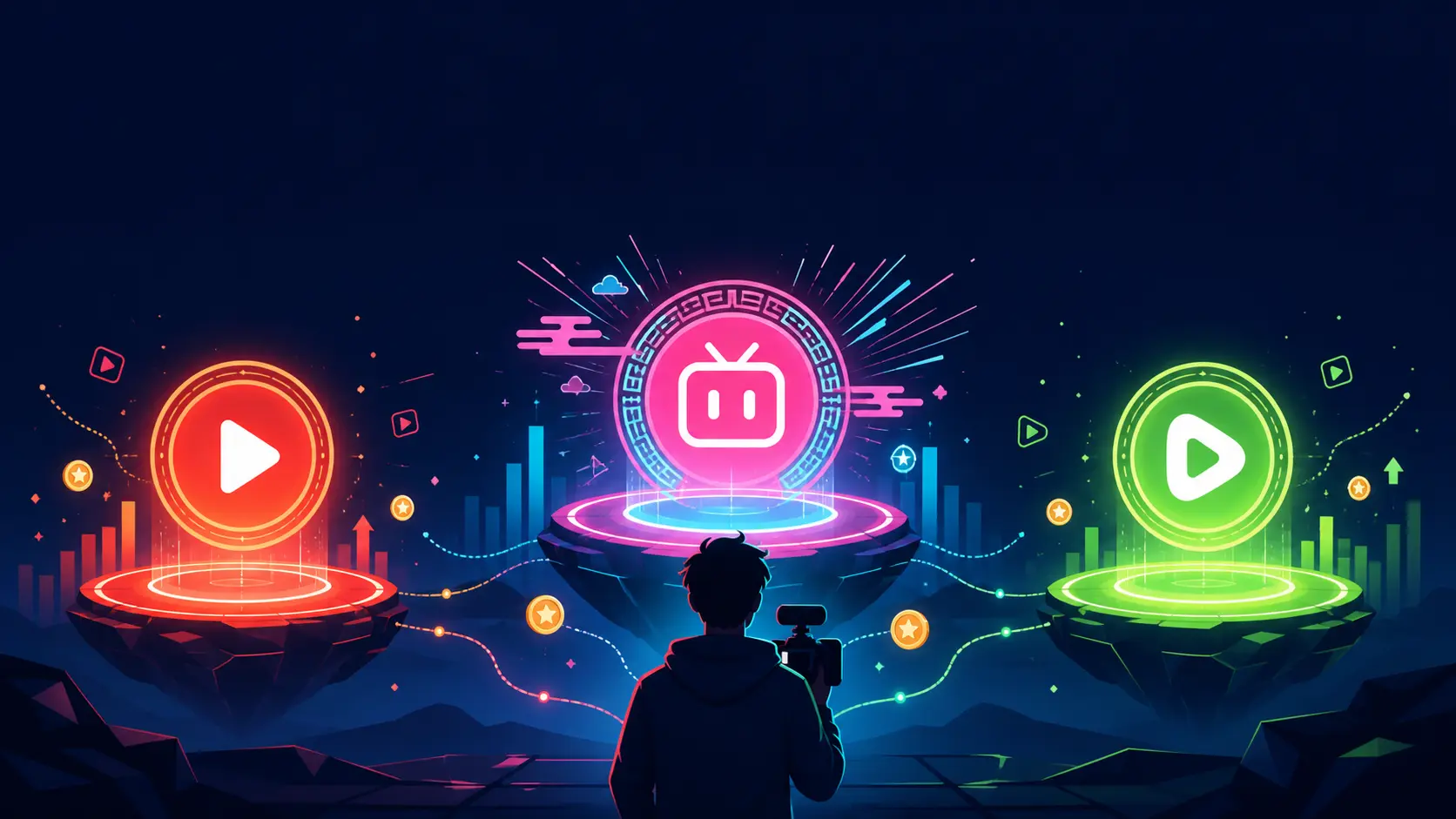
Bilibili and Rumble in 2026: An Honest Guide for Creators (What to Really Expect)
Published on:
Reading time: 14 min
Topic: Marketing
Author: Leandro Valencia
How Bilibili and Rumble actually work for creators in 2026: real monetization requirements, honest RPM figures, the fine print of each program, and a four-week plan to diversify without abandoning YouTube.
Table of Contents
- The comparison that matters
- First things first: what actually happened with YouTube
- A four-week plan
- Realistic expectations
- Sources
Every so often the same promise makes the rounds: "the alternative platform where there's still no competition." Sometimes it's true. It's almost always badly explained.
Bilibili and Rumble are genuinely having an opening moment. Bilibili relaunched its international app in August 2026 and is hiring community managers in Mexico City, São Paulo, Los Angeles, London, Istanbul, and Tokyo. Rumble remains the only major platform where you can monetize with ads without any subscriber minimum. Both things are true.
But it's also true that Bilibili's incentive program is capped at around $278 per month per creator, that Rumble's real average RPM sits below the advertised range, and that its Creator Program isn't available in Spain or almost any country in Latin America. Nobody puts that in the headline.
This guide is the complete map: the links first, the comparison next, then the details of each platform with the fine print included.
All the links, up front
So you don't have to dig through the text when you come back to this article.
Bilibili
| What it is | Link |
|---|---|
| Bilibili Studio (dashboard for global creators) | https://member.bilibili.com/creator/ |
| Bilibili Global (international version) | https://www.bilibili.tv |
| Bilibili China (main site, in Mandarin) | https://www.bilibili.com |
| Domestic creator dashboard | https://member.bilibili.com/platform/home |
| Global creator recruitment program | https://www.bilibili.com/blackboard/activity-RCCsUFvzkk.html |
Rumble
| What it is | Link |
|---|---|
| Main site and sign-up | https://rumble.com |
| Creator dashboard | https://rumble.com/account/dashboard |
| Rumble Studio (live streaming) | https://studio.rumble.com/home |
| Rumble Premium (program requirement) | https://rumble.com/premium |
| Help center | https://rumble.support |
| 2026 Creator Program requirements | https://rumble.support/help/rumble-creator-program |
YouTube (for quick reference)
| What it is | Link |
|---|---|
| Partner Program requirements | https://support.google.com/youtube/answer/72851 |
| Creator portal | https://www.youtube.com/creators/ |
| YouTube Studio | https://studio.youtube.com |
The comparison that matters
| Parameter | Bilibili | Rumble | YouTube |
|---|---|---|---|
| Monthly active users | ~376M (Q1 2026), 115M daily | ~50–80M | ~2.5B |
| Daily usage time | 100–119 min per user | Not published | ~45–60 min |
| Monetization entry | 1,000 followers for the Incentive Program | Ads with no minimum: account 30 days old, no strikes, 1 licensed video | 500 subs (fan funding) / 1,000 subs + 4,000h (ads) |
| Ad revenue share | Mixed: incentive + share | 60% to the creator | 55% to the creator |
| Revenue per 1,000 views | ~$0.70 estimated outside China (unofficial) | $1.20–2.80 real average; $2–10 by niche | $1–5 depending on niche and country |
| Incentive cap | No cap | No cap | |
| Payout | Shells system (贝壳) — CNY | $50 minimum, PayPal / bank transfer | $100 minimum, AdSense |
| Moderation | Strict, under Chinese regulation | Very permissive | Moderate, with frequent demonetization |
| Competition in Spanish | Low (AI translation into Mandarin) | Very low | Extremely high |
| Real barrier | Language and platform culture | Geographic restriction of the premium program | Sheer volume of competition |
Read it with one idea in mind: none of the three replaces the others. Bilibili gives you reach in a market that doesn't compete with you. Rumble gives you monetization from day one. YouTube gives you everything else. The sensible strategy is multiplatform, not migration.
First things first: what actually happened with YouTube
There's a lot of talk about YouTube "raising the requirement from 4,000 to 8,000 hours." It's worth clarifying, because it changes how urgent everything else is.
As of today, in 2026, the requirements are still the usual ones. There are two tiers: fan funding, with 500 subscribers, three public uploads in the last 90 days, and 3,000 watch hours or 3 million Shorts views; and full ad monetization, with 1,000 subscribers and 4,000 hours or 10 million Shorts views.
The switch to 8,000 hours and 20 million Shorts views takes effect on February 1, 2027, and only for new applicants. If you're already in the program, it doesn't affect you. If you're near the threshold, you have until January 2027 to get in under the current rules.
In other words: it's not an emergency, it's a window. And it's a good argument for diversifying now, calmly, instead of rushing into it a year from now.
Bilibili: the huge market almost nobody is looking at
Bilibili is not a YouTube clone. It was born as an anime, comics, and gaming niche, and today it spans technology, science, education, finance, and lifestyle. With more than 376 million monthly users and daily usage averaging close to two hours, its consumption depth beats almost any Western platform.
Its culture is different, and it's worth understanding before you upload anything. Comments float over the video (danmaku), users "gift" coins to videos they like, and the algorithm weighs that coin-to-view rate more heavily than total views. A video with fewer plays but lots of coins gets recommended over one with many views and little interaction. It's a platform that rewards content people value, not content people merely open.
There are two paths, and this is what almost no guide distinguishes
The domestic path is the one most articles describe: registration with a Chinese phone number, real-name verification (实名认证) with a passport and a selfie holding the document, and the famous membership exam of 40 to 100 questions about community rules and copyright, in Mandarin. It's real and it still exists.
The global path is new and far simpler. Since August 2026, Bilibili has relaunched its international app and opened Bilibili Studio, a dashboard for global creators in English. You sign up with an email address or phone number, with no identity verification or passport. Start there. Don't complicate things with the Chinese flow if you don't need it.
That said, if you want to livestream or withdraw earnings, verification will eventually come up. Think of the global sign-up as a way to start publishing and test the platform friction-free, not as a permanent exemption.
The differentiating asset: automatic translation
Bilibili includes an AI that analyzes audio in Spanish or English, translates it, and adds Mandarin subtitles. This is what makes the platform genuinely interesting for a Spanish-speaking creator: you can upload your content as-is and be understandable to an audience of hundreds of millions.
It's not magic. The generated subtitles have errors, especially with technical terminology, proper names, and slang. Reviewing them on your first videos also teaches you which vocabulary the system is getting wrong, and you can adjust how you speak accordingly.
How you make money (and how much, really)
The Creator Incentive Program activates at 1,000 followers and pays based on a video's overall performance: views, retention, likes, favorites, and coins.
Here comes the figure almost nobody mentions: since March 2024, that cash incentive is capped at around 2,000 RMB per month — about $278 — no matter how many views you rack up. Estimates circulating for creators outside China hover around $0.70 per 1,000 views, and that is not an official platform figure.
Bottom line: Bilibili is not where you'll build your main income. The direct incentive has a low ceiling. The real value lies in the rest of the system, which does scale:
- Coins. Users receive daily coins and hand them out. It's the most important signal for the algorithm.
- Tips and "batteries." Direct support from viewers, equivalent to Super Thanks.
- Shells (贝壳). The withdrawable balance, convertible to yuan.
- Brand deals. This is where the real money is. Bilibili is building an international marketplace to connect creators with companies, usually accessible from 10,000 followers.
The right way to think about Bilibili is audience building in a market with no competition in your niche, with a symbolic initial income and real potential in sponsorships. Not as an ad revenue source.
Rumble: monetization from the first video, with big fine print
Rumble is YouTube's direct competitor in format and approach, with noticeably more permissive moderation and roughly 50 to 80 million monthly users, mostly English-speaking. The Spanish-speaking market is practically empty.
Its big advantage is genuine: there's no subscriber or watch-hour minimum to monetize with ads. The requirements are an account in good standing for 30 days, no strikes or terms-of-service violations, and at least one video with an activated license. You earn from the very first video.
The split is 60% for the creator, above YouTube's 55%.
About RPM: the advertised range and the real number
You'll see everywhere that Rumble pays between $2 and $10 per 1,000 views. That range exists, but it corresponds to the best-paying niches and audiences. The real average across all niches is closer to $1.20 to $2.80. If your audience is Spanish-speaking, expect the low end: advertising CPM in Spanish is structurally lower than in English on any platform.
The Creator Program: here's the problem
The material floating around usually says "once you hit 100 followers you're enrolled in the Creator Program." It's a simplification that can cost you weeks of misdirected work, so it's worth reading the actual requirements, updated on July 1, 2026.
To apply you need 100 followers, at least one hour streamed via Rumble Studio in the previous 30 days, and an active paid subscription to Rumble Premium.
To actually get paid each month, inside the program, you must meet all of this: 30 total hours of live streaming, 5 of them exclusive to Premium subscribers, 500 accumulated hours of watch time, 75 distinct users typing in chat, a raid on five different streams, and 20 Shorts uploaded per month.
And the decisive detail: the program is only open to creators in Australia, Canada, El Salvador, Macedonia, South Korea, the United Kingdom, and the United States.
If you're in Spain, Mexico, Colombia, Argentina, or almost any other Spanish-speaking country, you are not eligible for the Creator Program. It's not an obstacle you overcome with effort: it's a door closed by geography.
This doesn't invalidate Rumble. Basic ad monetization, which is what matters to most people, is available and still has no subscriber requirements. But you should know that the premium program, with its pool of subscription revenue, is a model designed for live streamers from English-speaking markets. If your content is edited video in Spanish, that program is not your path.
What you should actually use Rumble for
YouTube sync. Rumble lets you link your YouTube channel to import your videos automatically. You publish on YouTube and minutes later the video appears on Rumble without you doing anything. It's the best effort-to-return ratio in this whole guide: one-time setup, passive income indefinitely.
Video licensing. You can sell the rights to viral videos to affiliated media outlets and TV, with substantial commissions. If you ever capture something newsworthy, this channel can pay more than years of ads. Always choose the non-exclusive license to keep your rights on every other platform.
Payouts. $50 minimum, via PayPal or bank transfer. Keep in mind that payment can take 30 to 60 days from when earnings consolidate, so your first real payout arrives later than the schedule suggests.
A four-week plan
The version that makes sense after everything above.
Week 1 — Preparation. Register both accounts: Rumble with an email address, Bilibili through the global route in Bilibili Studio. Design a unified banner and profile photo matching your brand. Spend an hour browsing content in your niche on Bilibili without posting anything: you need to understand the platform's culture before contributing to it.
Week 2 — Configuration. On Rumble, complete identity verification and connect your payout method; without this nothing accumulates. On Bilibili, upload your first video and watch how the automatic Mandarin translation behaves.
Week 3 — Automation. This is the highest-yield step: link your YouTube channel to Rumble for automatic importing, and upload your first video under a non-exclusive license. From here on, Rumble runs itself.
Week 4 — Correction. Review Bilibili's automatic subtitles and fix what the AI got wrong. Check what coin-to-view ratio your video achieved: that's your benchmark metric on that platform, more than raw views.
Month 2 onward. A sustainable cadence of two to three videos per week. On Bilibili, the goal is 1,000 followers for the incentive and, in the medium term, 10,000 for brand deals. On Rumble, let the sync work and check the dashboard once a month.
Realistic expectations
The barrier to entry on these platforms is far lower than YouTube's. Building a profitable channel is not.
Most creators on both platforms go through a three-to-six-month maturation period before seeing income worth the name. And with the numbers on the table — the $278 monthly cap on Bilibili, a single-digit average RPM on Rumble — it's worth calibrating what "profitable" actually means.
My take is this: Rumble is an easy decision. You set up YouTube sync once and it generates passive income on top of work you were already doing. The marginal cost is nearly zero, so even if the return is modest, the math works.
Bilibili is a different bet, and a more interesting one. You're not going for the direct money, which is capped. You're going because there are 376 million people spending two hours a day on the platform, an AI that breaks the language barrier for you, and practically no Spanish-speaking creators talking about your topic. That's early positioning in a huge market, and that value isn't measured in RPM.
What I wouldn't recommend is abandoning YouTube for either of them. Diversification protects your digital independence; migration just changes who owns the risk.
FAQ
Can I monetize with ads on Rumble if I live in Spain or Latin America?
Yes — basic ad monetization has no geographic restrictions and no subscriber minimum. What is closed off for nearly the entire Spanish-speaking market is the premium Creator Program (the live-streaming one), available only in Australia, Canada, El Salvador, Macedonia, South Korea, the United Kingdom, and the United States.
How much does Bilibili really pay per 1,000 views?
The figure circulating outside China is around $0.70 per 1,000 views, and it's not an official platform number. On top of that, the cash incentive has been capped at roughly 2,000 RMB (about $278) per month per creator since March 2024, no matter how much your views grow.
Did YouTube really raise the requirement to 8,000 hours?
Yes, but it doesn't apply yet. The change takes effect on February 1, 2027 and only affects new applicants. If you're already in the program, it doesn't touch you; if you're near the threshold, you have until January 2027 to get in under the current requirements (1,000 subscribers and 4,000 hours).
Should I leave YouTube for Bilibili or Rumble?
No. Neither replaces YouTube in audience volume or advertising maturity. The strategy that works is adding distribution channels while you keep publishing where you already have traction: Rumble for nearly automatic syncing, Bilibili for access to an enormous market with no Spanish-language competition.
Which is easier to monetize when you're starting out?
Rumble, no contest. It requires no subscribers or watch hours for ads, just 30 days of a clean account and one licensed video. Bilibili requires 1,000 followers to enter the Incentive Program, and its payout ceiling is much lower than Rumble's.
If you're building a project and decisions like these — where to publish, what to automate, what to ignore — are taking more of your time than they should, at leotransforma.co I work on exactly that: how to create, execute, and scale without scattering yourself across every opportunity that appears.
Sources
- YouTube Partner Program: Requirements and How to Join in 2026 — vidIQ
- YouTube Monetization Requirements 2026 (and What Changes in 2027)
- YouTube is making it harder for creators to start getting a cut — Engadget
- Rumble 2026 Creator Program — Rumble Help Center
- How Much Does Rumble Pay Creators? (2026) — Gemlist
- How Much Does Rumble Pay Per 1000 Views in 2026 — Fluxnote
- How Much Does Bilibili Pay Creators in 2026 — Gemlist
- Bilibili Goes Global: China's YouTube Alternative Relaunches Its International App — CineD
- China's Bilibili Goes Global to Challenge YouTube
- bilibili Studio, global creator services center
Related Posts
Keep exploring similar content that may interest you

How to Choose a Creator Management Agency: Checklist
A checklist for creators and brands looking for a creator marketing agency: how they charge, what to ask before you sign, and red flags in brand deals.
Rank Your Website on Google and Bing in 2026 (Real Data)
My process for getting organic traffic on Google, Bing and AI: keywords, article clusters, Search Console, Bing Webmaster Tools and IndexNow, with real numbers.
Top 10 Marketing and Sales Books for Entrepreneurs
10 books on marketing, persuasion and sales to help you sell without feeling like a salesperson, with what each delivers and links to Amazon Spain and the US.
Partnerships
Tools I use every day, on better terms for this community.