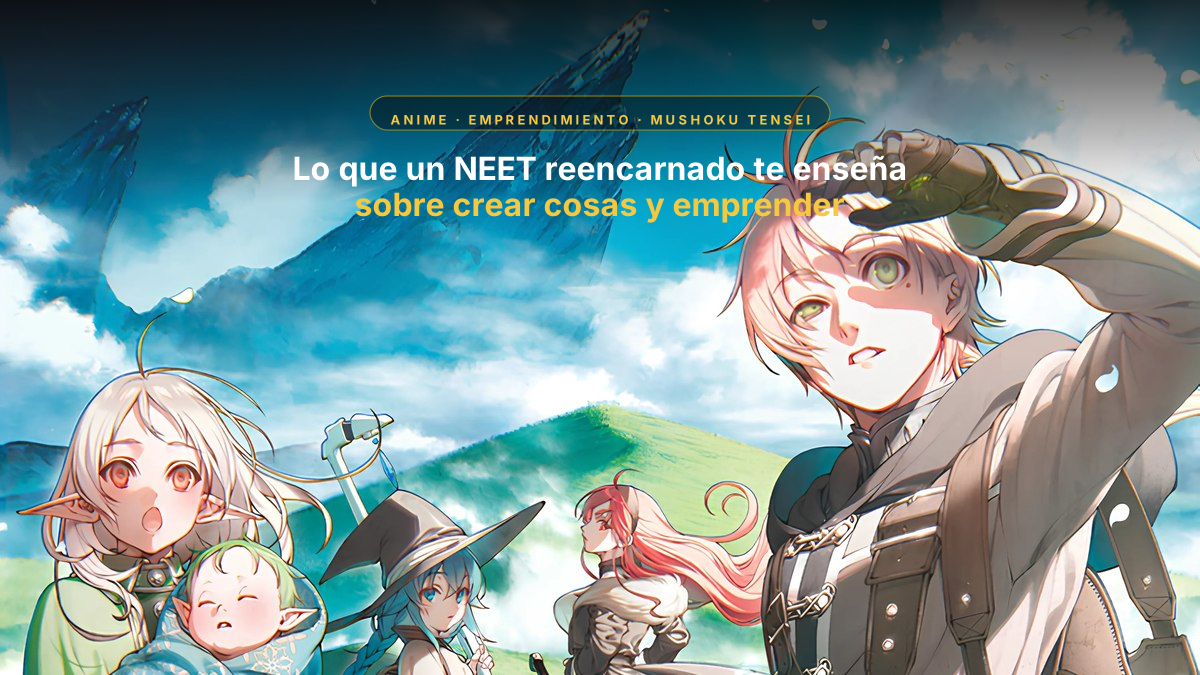
Mushoku Tensei: startup lessons from a reincarnated NEET
Published on:
Reading time: 13 min
Topic: Entrepreneurship
Author: Leandro Valencia
Beneath the magic and the isekai setting, Mushoku Tensei hides an entrepreneurship playbook: reinvention, mentorship, pivots, prototyping, and building systems that outlive you.
Table of Contents
- Reinvention Doesn't Start With Talent, It Starts With a Decision
- Find Mentors, Then Become One
- The Begaritt Desert: When the Market Forces You to Pivot
- Zanoba, Julie, and the Figurines: Seeing Businesses Where Others See Toys
- Ranoa University: The Ecosystem Where a Research Mindset Is Born
- Magic Armor: Prototype, Fail, Version
- Working for Orsted: The Entrepreneur Who Learned to Have a Boss
- The Other Side: Failing, Falling Apart, and Coming Back
- Rudeus's 8 Lessons for Anyone Who Builds Things
- FAQ
⚠️ Warning: this article contains full spoilers for Mushoku Tensei, including both the anime and the light novels.
There's a scene at the start of Mushoku Tensei that hurts more than any magic battle: a 34-year-old man, unemployed, friendless, and hasn't left his room in years, gets thrown out of his house on the day of his parents' funeral. He dies hit by a truck while trying, for the first time in decades, to do something for someone else.
And then the story asks him the question it asks all of us: if you had a second chance, what would you do differently?
Rudeus Greyrat —that man's reincarnation in a world of swords and magic— doesn't answer with words. He answers with twenty years of work, prototypes, businesses, failures, and products. And that's why Mushoku Tensei, underneath the isekai trappings, the magic, and the family drama, is one of the best stories about creativity and entrepreneurial spirit anime has ever produced.
Let's break it down.
Reinvention Doesn't Start With Talent, It Starts With a Decision
The first thing Rudeus does when he realizes he's been reborn isn't celebrate his new powers. It's making a decision: "this time, I'm going to take life seriously."
Notice the detail: when he makes that decision, he still doesn't know he has an enormous affinity for magic. He hasn't discovered any talent yet. The decision comes before the talent, not after. And that's the exact opposite of how most of us think about entrepreneurship and creativity: "once I discover my gift, I'll start." Rudeus starts, and discovers the gift along the way.
His first "company" is himself. As a baby, he crawls to a magic book and practices in secret every day. No mentor, no permission, no age requirement. Just consistency. By the time Roxy becomes his tutor, she doesn't find a prodigy born out of nowhere: she finds someone who had already spent years stacking repetitions.
The lesson for creators: compound interest applies to skills too. Rudeus didn't break the wordless-casting barrier through sheer genius — he broke it because he practiced when nobody was watching and nobody was clapping. If you're waiting for external validation before you start your project, you're already late: the invisible stage is mandatory.
Find Mentors, Then Become One
Rudeus has something many proud entrepreneurs lack: zero shame about learning from others. He learns magic from Roxy, swordsmanship from Ghislaine, and picks up politics along the way, while at the same time teaching Ghislaine to read. And there's the flip side of the coin.
From a very young age, Rudeus discovers that teaching is a business model. His first formal "job" is as Eris's tutor at the Boreas mansion. He turns his knowledge into a service, negotiates terms, and designs a method for a student who literally greets him with punches. That's pure educational entrepreneurship: spot someone with a problem (an unmanageable girl who needs an education), package your knowledge, and get paid to solve it.
He repeats the formula again and again later on: teaching magic to Zanoba, taking Julie on as an apprentice, writing guides. Every time Rudeus learns something, sooner or later he turns it into something teachable. In today's creator economy, we'd put it this way: document what you learn — there's a product hiding in there.
The Begaritt Desert: When the Market Forces You to Pivot
After the disaster of the Teleportation Incident, Rudeus ends up on the demon continent with no money, no contacts, and two mouths to feed. What does he do? He registers as an adventurer and founds "Dead End," his first team... or put another way, his first services startup.
And here comes one of the sharpest marketing moves in the entire series: the name. "Dead End" is the nickname —feared, not celebrated— attached to Ruijerd, the Superd warrior. Rudeus takes a stigma, a name that scares off clients, and turns it into a brand. He uses the bad reputation as brand recognition, then works to change what it means.
Because Rudeus's real project in that arc isn't completing quests: it's rehabilitating the reputation of an entire race. The Superd are hated for a massacre they didn't commit. Rudeus's solution? No speeches, no fights: content. He makes collectible figures of Ruijerd and gives them away. He writes and distributes children's stories where the Superd warrior is the hero who saves kids. He plants stories in every city he passes through.
Read that again with an entrepreneur's eyes: facing a brand-perception problem, Rudeus launches a merchandising + storytelling + free distribution campaign aimed at the next generation of "consumers" (the children who'll grow up without fearing the Superd). It's content marketing with a hundred-year head start. And it works: decades later, the Superd's image starts to shift. The results of good content are rarely immediate; they're cumulative.
Zanoba, Julie, and the Figurines: Seeing Businesses Where Others See Toys
If there's one arc business schools should study, it's the figurine business at Ranoa University of Magic.
Rudeus knows how to sculpt figurines with earth magic. To him it's almost a hobby, a party trick. But he meets Zanoba, a prince with a genuine obsession for figurines and a monstrous strength that makes him destroy anything he tries to sculpt. Rudeus doesn't see a weird nerd: he sees unmet demand.
The problem: Rudeus can't spend his life hand-making figurines forever. His time doesn't scale. The solution? The team buys Julie, an enslaved dwarf girl, frees her in practice, educates her, and trains her as a craftswoman. Rudeus designs, Zanoba directs quality control with a superfan's eye, Julie produces. In a medieval world, they've just invented the split between product design, quality control, and manufacturing.
Over time, this becomes a real company that makes and sells figurines (and later articulated dolls, even moving magical figures), with Zanoba at the helm. A business born from three pieces nobody else had put together: a "useless" skill (sculpting with magic), a "ridiculous" passion (collecting figurines), and a person society had discarded (an enslaved girl with manual talent).
The lesson for creators: opportunities almost never look like opportunities. They look like weird hobbies, dead-end skills, and underestimated people. The entrepreneur is the one who connects the pieces.
Ranoa University: The Ecosystem Where a Research Mindset Is Born
Rudeus arrives at Ranoa University of Magic for a mundane reason, but what he finds there transforms him: for the first time in two lifetimes, he's surrounded by a creative ecosystem.
Think about it: up to that point, Rudeus had always been "the most capable person in the room." At Buena Village, at the Boreas mansion, at Dead End. That inflates the ego but kills curiosity. At Ranoa, instead, he meets Cliff researching artifacts and curses, Zanoba willing to study what nobody studies, professors, libraries, labs — and above all, Nanahoshi.
Nanahoshi (Silent Sevenstar) is another traveler from Rudeus's world, stuck with no magic and obsessed with a single goal: getting home. Her method is the closest thing to the scientific method that exists in that world: hypothesis, experiment, record, failure, adjustment, repeat. She's spent years researching summoning and teleportation magic with no guarantee of success at all.
Rudeus joins her research as an assistant, and something crucial happens: he stops using magic purely as a tool and starts asking how it works. He experiments with magic circles, summonings, combinations nobody had tried. Many experiments fail. Some discoveries seem useless at the time... and years later become foundational pieces of his creations, including the technology that eventually makes his magic armor and his communication artifacts possible.
There's the pattern every creator should tattoo on themselves: research with no apparent application is future inventory. No one doing research knows exactly what their discoveries will be good for. Rudeus wasn't helping Nanahoshi in order to build armor; the armor became possible because he'd explored without an agenda first.
The university also teaches him something more uncomfortable: to be a student again. The mage who defeated adults at age seven agrees to sit through classes, do lab work, and learn from people more expert than him in specific fields. His research mindset isn't born from a new talent — it's born from a shift in posture: from "I already know how to do this" to "why does this work, and what else could I do with it?"
The lesson for creators: find your Ranoa. An environment where you're not the smartest person in the room, with access to people obsessed with problems different from yours. Creativity isn't a personality trait: it's a function of the ecosystem you put yourself in. And always reserve a percentage of your time for research with no immediate ROI — that's the inventory your best products will come from.
Magic Armor: Prototype, Fail, Version
When Rudeus prepares to face Orsted —the most powerful being in the world— he knows he can't win with what he's got. So he does what any good maker would: he builds tools.
The development of the magic armor is a textbook case of product development. Version 1 is a huge, energy-hungry monster that almost no one but him can power. It works, but it's unviable as a "product." Does he give up? No: he iterates. Later versions are smaller, more efficient, more portable. Each prototype informs the next.
And he doesn't do it alone: he recruits Zanoba (who turns out to be a brilliant researcher), Cliff (the magic artifact genius), and combines disciplines that normally never talk to each other. In Mushoku Tensei, innovation is never a lone genius in his room — that was precisely the man who got hit by a truck. It's a multidisciplinary team iterating on a concrete problem.
Working for Orsted: The Entrepreneur Who Learned to Have a Boss
Here's the twist that throws a lot of people: after his entire journey, Rudeus ends up... an employee? He becomes Orsted's subordinate in exchange for protection for his family.
But look at what he does with that "job." Orsted has a brutal problem: a curse makes everyone instinctively hate him. He can't talk to anyone, can't negotiate, can't build networks. Rudeus becomes his public face, his operator, and his infrastructure builder. He founds the Rude Mercenaries company and opens branches in multiple countries. He places allies in key positions, weaves alliances with kingdoms, with the university, with the Superd. He turns the war against Hitogami into something that looks less like a battle and more like building an organization that will outlast him.
It's the final evolution of the entrepreneur: from doing things, to building systems that do things, to training people who build systems. Rudeus dies of old age, surrounded by his family, in one of the best deaths in recent fiction, and his companies, his alliances, and his people keep functioning without him. That's what we call legacy in business, and in the series it feels exactly the same.
The Other Side: Failing, Falling Apart, and Coming Back
It would be dishonest to paint Rudeus as a productivity machine. The series doesn't do that either, and that's its greatest achievement.
When Eris leaves him after Begaritt, Rudeus breaks. He falls into a year-long depression, stops taking care of himself, drifts. The man who swore to take life seriously starts dangerously resembling the one who got hit by a truck. And the series neither punishes nor glorifies it: it simply shows that relapse is part of the process, not its end. Rudeus climbs out with help (a stranger's advice, the structure of the university, new people), not through sheer willpower alone.
Same with his specific failures: he loses a duel, loses money, loses Paul and Zenith in Begaritt despite all his planning. Building something, in the series and in life, isn't a rising staircase: it's a series of bets where sometimes you lose things you never get back, and you still have to decide what you build with what's left.
The single most important lesson: the line that defines the series isn't "become powerful," it's "this time I'll do it for real." Doing it for real doesn't mean without mistakes. It means without quitting.
Rudeus's 8 Lessons for Anyone Who Builds Things
To wrap up, the complete playbook of the reincarnated NEET:
- Decide before you have talent. Determination precedes the discovery of the gift, not the other way around.
- Stack reps in the invisible stage. Practice when no one's watching. Compound interest on skills is real.
- Everything you learn is teachable, and everything teachable is sellable. From tutoring Eris to mentoring Zanoba: document and package your knowledge.
- Bad reputations are unmanaged brands. "Dead End" and the Superd campaign: storytelling changes perceptions that force can't touch.
- Businesses hide in weird hobbies and underestimated people. Figurines + an obsessed prince + an enslaved girl with talent = a company.
- Find your Ranoa. Get into ecosystems where you're not the best in the room, and research without immediate ROI: it's the inventory for your future products.
- Prototype and version. Magic Armor V1 was an unworkable monster. The key wasn't getting it right the first time — it was iterating.
- Build systems that outlive you. Rudeus's ultimate success isn't his power: it's that everything he built kept working after he was gone.
Rudeus Greyrat started out as the worst possible version of himself: someone with time, intelligence, and zero output. He ended up as someone whose world was literally full of things he created: companies, books, figurines, schools, alliances, a family.
Between those two points there was no trick, no special power, no luck. There was a decision, renewed every day, for twenty years.
You don't need to reincarnate to make it. You just need to start your invisible stage today.
Now go build things.
FAQ
Do I need to have watched Mushoku Tensei to understand this article? Not strictly, but the article contains full plot spoilers, so if you plan on watching it, you might want to read this afterward instead.
Which lesson is most applicable if I'm starting a project from scratch? The first one: decide before you have talent. Most people delay because they're waiting to "feel ready," and Rudeus proves that consistent practice without an audience is what generates talent, not the other way around.
What does this have to do with content marketing? Rudeus's campaign to rehabilitate the Superd's image — figurines, children's stories, free distribution — is essentially a long-term content marketing strategy aimed at shifting brand perception over time.
At creacosas.com we keep looking for lessons on creativity and entrepreneurship in places nobody else thinks to look, even in a fantasy isekai. If this was useful to you, share it with whoever's stuck in their own "invisible stage."
Related Posts
Keep exploring similar content that may interest you

Jobs to Be Done (JTBD): What It Is, Examples and How to Apply It
What Jobs to Be Done is and how to use it: the 4 forces of progress, timeline interviews with ready-to-use questions and a plan to validate your product.
Business Plan Examples for Startups and SMBs (With Template)
How to write a lean business plan in 7 blocks, with a copy-ready template and 2 worked examples: a B2B SaaS and an online store in Latin America.

Validate a Business Idea With $0 in LATAM: 14-Day Plan
How to validate a business idea with $0 in Latin America: Mom Test interviews, a test landing page, presales via Pix, Yape, Nequi or SPEI, and a 14-day plan.
Partnerships
Tools I use every day, on better terms for this community.