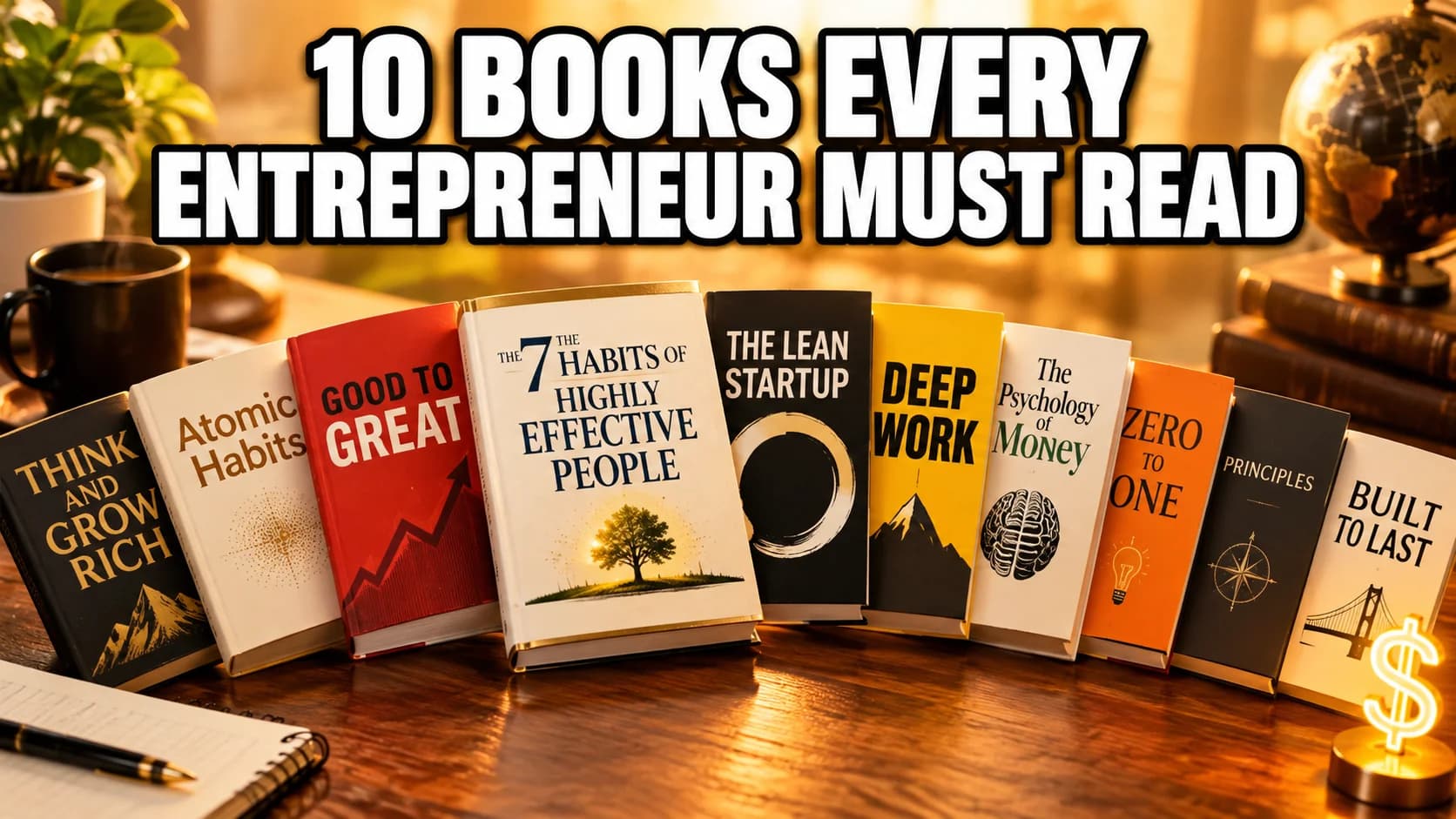
Top 10 Books for Entrepreneurs (With Lessons You Can Actually Apply)
Published on:
Reading time: 9 min
Topic: Entrepreneurship
Author: Leandro Valencia
10 books every entrepreneur should read, with what each one delivers, why it's worth your time, and direct links to Amazon Spain and the US.
Table of Contents
- 1. Think Billionaire: 285 Business Lessons — Dinesh Kumar Goyal
- 2. Rich Dad Poor Dad — Robert Kiyosaki
- 3. The Lean Startup — Eric Ries
- 4. Zero to One — Peter Thiel
- 5. Start with Why — Simon Sinek
- 6. Think and Grow Rich — Napoleon Hill
- 7. The 4-Hour Workweek — Tim Ferriss
- 8. The 7 Habits of Highly Effective People — Stephen R. Covey
- 9. Good to Great — Jim Collins
- 10. The Art of the Start 2.0 — Guy Kawasaki
- Where should you start?
Most "books for entrepreneurs" lists repeat the same five titles without explaining what each one is actually for. This one gets straight to the point: what problem each book solves, who it serves best, and what you'll be able to apply the same week you finish it — so you can choose based on the stage your business is at, not on whatever's trending on social media.
If your specific problem is selling or communicating better, there's a separate top list of marketing and sales books. If you're already leading a team, the one on leadership and team management goes straight at that.
1. Think Billionaire: 285 Business Lessons — Dinesh Kumar Goyal
A book with a different format from the rest of the list: instead of one argument stretched across 300 pages, it's 285 short business lessons, meant to be read in pieces — one idea, one reflection, apply it, move on. It covers topics like customer service, client relationships, customer success, and the buying experience, which is exactly where a lot of small businesses bleed money without noticing: not for lack of product, but for failing to take care of the customers they already have.
It's useful if you prefer quick-reference formats — keeping it within reach and reading a lesson when you need one — over sitting down to read a book start to finish. Each lesson runs half a page or less, so it also works as a nightstand book: one before bed, without losing the thread of a long chapter.
Think Billionaire: 285 Business Lessons
Affiliate link: you pay the same price and the blog earns a small commission from Amazon.
2. Rich Dad Poor Dad — Robert Kiyosaki
The classic of financial education for anyone who never got any. Its real contribution isn't the specific investments it mentions (some already dated), but the mental shift: telling assets apart from liabilities, and understanding that a high salary isn't the same thing as financial freedom. A required entry point if you come from a background where money was never talked about openly.
The book's most-quoted line — that an asset puts money in your pocket and a liability takes it out — sounds obvious once you read it, but it explains why plenty of high earners never build wealth: they spend that income on things that look like assets (a bigger house, a nicer car) but are actually liabilities. For an early-stage entrepreneur, the book is less about "how to invest" and more about "how to decide what you reinvest your business's first profits into."
Rich Dad Poor Dad
Affiliate link: you pay the same price and the blog earns a small commission from Amazon.
3. The Lean Startup — Eric Ries
If you're validating a business idea (you haven't built it yet), this is the book. It introduces the "minimum viable product" concept and the build-measure-learn loop, which heads off the most expensive mistake in entrepreneurship: spending months building something nobody wanted to buy.
The central idea worth holding onto is "validated learning": a business hypothesis is worth nothing until you put it in front of real customers and measure what they do, not what they say they'd do. Ries also introduces "vanity" metrics versus actionable ones — a distinction that's still relevant today, when it's easy to mistake likes or downloads for real business traction.
The Lean Startup
Affiliate link: you pay the same price and the blog earns a small commission from Amazon.
4. Zero to One — Peter Thiel
It goes against the instinct to "find a big market and compete in it." Thiel argues that the most valuable businesses are the ones that create something new (temporary monopolies), not the ones fighting over already-saturated markets. Mentally dense, but it changes how you evaluate whether your idea is worth pursuing.
The book's most useful exercise is an uncomfortable question Thiel asks in every investment interview: "what important truth do very few people agree with you on?" It's not rhetorical — it's literally the filter he uses to decide whether a business idea has a real edge or is just a slightly better version of something that already exists. If your answer is "we'll do the same thing but better," the book is going to make you uncomfortable, which is exactly the point.
Zero to One
Affiliate link: you pay the same price and the blog earns a small commission from Amazon.
5. Start with Why — Simon Sinek
It explains why some brands generate genuine loyalty and others compete only on price: the former communicate a purpose (the "why"), not just what they sell. Useful for nailing down your brand message before you spend a dollar on marketing, because without a clear why, any campaign feels hollow.
The "Golden Circle" (why, how, what) that Sinek proposes is simple enough to sketch on a napkin, but most businesses have it backwards: they lead with what they sell, then how they do it, and rarely get around to explaining why they exist. Before writing a single ad, it's worth answering that question in writing — not the generic "helping our customers" answer, but the specific reason that particular business exists and not some other one.
Start with Why
Affiliate link: you pay the same price and the blog earns a small commission from Amazon.
6. Think and Grow Rich — Napoleon Hill
From 1937 and still recommended, because its central argument — that defined desire, persistence, and mental discipline come before material results — is still the skeleton of most mindset books written today. Read it as the origin of the genre, period-appropriate language and all.
Hill wrote the book after spending twenty years interviewing hundreds of people who'd built fortunes (Ford, Edison, and Carnegie among them), looking for a common pattern. The result isn't a magic formula but something simpler: most people quit right before the effort starts paying off, and deliberate persistence — not talent — is what separates the ones who make it from the ones who don't. Worth reading with the awareness that it's a product of its time; some chapters have aged better than others.
Think and Grow Rich
Affiliate link: you pay the same price and the blog earns a small commission from Amazon.
7. The 4-Hour Workweek — Tim Ferriss
Controversial because it promises more than most people can literally replicate, but its real value is in automation and delegation: questioning which tasks in your business genuinely need to be done by you. Useful for entrepreneurs who are already generating revenue but keep operating as if they had no one else on the team.
The DEAL framework (Define, Eliminate, Automate, Delegate) is more applicable than the book's headline promise: before hiring someone else or buying another tool, the question is what can simply be eliminated. Ferriss also popularizes the "Pareto principle" applied to customers and tasks — the idea that 80% of your problems come from 20% of your clients or processes, and that identifying them is worth more than putting in more hours.
The 4-Hour Workweek
Affiliate link: you pay the same price and the blog earns a small commission from Amazon.
8. The 7 Habits of Highly Effective People — Stephen R. Covey
Not a business book per se, but one about personal effectiveness — and nearly every successful entrepreneur cites it anyway. Habits like "begin with the end in mind" or "put first things first" are the foundation for prioritizing in a business where everything feels urgent at once.
The habit that most changes an entrepreneur's day-to-day is the Eisenhower matrix Covey builds "put first things first" around: sorting tasks by urgent/important instead of just urgent. Most small businesses spend their time putting out fires (urgent but not important) and indefinitely postpone whatever actually moves the needle (important but not urgent, like planning or improving processes). The book runs long and repeats itself in parts, but that one framework alone justifies reading it.
The 7 Habits of Highly Effective People
Affiliate link: you pay the same price and the blog earns a small commission from Amazon.
9. Good to Great — Jim Collins
Data-driven research (not opinion) on what makes a good company become great and stay that way over time. The "Hedgehog Concept" — doing one single thing better than anyone else in the world — is especially useful once you already have traction and need to decide what to focus on.
Collins and his team analyzed decades of financial data across hundreds of companies to isolate what the ones that went from "good" to "great" had in common, and sustained that leap for 15 years or more. Two ideas stick beyond the Hedgehog Concept: "Level 5 leadership" (ambition channeled into the company, not the leader's ego) and the flywheel — the idea that growth doesn't come from one brilliant move but from pushing the same wheel in the same direction, consistently, until it builds its own momentum.
Good to Great
Affiliate link: you pay the same price and the blog earns a small commission from Amazon.
10. The Art of the Start 2.0 — Guy Kawasaki
A practical, no-nonsense guide to the real first steps of a business: how to launch, how to raise money, how to build a brand from scratch. A good way to close out the list, because it turns everything above into concrete, actionable steps.
Kawasaki was one of Apple's first product evangelists, and it shows: the book treats launching a business as a communication problem just as much as a product one. The "how to launch" checklist — find your niche, write your mantra in three words, build a prototype before a perfect business plan — is more useful as an actual checklist than as inspirational reading, which is exactly what most books on this list are missing.
The Art of the Start 2.0
Affiliate link: you pay the same price and the blog earns a small commission from Amazon.
Where should you start?
If you're still validating an idea: start with The Lean Startup and Zero to One. If you're already selling but feel like you're losing customers along the way: Think Billionaire goes straight at that. If the problem is more about mindset and habits than strategy: The 7 Habits and Think and Grow Rich. If you need to simplify and delegate because the business has outgrown you: The 4-Hour Workweek.
Transparency note: the links in this article are Amazon affiliate links — if you buy through them, you pay nothing extra, but it helps keep this content going.
— Leandro Valencia
Related Posts
Keep exploring similar content that may interest you
Jobs to Be Done (JTBD): What It Is, Examples and How to Apply It
What Jobs to Be Done is and how to use it: the 4 forces of progress, timeline interviews with ready-to-use questions and a plan to validate your product.

One-Person Micro-SaaS with AI: How to Build One in 2026
Build a micro-SaaS on your own with AI: validate a niche, pick your stack, charge through a Merchant of Record, retain customers and follow an 8-week plan.
Business Plan Examples for Startups and SMBs (With Template)
How to write a lean business plan in 7 blocks, with a copy-ready template and 2 worked examples: a B2B SaaS and an online store in Latin America.
Partnerships
Tools I use every day, on better terms for this community.