How to copy like an artist without becoming a photocopy
Published on:
Reading time: 6 min
Topic: Creativity
Author: Leandro Valencia
The difference between copying and stealing ideas: how to actually steal (understand why things work and take the principle), with concrete techniques for illustrators, writers, designers and creators.
Table of Contents
- The blank page is a lie
- The difference between copying and stealing
- Where the line is between inspiration and plagiarism
- What remains
The blank page is a lie
No one creates from scratch. No one.
The Beatles started out playing Chuck Berry covers. Tarantino built an entire career recycling kung-fu cinema and spaghetti westerns. Kirby Ferguson documented this for years in his series Everything is a Remix: the line between influence and copying is far blurrier than we like to admit.
And yet, we keep sitting down in front of the canvas, the document, the empty Figma file, waiting for an original idea to fall from the sky. It doesn't. What falls are fragments of everything you've already seen, read and heard, mixed in a way that only you could mix them.
Austin Kleon wrote an entire book about this —Steal Like an Artist— and his thesis comes down to something uncomfortable but liberating: your work is an accumulation of your influences. Period. Originality isn't in the source material, it's in the combination.
The difference between copying and stealing
Here's the distinction that matters.
Copying is reproducing the result. You see a poster you like, you replicate it changing the colors, you get something almost identical and slightly worse. You took the surface.
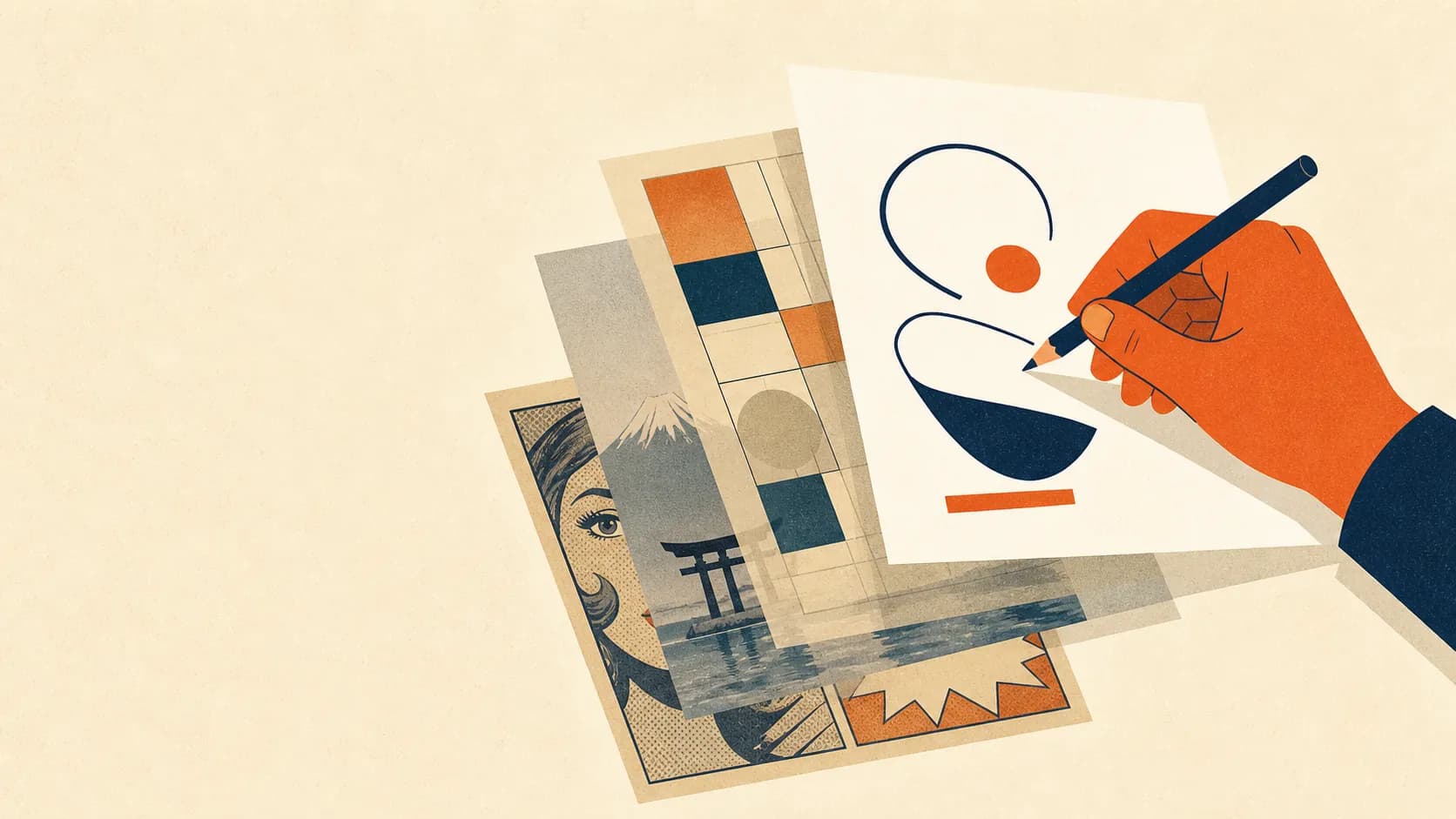
Stealing is understanding why it works and keeping that. You see that same poster and ask yourself: why does the typography feel so tense? what is the negative space doing? why does that palette produce that specific feeling? Then you take the principle, not the pixel. And the principle can be applied to something that looks nothing like the original.
One leaves you where you were. The other teaches you.
How to do it in practice
Copy by hand, not with Ctrl+C
There's a reason Renaissance painters copied their masters stroke by stroke, and a reason Hunter S. Thompson transcribed the entire The Great Gatsby on his typewriter. When you reproduce something with your body, your brain registers the decisions. When you download it, you register nothing.
If you're an illustrator, redraw. If you write, transcribe paragraphs that blow your mind. If you make music, figure out the song by ear. It's slow, and that's why it works.
Steal from many, not from one
Stealing from a single person is plagiarism. Stealing from twenty is research. When your references come from sources that don't speak to each other —a Japanese photographer, a Swiss designer from the 60s, your grandmother, a video game— the resulting mix doesn't look like any of them. That's where your voice appears.
Steal outside your discipline
If you're a designer and only look at design, you'll produce design that looks like all design. The interesting leaps almost always come from importing someone else's logic: the structure of a screenplay applied to a brand, the palette of a plate of food applied to a website, the rhythm of a poem applied to video editing.
Save everything, without justifying it
Keep an archive. A folder, a board, a notebook, whatever. Save what stops you even if you don't know why. The "why" shows up months later, almost always when you need it. That archive is your raw material; without it, every project starts from scratch.
Let the copy fail
The best argument for copying is that it never comes out the same. Your hands, your taste and your limitations deform the original, and that deformation is you. As Jim Jarmusch put it, steal from wherever resonates with your inspiration; authenticity doesn't exist, but your selection does.
Where the line is between inspiration and plagiarism
Let's be clear, because this matters too: there's a point where stealing stops being technique and starts being a problem.
The line is roughly this:
- If your work replaces the original in the market, you crossed it.
- If someone who knows the reference would say "this is a rip-off", you crossed it.
- If you're signing someone else's intellectual work as your own, you crossed it a long time ago.
And there's a simple test: cite your sources. Creators who are stealing well almost always tell you where they got their things, because they're proud of their lineage. Those who are plagiarizing get nervous when you ask about their references. If you'd be embarrassed to name the source, you already have your answer.
What remains
Copying like an artist isn't a permission, it's a discipline. It consists of studying deeply what you admire, understanding its mechanics, stealing its principles and then betraying it enough to produce something that only you could have made.
Start this week with something minimal: pick a piece you're obsessed with —a song, a poster, a paragraph— and reproduce it by hand. Not to publish it. To understand it. Then ask yourself what principle you took away and apply it to something completely different.
That's no longer a copy. That's your work beginning.
References worth stealing: "Steal Like an Artist" by Austin Kleon, the "Everything is a Remix" series by Kirby Ferguson, and any interview where a creator you admire talks about their influences.
Frequently asked questions
Is copying other artists wrong?
No, copying to study is how every great creator has learned. What's wrong is presenting someone else's work as your own or competing directly with the original work. The practical rule: copy to understand, cite your sources, and transform enough that the result is unrecognizable.
What's the difference between being inspired and plagiarizing?
You're inspired when you take the principle, the structure, or the emotion that makes something work, and apply it to a different context. You plagiarize when you reproduce the surface result, changing just enough to disguise it. Inspiration teaches you something; plagiarism only saves you work.
What did Picasso actually say about copying?
The phrase "good artists copy, great artists steal" is attributed to Picasso, though also to T.S. Eliot and others before him. The core idea isn't to steal the result, but to take the essence: the principle, the technique, or the design decision that makes something work.
How do I find my own creative influences?
By saving everything that stops you, without filtering or justifying. Keep an archive —physical or digital— of images, phrases, songs and objects that catch your attention even if you don't know why. Over time, patterns reveal what truly moves you, and that unique combination of references is what others will call your style.
Related Posts
Keep exploring similar content that may interest you

Viral marketing without a budget: why people share and 7 mechanics that actually work
Viral marketing isn't something you order: it's something you design. Why people share content, 7 mechanics without a budget, and how to audit your idea before you publish.

Level Up Your Life: The Ultimate Guide to Gamification for Entrepreneurial Productivity
Practical guide to applying gamification to entrepreneurial productivity: psychological principles, system design, tools, and tactics to turn goals into missions and maintain long-term motivation and resilience.

Unleash your creativity: strategies to innovate
A comprehensive guide with strategies, tools, and techniques to foster creativity in project development, valuable features, and to infuse innovation into every aspect of your daily life.
Partnerships
Tools I use every day, on better terms for this community.